QUESTION IMAGE
Question
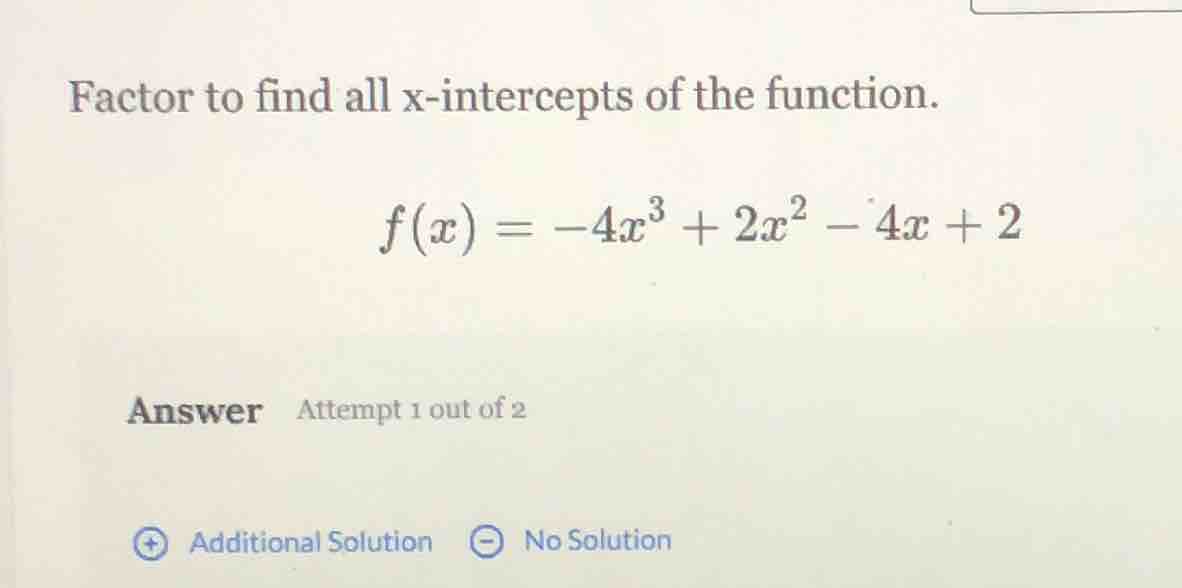
factor to find all x-intercepts of the function.
$f(x) = -4x^3 + 2x^2 - 4x + 2$
answer attempt 1 out of 2
additional solution no solution
Step1: Group terms
Group the first two terms and the last two terms:
$$f(x) = (-4x^3 + 2x^2) + (-4x + 2)$$
Step2: Factor out GCF from each group
Factor out \(-2x^2\) from the first group and \(-2\) from the second group:
$$f(x) = -2x^2(2x - 1) - 2(2x - 1)$$
Step3: Factor out common binomial factor
Factor out \((2x - 1)\) from both terms:
$$f(x) = (2x - 1)(-2x^2 - 2)$$
We can further factor out \(-2\) from the second factor:
$$f(x) = -2(2x - 1)(x^2 + 1)$$
Step4: Find x - intercepts
To find the x - intercepts, we set \(f(x)=0\), so:
\(-2(2x - 1)(x^2 + 1)=0\)
Since \(-2
eq0\), we consider the other factors:
- For \(2x - 1 = 0\), we solve for \(x\):
\(2x=1\), so \(x=\frac{1}{2}\)
- For \(x^2 + 1=0\), we have \(x^2=- 1\), and since there are no real solutions for this equation (in the set of real numbers), the only real x - intercept comes from \(2x - 1 = 0\)

Snap & solve any problem in the app
Get step-by-step solutions on Sovi AI
Photo-based solutions with guided steps
Explore more problems and detailed explanations
The x - intercept of the function \(f(x)=-4x^{3}+2x^{2}-4x + 2\) is \(x = \frac{1}{2}\) (in the real number system, if we consider complex numbers, the roots of \(x^{2}+1 = 0\) are \(x=i\) and \(x=-i\), but usually for the x - intercepts of a function (where the graph intersects the x - axis, we consider real numbers) the x - intercept is \(x=\frac{1}{2}\))