QUESTION IMAGE
Question
farewell speech
(dwight d. eisenhower)
mr. president, mr. speaker, and distinguished members of the congress:
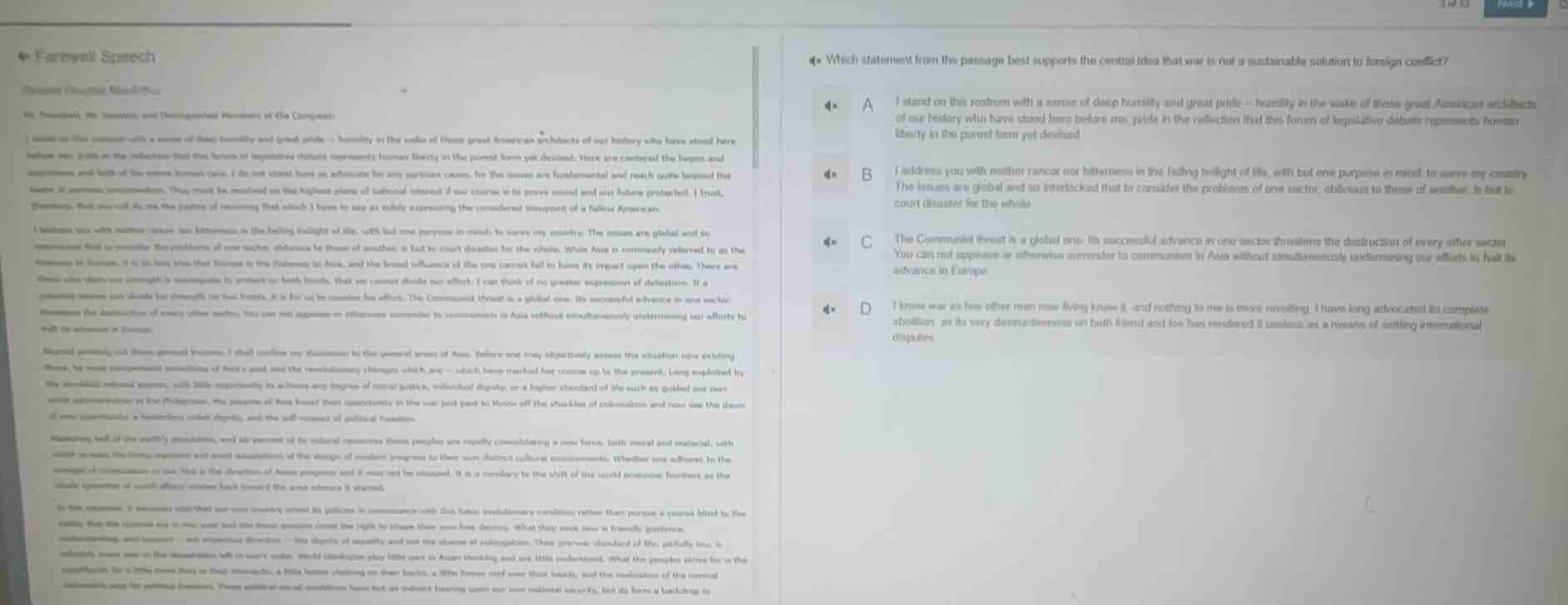
i stand on this rostrum with a sense of deep humility and great pride - humility in the wake of those great american architects of our history who have stood here before me; pride in the reflection that this forum of legislative debate represents human liberty in the purest form yet devised. here are centered the hopes and aspirations and faith of the entire human race. i do not stand here as advocate for any partisan cause, for the issues are fundamental and reach quite beyond the realm of partisan considerations. they must be resolved on the highest plane of national interest if our course is to prove sound and our future protected. i trust, therefore, that you will do me the justice of receiving that which i have to say as solely expressing the considered viewpoint of a fellow american.
i address you with neither rancor nor bitterness in the fading twilight of life, with but one purpose in mind: to serve my country. the issues are global and so interlocked that to consider the problems of one sector, oblivious to those of another, is but to court disaster for the whole. while asia is commonly referred to as the theatre of decision, it is no less true that europe is the theatre of decision, and the broad influence of the one cannot fail to have its impact upon the other. there are those who claim that communism is the wave of the future. let them come to berlin. there is no greater demonstration of defeatism than to believe or to teach that you can do nothing. it is a common theme of history that freedom is not free. its successful advance is not a spectator sport. the communist threat is a global one. its successful advance in one sector threatens the destruction of every other sector. you can not appease or otherwise surrender to communism in asia without simultaneously undermining our efforts to halt its advance in europe.
informed by past great experience, i deal candidly with you in the general terms of asian, before we may adequately assess the situation now existing there, by which you must judge something of the past and the revolutionary changes which are - which have reached far across to the present. long exploited by the colonial powers, asia has now, with little opportunity to achieve any league of social justice, individual dignity, or a higher standard of life such as guided our own national administration, the philippines, the passions of these brave people cannot be fully just to those who have taken the shackles of colonialism and now see the dawn of new opportunities, a bewildering social change, and the self - respect of political freedom.
measuring half of the earths population, and all percent of its natural resources these peoples are rapidly consolidating a new force, both moral and material, with which to meet the long - neglected and ever - worsening of the design of modern progress to their own distinct cultural environments. whether one adheres to the concept of colonization or not, this is the direction of asian progress and it may not be stopped. it is a corollary to the shift of the world economic frontiers as the whole atmosphere of world affairs has changed beyond the dreams of our forefathers.
in this situation, it becomes vital that our own country orient its policies in consonance with this basic evolutionary condition rather than pursue a course blind to the reality that the central key to our past and the basic question about the right to shape their own free destiny, what they seek now is friendly guidance, understanding, and support - not imperious direction - the dignity of equality and not the shame of subjugation. their pride, understandably, is in their own distinctive cultures, their own values, and their own spiritual heritage. what they seek is the opportunity to live decently, to learn, to work, to worship as they may choose, a little more food on their tables, a little better clothing on their backs, a little firmer roof over their heads, and the realization of the normal human desire for the common good. these attitudes of mind and heart which are so deeply ingrained in the peoples of asia do not represent a threat to our national security, but do have a background to
- which statement from the passage best supports the central idea that war is not a sustainable solution to foreign conflict?
a i stand on this rostrum with a sense of deep humility and great pride - humility in the wake of those great american architects of our history who have stood here before me; pride in the reflection that this forum of legislative debate represents human liberty in the purest form yet devised.
b i address you with neither rancor nor bitterness in the fading twilight of life, with but one purpose in mind: to serve my country. the issues are global and so interlocked that to consider the problems of one sector, oblivious to those of another, is but to court disaster for the whole.
c the communist threat is a global one. its successful advance in one sector threatens the destruction of every other sector. you can not appease or otherwise surrender to communism in asia without simultaneously undermining our efforts to halt its advance in europe.
d i know war as few other men now living know it, and nothing to me is more revolting. i have long advocated its complete abolition, as its very destructiveness on both friend and foe has rendered it useless as a means of settling international disputes.
To determine which statement supports the central idea that war is not a sustainable solution to foreign conflict, we analyze each option:
- Option A: Discusses humility and pride related to the forum of legislative debate, not war or conflict resolution.
- Option B: Talks about addressing with candor and the global nature of issues but doesn't directly relate to war's sustainability.
- Option C: Focuses on the Communist threat and its spread, not on war as a solution.
- Option D: The speaker states they know war well and advocate for its complete abolition, emphasizing its destructiveness and unsuitability for settling international disputes, which directly supports the idea that war is not sustainable.

Snap & solve any problem in the app
Get step-by-step solutions on Sovi AI
Photo-based solutions with guided steps
Explore more problems and detailed explanations
D. I know war as few other men now living know it, and nothing to me is more revolting. I have long advocated its complete abolition, as its very destructiveness on both friend and foe has rendered it useless as a means of settling international disputes.