QUESTION IMAGE
Question
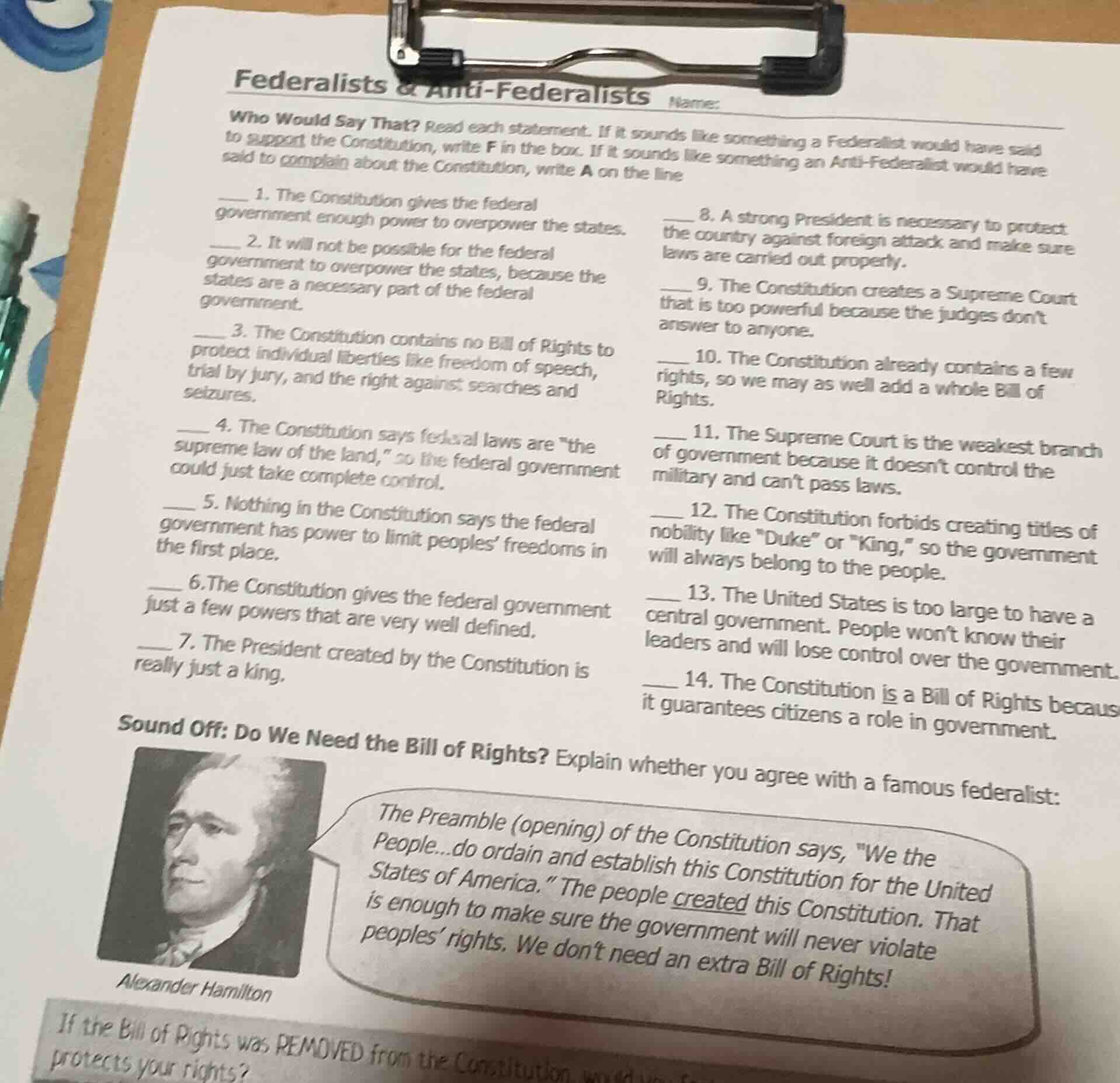
federalists & anti-federalists name:
who would say that? read each statement. if it sounds like something a federalist would have said to support the constitution, write f in the box. if it sounds like something an anti-federalist would have said to complain about the constitution, write a on the line
____ 1. the constitution gives the federal government enough power to overpower the states.
____ 2. it will not be possible for the federal government to overpower the states, because the states are a necessary part of the federal government.
____ 3. the constitution contains no bill of rights to protect individual liberties like freedom of speech, trial by jury, and the right against searches and seizures.
____ 4. the constitution says federal laws are \the supreme law of the land,\ so the federal government could just take complete control.
____ 5. nothing in the constitution says the federal government has power to limit peoples freedoms in the first place.
____ 6.the constitution gives the federal government just a few powers that are very well defined.
____ 7. the president created by the constitution is really just a king.
____ 8. a strong president is necessary to protect the country against foreign attack and make sure laws are carried out properly.
____ 9. the constitution creates a supreme court that is too powerful because the judges dont answer to anyone.
____ 10. the constitution already contains a few rights, so we may as well add a whole bill of rights.
____ 11. the supreme court is the weakest branch of government because it doesnt control the military and cant pass laws.
____ 12. the constitution forbids creating titles of nobility like \duke\ or \king,\ so the government will always belong to the people.
____ 13. the united states is too large to have a central government. people wont know their leaders and will lose control over the government.
____ 14. the constitution is a bill of rights because it guarantees citizens a role in government.
sound off: do we need the bill of rights? explain whether you agree with a famous federalist:
alexander hamilton
the preamble (opening) of the constitution says, \we the people...do ordain and establish this constitution for the united states of america.\ the people created this constitution. that is enough to make sure the government will never violate peoples rights. we dont need an extra bill of rights!
if the bill of rights was removed from the constitution, protects your rights?
- Federalists supported a strong federal government, so this aligns with their views.
- Anti-Federalists argued states would check federal power, so this is their view.
- Anti-Federalists criticized the lack of a Bill of Rights, so this is their view.
- Anti-Federalists feared federal supremacy would lead to overreach, so this is their view.
- Federalists believed the federal government only had enumerated powers, so this is their view.
- Federalists argued federal powers were limited and defined, so this is their view.
- Anti-Federalists feared the President would act like a monarch, so this is their view.
- Federalists supported a strong executive for national security, so this is their view.
- Anti-Federalists feared an unchecked Supreme Court, so this is their view.
- Anti-Federalists pushed for adding a full Bill of Rights, so this is their view.
- Federalists viewed the Supreme Court as the weakest branch, so this is their view.
- Federalists highlighted the Constitution's anti-nobility clause as a protection for the people, so this is their view.
- Anti-Federalists argued a large nation could not be governed by a central government, so this is their view.
- Federalists argued the Constitution's structure already protected rights, so this is their view.
For the "Sound Off" question: Alexander Hamilton's argument rests on the idea that the Constitution is a compact created by the people, so the government it establishes would not violate their rights. A counterpoint is that without explicit, enumerated protections (a Bill of Rights), there is no formal check on the government to prevent it from infringing on individual liberties, which is why Anti-Federalists pushed for its addition to safeguard specific freedoms like speech, religion, and due process.

Snap & solve any problem in the app
Get step-by-step solutions on Sovi AI
Photo-based solutions with guided steps
Explore more problems and detailed explanations
- F
- A
- A
- A
- F
- F
- A
- F
- A
- A
- F
- F
- A
- F
For "Sound Off":
One could disagree with Hamilton: The Constitution's creation by the people does not inherently prevent the government from overstepping. A Bill of Rights provides explicit, enforceable protections for individual liberties, ensuring the government cannot violate core freedoms like freedom of speech or due process. These explicit guarantees are necessary to hold the government accountable, rather than relying solely on the premise that a people-created government will act benevolently.