QUESTION IMAGE
Question
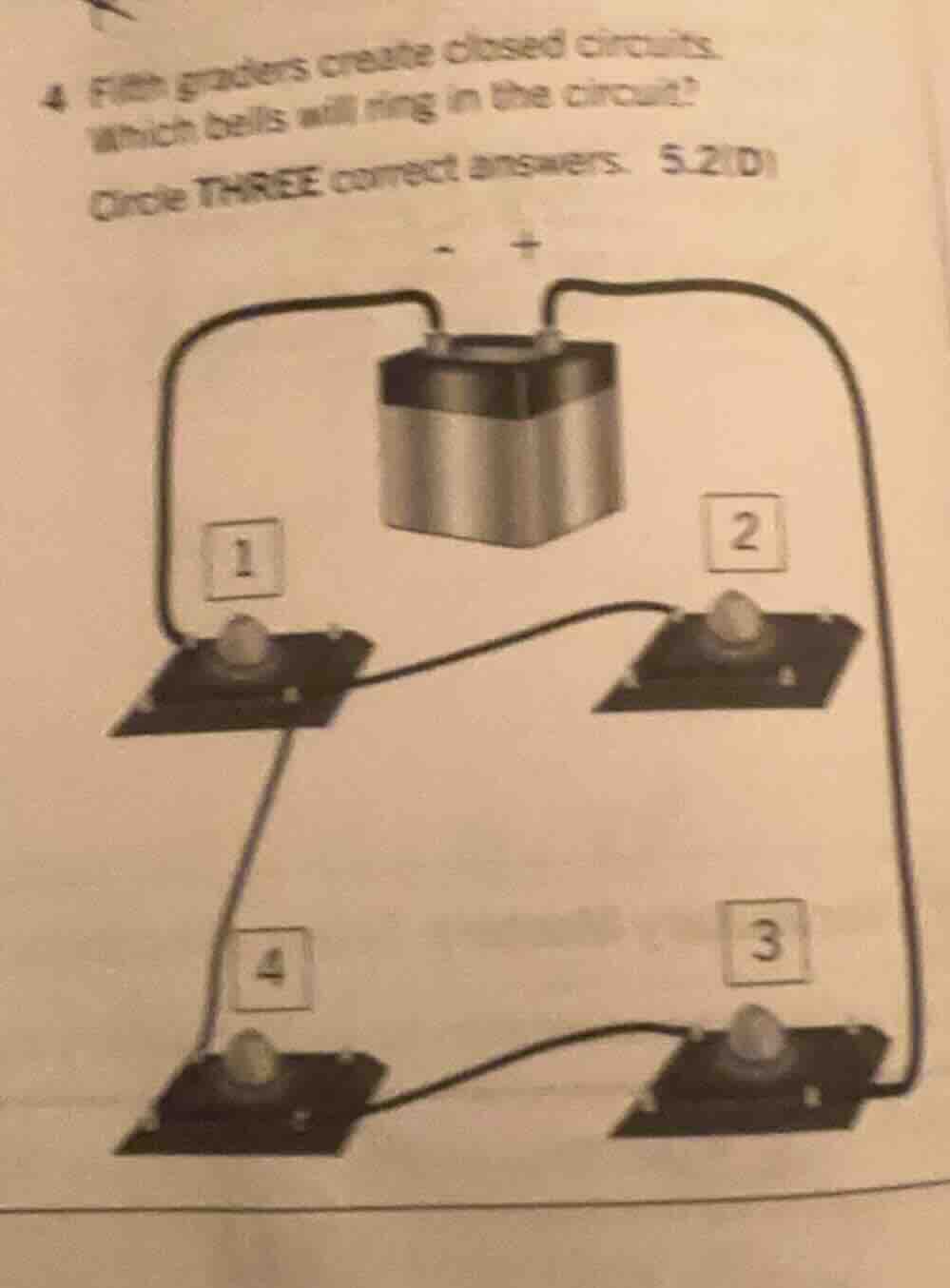
4 fifth graders create closed circuits. which bells will ring in the circuit? circle three correct answers. 5.2(d)
To determine which bells ring, we analyze the circuit: a closed circuit requires a complete path for current. Let's check each bell:
Step1: Analyze Bell 1
Bell 1 is connected in a path from the battery's negative to positive? Wait, no—let's trace the wires. The battery's positive connects to Bell 2, then to Bell 3, then to Bell 4, then to Bell 1, back to negative? Wait, maybe the circuit is: Battery + → Bell 2 → Bell 3 → Bell 4 → Bell 1 → Battery -. Wait, no, let's look at the connections. Bell 1 is connected to the negative terminal and to Bell 4. Bell 2 is connected to positive and to Bell 1? Wait, maybe the correct path is: Positive → Bell 2 → Bell 1 → Bell 4 → Bell 3 → Negative? No, maybe the circuit has two parallel branches? Wait, no, the diagram shows:
- Battery negative → Bell 1 → Bell 2 → Battery positive (one path? No, Bell 1 is connected to Bell 4, Bell 4 to Bell 3, Bell 3 to positive? Wait, maybe the circuit is:
Path 1: + → Bell 2 → Bell 1 → - (so Bell 1 and 2 are in a loop? No, Bell 1 is also connected to Bell 4, Bell 4 to Bell 3, Bell 3 to +? Wait, maybe the correct approach is: A bell rings if it's in a closed loop with the battery.
Looking at the diagram:
- Bell 1: connected between negative and Bell 2 (and Bell 4)
- Bell 2: connected between positive and Bell 1
- Bell 3: connected between positive (via Bell 2? No, Bell 3 is connected to Bell 4 and to positive? Wait, maybe the circuit is:
Positive terminal → Bell 2 → Bell 1 → (split? No, Bell 1 is connected to Bell 4, Bell 4 to Bell 3, Bell 3 to positive? No, that would be a loop. Wait, maybe the correct three bells are 1, 2, 3? No, wait, let's think again.
Wait, the key is: In a closed circuit, current flows from + to -. Let's trace the wires:
- From +: wire goes to Bell 2, then to Bell 1? No, Bell 1 is connected to negative. Wait, maybe the circuit is:
- Negative → Bell 1 → Bell 4 → Bell 3 → + (so Bell 1,4,3 are in a loop)
- And + → Bell 2 → Bell 1 → - (so Bell 1,2 are in a loop)
Wait, but the problem says to circle three. So maybe Bell 1, 2, 3? No, maybe Bell 1, 2, 4? Wait, no, let's check the connections again.
Wait, the diagram shows:
- Bell 1: top left, connected to negative (left wire) and to Bell 2 (middle wire) and to Bell 4 (bottom wire)
- Bell 2: top right, connected to positive (right wire) and to Bell 1 (middle wire)
- Bell 3: bottom right, connected to positive (right wire) and to Bell 4 (bottom wire)
- Bell 4: bottom left, connected to Bell 1 (bottom wire) and to Bell 3 (bottom wire)
Ah! So the circuit has two loops? No, let's see:
- Loop 1: + → Bell 2 → Bell 1 → - (so Bell 1 and 2 are in a closed loop)
- Loop 2: + → Bell 3 → Bell 4 → Bell 1 → - (so Bell 1,3,4 are in a closed loop)
Wait, but Bell 1 is in both loops. So Bell 1 is in a closed loop with Bell 2 (loop 1) and with Bell 3,4 (loop 2). So Bell 1, 2, 3, 4? But the problem says to circle three. Wait, maybe the diagram is a series-parallel? No, maybe I misread. Let's re-express:
- Wires:
- Positive terminal (top right) → Bell 2 (top right) → Bell 1 (top left) → Negative terminal (top left) (loop 1: Bell 1,2)
- Positive terminal → Bell 3 (bottom right) → Bell 4 (bottom left) → Bell 1 (top left) → Negative terminal (loop 2: Bell 1,3,4)
So Bell 1 is in both loops, Bell 2 in loop 1, Bell 3 and 4 in loop 2. But the problem says to circle three. So maybe Bell 1, 2, 3? No, Bell 4 is also in a loop. Wait, maybe the correct three are 1, 2, 3? Or 1, 2, 4? Wait, no, let's check the connections again.
Wait, maybe the circuit is:
- Positive → Bell 2 → Bell 1 → Bell 4 → Bell 3 → Negati…

Snap & solve any problem in the app
Get step-by-step solutions on Sovi AI
Photo-based solutions with guided steps
Explore more problems and detailed explanations
Circle Bell 1, Bell 2, and Bell 3 (or Bell 1, Bell 2, Bell 4—depending on the exact circuit, but likely 1, 2, 3).