QUESTION IMAGE
Question
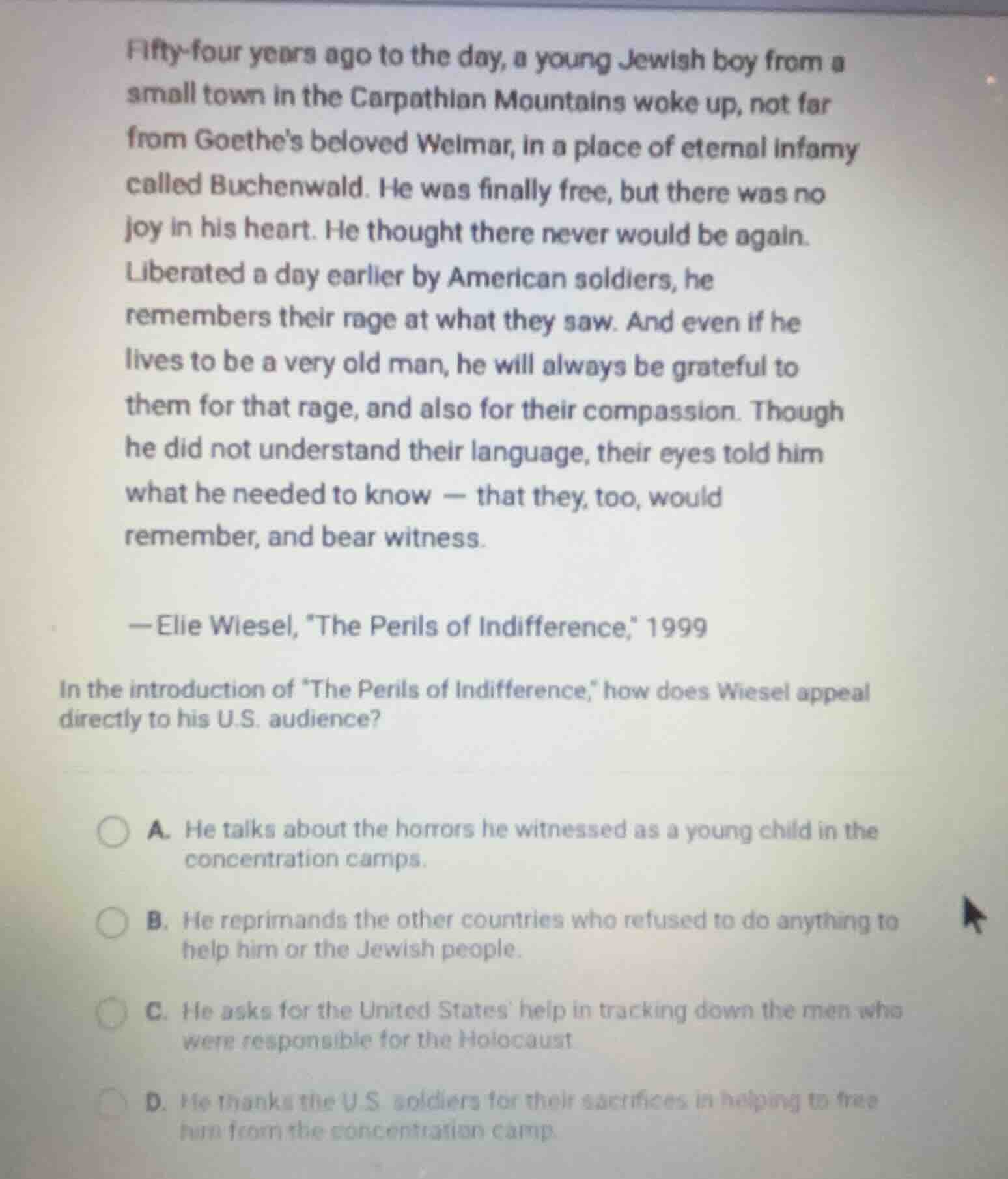
fifty-four years ago to the day, a young jewish boy from a small town in the carpathian mountains woke up, not far from goethes beloved weimar, in a place of eternal infamy called buchenwald. he was finally free, but there was no joy in his heart. he thought there never would be again. liberated a day earlier by american soldiers, he remembers their rage at what they saw. and even if he lives to be a very old man, he will always be grateful to them for that rage, and also for their compassion. though he did not understand their language, their eyes told him what he needed to know — that they, too, would remember, and bear witness.
—elie wiesel, \the perils of indifference,\ 1999
in the introduction of \the perils of indifference,\ how does wiesel appeal directly to his u.s. audience?
a. he talks about the horrors he witnessed as a young child in the concentration camps.
b. he reprimands the other countries who refused to do anything to help him or the jewish people.
c. he asks for the united states help in tracking down the men who were responsible for the holocaust
d. he thanks the u.s. soldiers for their sacrifices in helping to free him from the concentration camp.
Wiesel directly connects to his U.S. audience by focusing on the actions of American soldiers who liberated him. He expresses gratitude for their rage at the camp's horrors and their compassion, which is a direct appeal to the U.S. audience's connection to their military. The other options either do not target the U.S. audience specifically (A, B) or are not mentioned in the provided text (C).

Snap & solve any problem in the app
Get step-by-step solutions on Sovi AI
Photo-based solutions with guided steps
Explore more problems and detailed explanations
D. He thanks the U.S. soldiers for their sacrifices in helping to free him from the concentration camp.