QUESTION IMAGE
Question
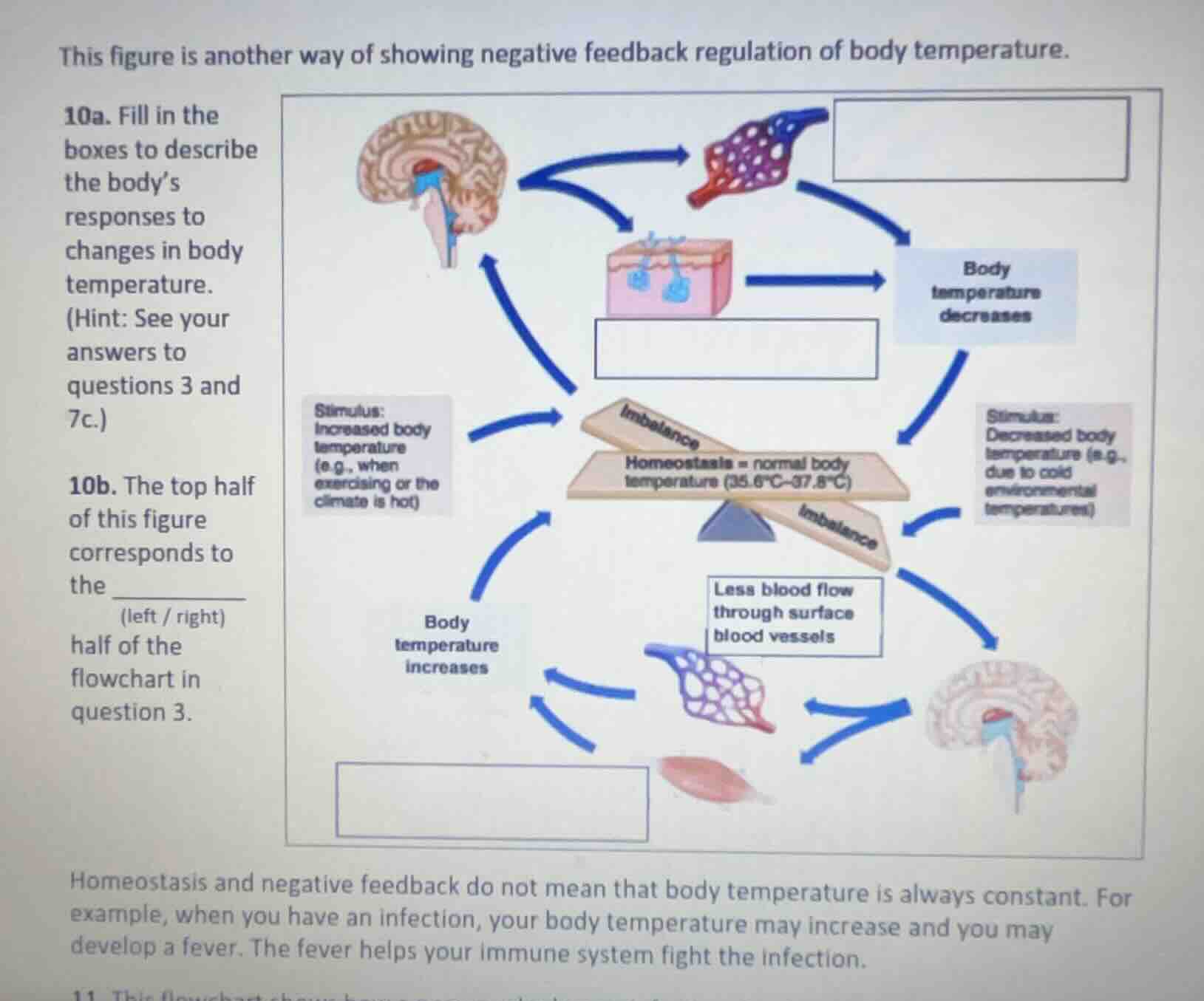
this figure is another way of showing negative feedback regulation of body temperature.
10a. fill in the boxes to describe the body’s responses to changes in body temperature. (hint: see your answers to questions 3 and 7c.)
10b. the top half of this figure corresponds to the ________ (left / right) half of the flowchart in question 3.
homeostasis and negative feedback do not mean that body temperature is always constant. for example, when you have an infection, your body temperature may increase and you may develop a fever. the fever helps your immune system fight the infection.
- this flowchart shows...
10a Solution (Filling the Boxes):
Top Box (Gland/Organ for Cooling):
The top - most organ (likely the skin's sweat glands or the brain's response, but for cooling, the sweat glands are key. When body temperature needs to decrease, sweat glands secrete sweat. Also, the blood vessels in the skin (the middle box) dilate. Wait, let's re - analyze. The middle box (skin - related) when body temperature decreases? No, wait, the left side is for increased body temperature, right for decreased. Wait, the diagram: the top path is for body temperature decrease? Wait, no, the stimulus on the left is increased body temperature, leading to body temperature increase? No, the labels: "Body temperature increases" on the left, "Body temperature decreases" on the right.
For the top box (the gland - like structure, maybe the sweat glands? No, when cooling, sweat glands secrete sweat, and blood vessels dilate. Wait, the middle box (skin) when body temperature is being decreased: the skin's blood vessels dilate? No, when cooling, blood vessels in skin dilate to release heat, and sweat glands secrete sweat. Wait, the top box (the organ) for the "body temperature decreases" path: maybe the muscle? No, when cold, muscles shiver. Wait, the top box (the purple - red organ) – when body temperature is too high, we sweat (skin) and maybe the sweat glands? Wait, let's correct.
- Top Box (for body temperature decrease path): When body temperature is too high (left stimulus), the body responds with sweat glands secreting sweat (but in the "body temperature decreases" path, the responses are for cooling. Wait, the top path: the organ (maybe the sweat gland? No, the middle box is skin. Wait, the middle box (skin) – when body temperature is decreasing (right side), no, the left side is increased body temperature. Wait, the diagram has two paths: left (increased body temp stimulus) leading to body temp increase? No, no, homeostasis: when body temp increases (stimulus), the body responds to decrease it. When body temp decreases (stimulus), the body responds to increase it.
So for the "body temperature decreases" path (right side), the responses to increase body temperature: muscles shiver (top box) and blood vessels constrict (middle box? No, the middle box in the top path (body temp decrease) – wait, the middle box (skin) in the top path: when body temp is too high, skin blood vessels dilate (to release heat) and sweat glands secrete sweat. When body temp is too low, skin blood vessels constrict (less blood flow) and muscles shiver.
So:
- Top box (the organ - like structure) for the "body temperature decreases" (so we need to increase it back) – muscles shiver (shivering produces heat).
- Middle box (skin - related) for the "body temperature decreases" path – blood vessels constrict (less blood flow to skin, so less heat loss). Wait, no, the middle box in the top path (the skin diagram) – when body temperature is being reduced (left side, increased body temp stimulus), the skin's blood vessels dilate (to release heat) and sweat glands secrete sweat. When body temperature is too low (right side, decreased body temp stimulus), the skin's blood vessels constrict (less blood flow, less heat loss) and muscles shiver (produce heat).
Wait, the question 10a: fill in the boxes to describe the body's responses to changes in body temperature.
For the top box (the organ - like structure) in the "body temperature decreases" path (so we need to increase body temperature): Muscles shiver (shivering generates heat).
For the middle box (skin - related) in the "…

Snap & solve any problem in the app
Get step-by-step solutions on Sovi AI
Photo-based solutions with guided steps
Explore more problems and detailed explanations
10a Solution (Filling the Boxes):
Top Box (Gland/Organ for Cooling):
The top - most organ (likely the skin's sweat glands or the brain's response, but for cooling, the sweat glands are key. When body temperature needs to decrease, sweat glands secrete sweat. Also, the blood vessels in the skin (the middle box) dilate. Wait, let's re - analyze. The middle box (skin - related) when body temperature decreases? No, wait, the left side is for increased body temperature, right for decreased. Wait, the diagram: the top path is for body temperature decrease? Wait, no, the stimulus on the left is increased body temperature, leading to body temperature increase? No, the labels: "Body temperature increases" on the left, "Body temperature decreases" on the right.
For the top box (the gland - like structure, maybe the sweat glands? No, when cooling, sweat glands secrete sweat, and blood vessels dilate. Wait, the middle box (skin) when body temperature is being decreased: the skin's blood vessels dilate? No, when cooling, blood vessels in skin dilate to release heat, and sweat glands secrete sweat. Wait, the top box (the organ) for the "body temperature decreases" path: maybe the muscle? No, when cold, muscles shiver. Wait, the top box (the purple - red organ) – when body temperature is too high, we sweat (skin) and maybe the sweat glands? Wait, let's correct.
- Top Box (for body temperature decrease path): When body temperature is too high (left stimulus), the body responds with sweat glands secreting sweat (but in the "body temperature decreases" path, the responses are for cooling. Wait, the top path: the organ (maybe the sweat gland? No, the middle box is skin. Wait, the middle box (skin) – when body temperature is decreasing (right side), no, the left side is increased body temperature. Wait, the diagram has two paths: left (increased body temp stimulus) leading to body temp increase? No, no, homeostasis: when body temp increases (stimulus), the body responds to decrease it. When body temp decreases (stimulus), the body responds to increase it.
So for the "body temperature decreases" path (right side), the responses to increase body temperature: muscles shiver (top box) and blood vessels constrict (middle box? No, the middle box in the top path (body temp decrease) – wait, the middle box (skin) in the top path: when body temp is too high, skin blood vessels dilate (to release heat) and sweat glands secrete sweat. When body temp is too low, skin blood vessels constrict (less blood flow) and muscles shiver.
So:
- Top box (the organ - like structure) for the "body temperature decreases" (so we need to increase it back) – muscles shiver (shivering produces heat).
- Middle box (skin - related) for the "body temperature decreases" path – blood vessels constrict (less blood flow to skin, so less heat loss). Wait, no, the middle box in the top path (the skin diagram) – when body temperature is being reduced (left side, increased body temp stimulus), the skin's blood vessels dilate (to release heat) and sweat glands secrete sweat. When body temperature is too low (right side, decreased body temp stimulus), the skin's blood vessels constrict (less blood flow, less heat loss) and muscles shiver (produce heat).
Wait, the question 10a: fill in the boxes to describe the body's responses to changes in body temperature.
For the top box (the organ - like structure) in the "body temperature decreases" path (so we need to increase body temperature): Muscles shiver (shivering generates heat).
For the middle box (skin - related) in the "body temperature decreases" path: Blood vessels constrict (less blood flow to skin, so less heat is lost to the environment).
For the bottom box (in the "body temperature increases" path, left side): when body temperature increases (stimulus), the body responds with Sweat glands secrete sweat (and skin blood vessels dilate, but the bottom box is the organ - like structure, maybe the sweat gland? No, the bottom box (the muscle - like structure) in the "body temperature increases" path: no, when body temp is too low, muscles shiver; when too high, sweat glands secrete sweat. Wait, the bottom box (the organ) in the "body temperature increases" path (left side, body temp increases as a result of stimulus? No, the stimulus is increased body temp, so the body responds to decrease it. So the bottom box (the organ) – sweat glands secrete sweat, and the middle box (skin) – blood vessels dilate.
This is getting confusing. Let's use standard negative feedback for body temperature:
- When body temperature is too high (stimulus: increased body temp):
- Skin blood vessels dilate (more blood flow to skin, release heat).
- Sweat glands secrete sweat (evaporation cools the body).
- When body temperature is too low (stimulus: decreased body temp):
- Skin blood vessels constrict (less blood flow to skin, less heat loss).
- Muscles shiver (generate heat).
So in the diagram:
- Top box (the organ - like structure) in the "body temperature decreases" (so we need to increase body temp) path: Muscles shiver (produces heat).
- Middle box (skin - related) in the "body temperature decreases" path: Blood vessels constrict (less heat loss).
- Bottom box (the organ - like structure) in the "body temperature increases" (so we need to decrease body temp) path: Sweat glands secrete sweat (cools the body).
10b Solution:
The top half of the figure has "Body temperature decreases" as a result. The flowchart in question 3 (not shown, but typically, the right half of a homeostasis flowchart for body temperature is for decreasing body temperature (cooling responses: sweat, dilate blood vessels), and the left is for increasing (shiver, constrict blood vessels). Wait, no – the stimulus on the left is "Increased body temperature", which should lead to responses that decrease body temperature. The top half of the given diagram has "Body temperature decreases" as an outcome. So the top half of this figure corresponds to the right half of the flowchart in question 3 (assuming question 3's flowchart has left for heating responses and right for cooling responses). Wait, no, let's think again. The stimulus on the left is "Increased body temperature", which is the trigger for responses that will decrease body temperature (cooling responses: sweat, dilate blood vessels). The top half of the given diagram shows the responses that lead to "Body temperature decreases", which is the cooling response. So if question 3's flowchart has a left and right half, the top half of this figure (cooling responses) would correspond to the right half of question 3's flowchart (if question 3's flowchart has cooling on the right and heating on the left).
10a Final Answers for Boxes:
- Top box (organ for body temp decrease path, i.e., to increase body temp): \(\boldsymbol{\text{Muscles shiver}}\)
- Middle box (skin - related for body temp decrease path): \(\boldsymbol{\text{Blood vessels constrict}}\) (Wait, no, when body temp is too high, skin blood vessels dilate. Wait, I think I mixed up the paths. Let's start over.
Correct approach for 10a:
- Path 1: Stimulus - Increased body temperature (left side)
- Leads to body temperature increase? No, homeostasis: stimulus (increased body temp) → body responds to decrease it.
- Responses: Skin blood vessels dilate (middle box, skin) and sweat glands secrete sweat (top box? No, the top box is a gland - like structure, maybe sweat gland. Wait, the diagram: the top box (gland) – sweat glands secrete sweat; middle box (skin) – blood vessels dilate. Then body temperature decreases.
- Path 2: Stimulus - Decreased body temperature (right side)
- Leads to body temperature decrease? No, body responds to increase it.
- Responses: Muscles shiver (top box, gland - like structure? No, muscles are organs) and blood vessels constrict (middle box, skin). Then body temperature increases.
So for the "body temperature decreases" path (left stimulus, increased body temp), the boxes:
- Top box (gland): \(\boldsymbol{\text{Sweat glands secrete sweat}}\)
- Middle box (skin): \(\boldsymbol{\text{Blood vessels dilate}}\)
For the "body temperature increases" path (right stimulus, decreased body temp), the boxes:
- Top box (organ): \(\boldsymbol{\text{Muscles shiver}}\)
- Middle box (skin): \(\boldsymbol{\text{Blood vessels constrict}}\)
And the bottom box (in the "body temperature increases" path, the organ - like structure): \(\boldsymbol{\text{Muscles shiver}}\) (wait, the bottom box is in the "body temperature increases" path, the organ that produces heat – muscles shiver.
10b Final Answer:
The top half of this figure corresponds to the \(\boldsymbol{\text{right}}\) half of the flowchart in question 3 (assuming question 3's flowchart has cooling responses (leading to body temp decrease) on the right).
10a Step - by - Step (Correcting):
Step 1: Analyze the "Increased body temperature" stimulus (left side)
The body needs to decrease temperature. Responses: Sweat glands (top box) secrete sweat, and skin blood vessels (middle box) dilate to release heat.
Step 2: Analyze the "Decreased body temperature" stimulus (right side)
The body needs to increase temperature. Responses: Muscles (top box) shiver to produce heat, and skin blood vessels (middle box) constrict to reduce heat loss.
Step 3: Fill the boxes
- Top box (for "body temperature decreases" path, i.e., cooling responses from increased temp stimulus): \(\text{Sweat glands secrete sweat}\)
- Middle box (skin for cooling responses): \(\text{Blood vessels dilate}\)
- Top box (for "body temperature increases" path, i.e., heating responses from decreased temp stimulus): \(\text{Muscles shiver}\)
- Middle box (skin for heating responses): \(\text{Blood vessels constrict}\)
- Bottom box (for "body temperature increases" path, muscle - related): \(\text{Muscles contract (shiver)}\) (Wait, the bottom box in the diagram is a muscle - like structure, so for the "body temperature increases" path, the muscle response is shivering, so the bottom box: \(\text{Muscles shiver}\) (or "Muscles contract (shivering)")
10b Step - by - Step:
Step 1: Identify the outcome of the top half
The top half of the diagram results in "Body temperature decreases", which is the cooling response to increased body temperature.
Step 2: Relate to question 3's flowchart
If question 3's flowchart has a left half for heating responses (to increase body temperature) and a right half for cooling responses (to decrease body temperature), then the top half of this figure (cooling responses) corresponds to the \(\text{right}\) half of question 3's flowchart.
Final Answers:
10a (Boxes):
- Top box (gland - like structure for cooling): \(\boldsymbol{\text{Sweat glands secrete sweat}}\)
- Middle box (skin for cooling): \(\boldsymbol{\text{Blood vessels dilate}}\)
- Top box (muscle - like structure for heating): \(\boldsymbol{\text{Muscles shiver}}\)
- Middle box (skin for heating): \(\boldsymbol{\text{Blood vessels constrict}}\)
- Bottom box (muscle - like structure for heating): \(\boldsymbol{\text{Muscles shiver}}\) (or "Muscles contract (shivering)")
10b:
\(\boldsymbol{\text{right}}\)