QUESTION IMAGE
Question
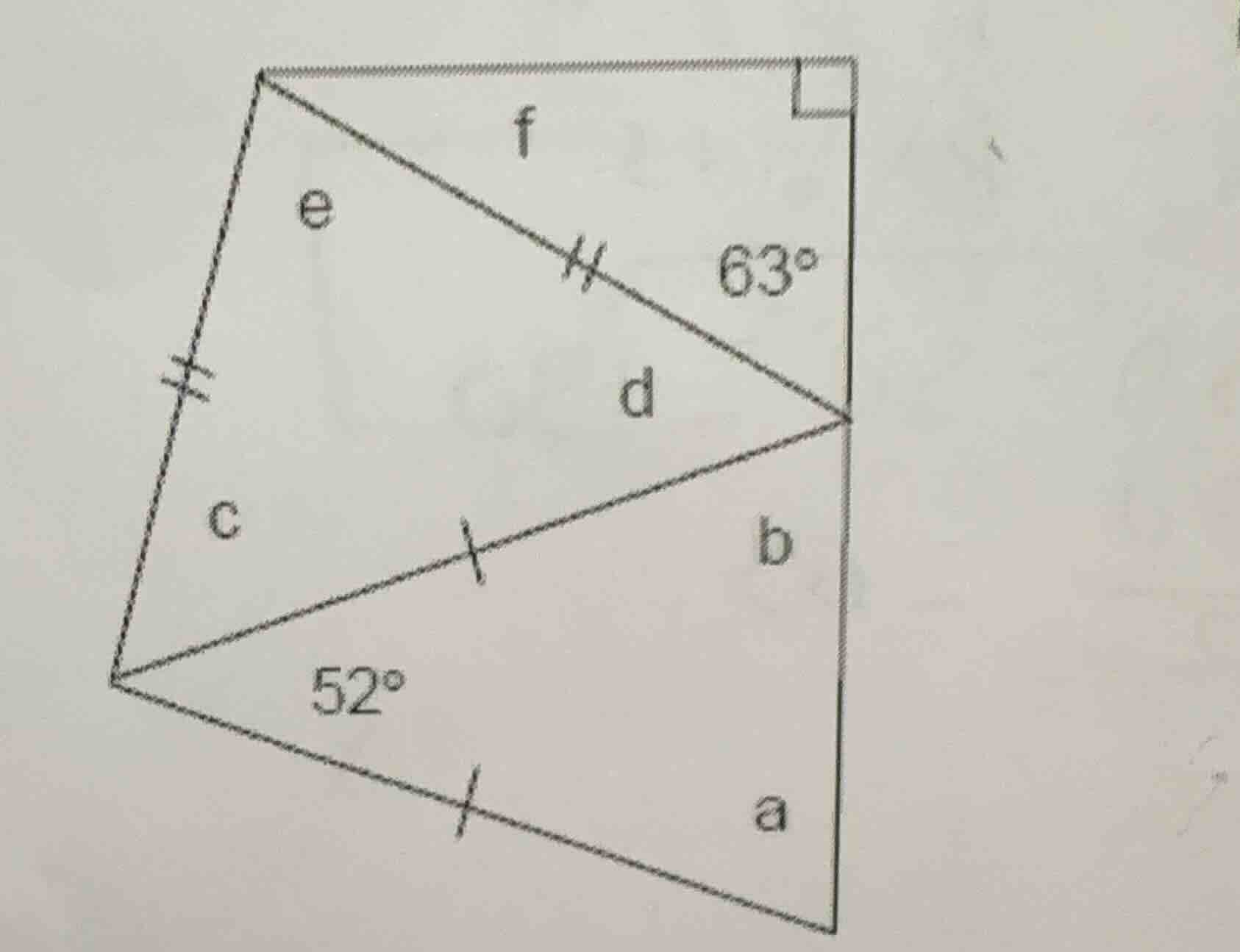
the figure contains several triangles with marked equal sides (indicated by tick marks) and angles (63° and 52°). the top - right triangle has a right angle. the triangles are labeled with letters a, b, c, d, e, f.
To solve for the unknown angles or sides, we analyze the given diagram:
Step 1: Identify Congruent Triangles
- Triangle \( d \) and \( f \): The marked sides (two tick marks) indicate congruent segments, and they share a common side. The right angle in \( f \) and the congruent sides suggest \( \triangle d \cong \triangle f \) (SAS or SSS).
- Triangle \( c \), \( b \), and \( a \): The single tick marks on sides suggest congruent segments, and the \( 52^\circ \) angle is given.
Step 2: Analyze Triangle \( f \) (Right Triangle)
In \( \triangle f \), one angle is \( 90^\circ \), another is \( 63^\circ \). The third angle (let’s call it \( x \)) is:
\[
x = 180^\circ - 90^\circ - 63^\circ = 27^\circ
\]
Since \( \triangle d \cong \triangle f \), the corresponding angle in \( \triangle d \) is also \( 27^\circ \).
Step 3: Analyze Triangle with \( 52^\circ \)
In the triangle with \( 52^\circ \), if sides are congruent (single tick marks), it is isosceles. Let the base angles be \( y \). For an isosceles triangle:
\[
2y + 52^\circ = 180^\circ \implies 2y = 128^\circ \implies y = 64^\circ
\]
Step 4: Sum of Angles in the Quadrilateral
The total sum of angles in a quadrilateral is \( 360^\circ \). We can use this to verify or find remaining angles, but the key angles (e.g., from congruent triangles) are derived as above.
Final Answer (Example for a Key Angle)
If solving for the angle in \( \triangle f \) (non - right angle), the answer is \( \boldsymbol{27^\circ} \). For the isosceles triangle with \( 52^\circ \), the base angle is \( \boldsymbol{64^\circ} \). (Adjust based on the specific unknown being solved.)

Snap & solve any problem in the app
Get step-by-step solutions on Sovi AI
Photo-based solutions with guided steps
Explore more problems and detailed explanations
To solve for the unknown angles or sides, we analyze the given diagram:
Step 1: Identify Congruent Triangles
- Triangle \( d \) and \( f \): The marked sides (two tick marks) indicate congruent segments, and they share a common side. The right angle in \( f \) and the congruent sides suggest \( \triangle d \cong \triangle f \) (SAS or SSS).
- Triangle \( c \), \( b \), and \( a \): The single tick marks on sides suggest congruent segments, and the \( 52^\circ \) angle is given.
Step 2: Analyze Triangle \( f \) (Right Triangle)
In \( \triangle f \), one angle is \( 90^\circ \), another is \( 63^\circ \). The third angle (let’s call it \( x \)) is:
\[
x = 180^\circ - 90^\circ - 63^\circ = 27^\circ
\]
Since \( \triangle d \cong \triangle f \), the corresponding angle in \( \triangle d \) is also \( 27^\circ \).
Step 3: Analyze Triangle with \( 52^\circ \)
In the triangle with \( 52^\circ \), if sides are congruent (single tick marks), it is isosceles. Let the base angles be \( y \). For an isosceles triangle:
\[
2y + 52^\circ = 180^\circ \implies 2y = 128^\circ \implies y = 64^\circ
\]
Step 4: Sum of Angles in the Quadrilateral
The total sum of angles in a quadrilateral is \( 360^\circ \). We can use this to verify or find remaining angles, but the key angles (e.g., from congruent triangles) are derived as above.
Final Answer (Example for a Key Angle)
If solving for the angle in \( \triangle f \) (non - right angle), the answer is \( \boldsymbol{27^\circ} \). For the isosceles triangle with \( 52^\circ \), the base angle is \( \boldsymbol{64^\circ} \). (Adjust based on the specific unknown being solved.)