QUESTION IMAGE
Question
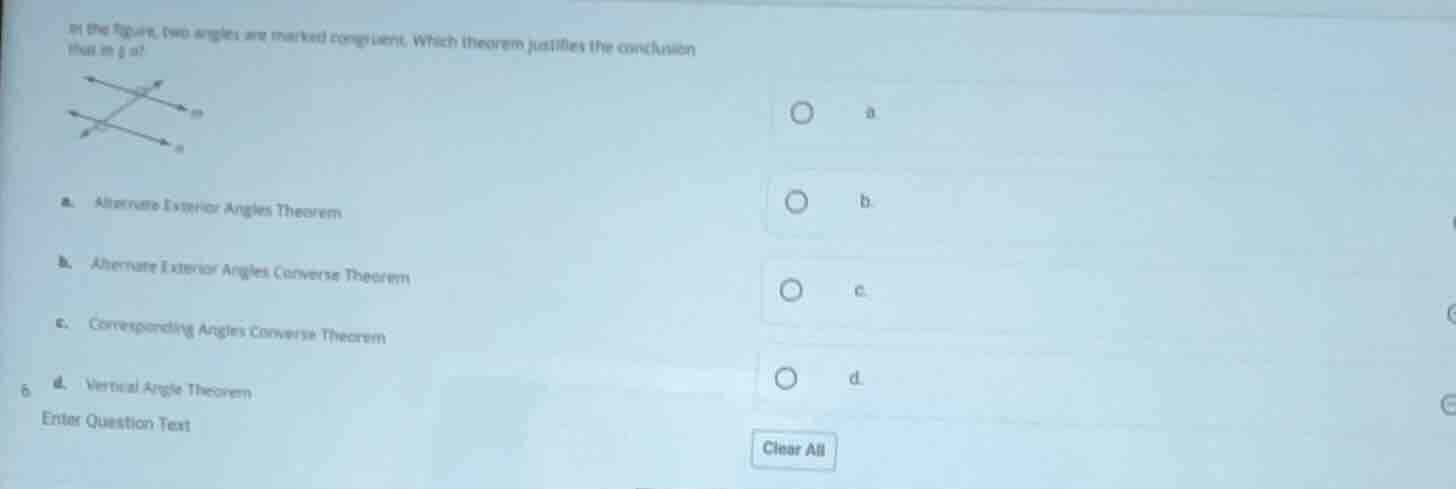
in the figure, two angles are marked congruent. which theorem justifies the conclusion that ( l parallel m )?
( \boldsymbol{\text{a.}} ) alternate exterior angles theorem
( \boldsymbol{\text{b.}} ) alternate exterior angles converse theorem
( \boldsymbol{\text{c.}} ) corresponding angles converse theorem
( \boldsymbol{\text{d.}} ) vertical angle theorem
enter question text
Brief Explanations
To determine which theorem justifies \( j \parallel n \) when two congruent angles (marked as alternate exterior angles) are given, we analyze each option:
- Option A (Alternate Exterior Angles Theorem): States that if lines are parallel, alternate exterior angles are congruent. This is the theorem (not the converse), so it does not justify parallelism from congruent angles.
- Option B (Alternate Exterior Angles Converse Theorem): States that if alternate exterior angles are congruent, then the lines are parallel. This matches the scenario: congruent alternate exterior angles imply \( j \parallel n \).
- Option C (Corresponding Angles Converse Theorem): Applies to corresponding angles, not alternate exterior angles.
- Option D (Vertical Angle Theorem): Deals with vertical angles being congruent, not parallel lines.

Snap & solve any problem in the app
Get step-by-step solutions on Sovi AI
Photo-based solutions with guided steps
Explore more problems and detailed explanations
B. Alternate Exterior Angles Converse Theorem