QUESTION IMAGE
Question
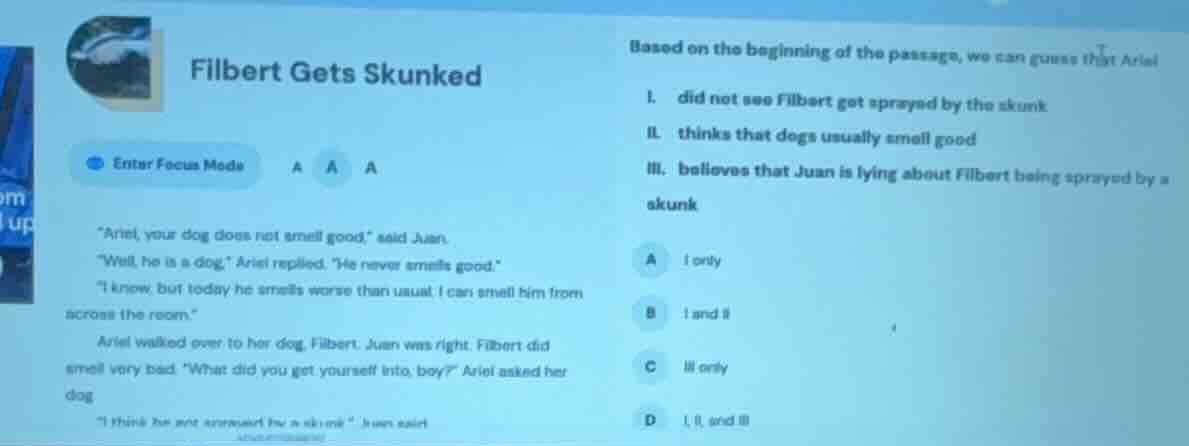
filbert gets skunked
enter focus mode
\ariel, your dog does not smell good,\ said juan.
\well, he is a dog,\ ariel replied. \he never smells good.\
\i know but today he smells worse than usual. i can smell him from across the room.\
ariel walked over to her dog, filbert. juan was right. filbert did smell very bad. \what did you get yourself into, boy?\ ariel asked her dog.
\i think he got sprayed by a skunk,\ juan said.
based on the beginning of the passage, we can guess that ariel
i. did not see filbert get sprayed by the skunk
ii. thinks that dogs usually smell good
iii. believes that juan is lying about filbert being sprayed by a skunk
a i only
b i and ii
c iii only
d i, ii, and iii
- For I: The passage starts with Juan's comment, then Ariel checks the dog. There's no info she saw the skunk spray, so I is correct.
- For II: Ariel says "He never smells good", implying she thinks dogs usually don't smell good (opposite of "usually smell good"), so II is incorrect.
- For III: Ariel walks to check and finds the dog smells bad, so she doesn't believe Juan is lying. III is incorrect. Wait, no—wait, re - evaluate II: Wait, Ariel's reply "He never smells good"—if she says he never smells good, that could mean she thinks dogs (in general, or her dog) don't usually smell good. But the statement II is "thinks that dogs usually smell good"—so that's the opposite. So II is wrong. For I: The beginning of the passage (before Ariel checks) – she didn't see the skunk spray, so I is correct. Wait, maybe I made a mistake. Let's re - read:
Juan says the dog smells worse than usual. Ariel replies "He never smells good" – so her view is that her dog (or dogs?) never smells good. So II is "thinks that dogs usually smell good" – which is opposite of her statement. So II is incorrect. For III: When Juan says he got sprayed by a skunk, Ariel asks "What did you get yourself into, boy?" – she is investigating, not believing Juan is lying. So III is incorrect. Wait, but the options: Wait, maybe I misread II. Wait, the option II is "thinks that dogs usually smell good" – Ariel says "He never smells good" – so if she thinks her dog never smells good, does that mean she thinks other dogs usually smell good? No, probably she thinks her dog (or dogs in general) don't smell good. So II is incorrect. Then I is correct (she didn't see the spray), II is incorrect, III is incorrect? But that's not an option. Wait, maybe I messed up. Wait, let's re - analyze:
- I: "did not see Filbert get sprayed by the skunk" – the beginning of the passage (before she walks to the dog) – she didn't see it, so I is correct.
- II: "thinks that dogs usually smell good" – Ariel says "He never smells good" – so if she says her dog never smells good, maybe she thinks that dogs (in general) usually don't smell good? But the statement II is that she thinks dogs usually smell good – which is the opposite. So II is wrong.
- III: "believes that Juan is lying about Filbert being sprayed by a skunk" – When Juan says he got sprayed, Ariel asks the dog what he got into – she is not accusing Juan of lying, so III is wrong. But the options are A (I only), B (I and II), C (III only), D (I, II, III). Wait, maybe my analysis of II is wrong. Wait, maybe "He never smells good" – maybe she is being sarcastic, or maybe she thinks that normally dogs smell good, but her dog is an exception? No, that's a stretch. Alternatively, maybe the question's II is "thinks that dogs usually smell good" – but Ariel's "He never smells good" could be a response to Juan's "your dog does not smell good" – maybe she is saying that dogs (in general) don't smell good, so Juan's complaint is unfounded. So if she thinks dogs usually don't smell good, then II (thinks dogs usually smell good) is wrong. So only I is correct. So the answer is A.

Snap & solve any problem in the app
Get step-by-step solutions on Sovi AI
Photo-based solutions with guided steps
Explore more problems and detailed explanations
A. I only