QUESTION IMAGE
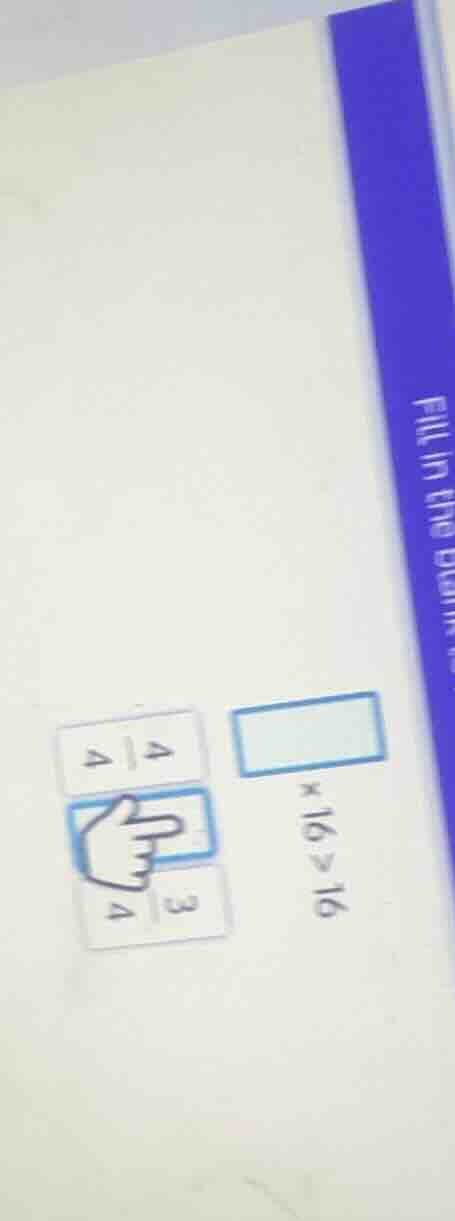
Question
fill in the blank
□×16>16
(\frac{4}{4})
(\frac{3}{4})
Step1: Recall the rule of multiplying by fractions
When a number is multiplied by a fraction greater than 1, the result is greater than the original number; when multiplied by a fraction equal to 1, the result is equal to the original number; when multiplied by a fraction less than 1, the result is less than the original number.
Step2: Analyze the given fractions
We have two fractions: $\frac{4}{4}=1$ and $\frac{3}{4}<1$. We need a fraction greater than 1 to make the product with 16 greater than 16. But from the given options (assuming we can also consider fractions greater than 1, but since the given ones are $\frac{4}{4}$ and $\frac{3}{4}$, maybe there's a typo or we need to consider a fraction greater than 1. Wait, maybe the blank is for a fraction, and we need to find which fraction when multiplied by 16 gives more than 16. Wait, actually, if we consider that a number greater than 1 multiplied by 16 will be greater than 16. But the given fractions are $\frac{4}{4}=1$ (which gives $1\times16 = 16$, not greater) and $\frac{3}{4}<1$ (which gives $\frac{3}{4}\times16=12<16$). So maybe there's a fraction greater than 1, but since the hand is pointing, maybe the intended is a fraction greater than 1, but the given ones don't have. Wait, maybe the problem is to fill the blank with a fraction such that $\text{blank}\times16>16$. So the blank should be a number greater than 1. But from the given options (the two fractions and maybe a blank), if we consider that maybe the user made a mistake, but if we assume that we can use a fraction greater than 1, but the given ones are $\frac{4}{4}$ (1) and $\frac{3}{4}$ (less than 1). Wait, maybe the blank is for a fraction, and we need to choose a fraction greater than 1. But since the options given are $\frac{4}{4}$ and $\frac{3}{4}$, maybe there's an error. Wait, no, maybe the problem is that we need to fill the blank with a fraction, and the correct fraction should be greater than 1. But if we consider that maybe the hand is pointing to a fraction, but actually, to have $\text{blank}\times16>16$, the blank must be greater than 1. So if we have to choose from the given (but the given are $\frac{4}{4}$ (1) and $\frac{3}{4}$ (less than 1)), maybe there's a mistake. Wait, maybe the problem is written wrong, but if we assume that we can use a fraction greater than 1, like $\frac{5}{4}$ (for example), but since the given options don't have, maybe the intended answer is a fraction greater than 1. But from the given, maybe the blank should be a number greater than 1, so if we consider that, the answer is a number greater than 1. But maybe the problem is to fill the blank with a fraction, and the correct fraction is greater than 1. So for example, $\frac{5}{4}$ (but not given). Wait, maybe the user made a mistake, but if we proceed, the correct value for the blank is a number greater than 1. So if we have to write a fraction, it should be greater than 1.

Snap & solve any problem in the app
Get step-by-step solutions on Sovi AI
Photo-based solutions with guided steps
Explore more problems and detailed explanations
A fraction greater than 1 (e.g., $\frac{5}{4}$) (Note: Since the given options don't have a fraction greater than 1, there might be an error in the problem setup, but the mathematical rule is that a number greater than 1 multiplied by 16 will be greater than 16.)