QUESTION IMAGE
Question
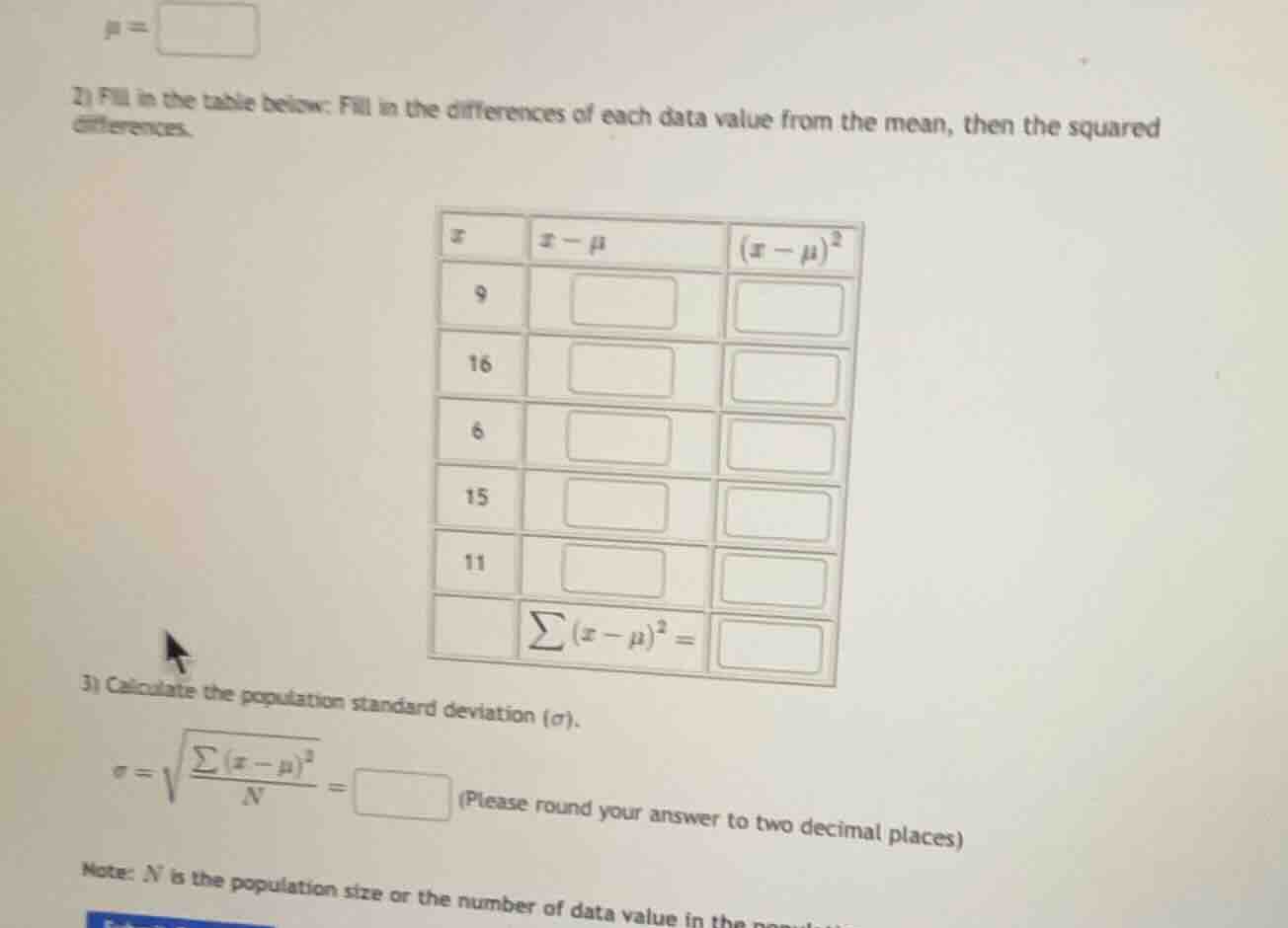
μ = \boxed{}
- fill in the table below: fill in the differences of each data value from the mean, then the squared differences.
\
- calculate the population standard deviation ($\sigma$).
$\sigma = \sqrt{\frac{\sum (x - \mu)^2}{n}} = \boxed{}$ (please round your answer to two decimal places)
note: $n$ is the population size or the number of data value in the
Step 1: Calculate the population mean (\(\mu\))
The data values are \(9, 16, 6, 15, 11\). The formula for the population mean is \(\mu=\frac{\sum x}{N}\), where \(N\) is the number of data points.
First, find \(\sum x\): \(9 + 16+6 + 15+11=57\).
There are \(N = 5\) data points. So, \(\mu=\frac{57}{5}=11.4\).
Step 2: Fill in the table for \(x - \mu\) and \((x - \mu)^2\)
- For \(x = 9\):
- \(x-\mu=9 - 11.4=- 2.4\)
- \((x - \mu)^2=(-2.4)^2 = 5.76\)
- For \(x = 16\):
- \(x-\mu=16 - 11.4 = 4.6\)
- \((x - \mu)^2=(4.6)^2=21.16\)
- For \(x = 6\):
- \(x-\mu=6 - 11.4=-5.4\)
- \((x - \mu)^2=(-5.4)^2 = 29.16\)
- For \(x = 15\):
- \(x-\mu=15 - 11.4 = 3.6\)
- \((x - \mu)^2=(3.6)^2 = 12.96\)
- For \(x = 11\):
- \(x-\mu=11 - 11.4=-0.4\)
- \((x - \mu)^2=(-0.4)^2=0.16\)
Step 3: Calculate \(\sum(x - \mu)^2\)
Sum up the squared differences: \(5.76+21.16 + 29.16+12.96+0.16=69.2\)
Step 4: Calculate the population standard deviation (\(\sigma\))
The formula for population standard deviation is \(\sigma=\sqrt{\frac{\sum(x - \mu)^2}{N}}\).
We know \(\sum(x - \mu)^2 = 69.2\) and \(N = 5\).
First, calculate \(\frac{\sum(x - \mu)^2}{N}=\frac{69.2}{5}=13.84\)
Then, \(\sigma=\sqrt{13.84}\approx3.72\)
Final Answers:
- \(\mu=\boldsymbol{11.4}\)
- Table:
| \(x\) | \(x-\mu\) | \((x - \mu)^2\) |
|---|---|---|
| 16 | 4.6 | 21.16 |
| 6 | -5.4 | 29.16 |
| 15 | 3.6 | 12.96 |
| 11 | -0.4 | 0.16 |
| \(\sum(x - \mu)^2=\) | 69.2 |
- \(\sigma\approx\boldsymbol{3.72}\)

Snap & solve any problem in the app
Get step-by-step solutions on Sovi AI
Photo-based solutions with guided steps
Explore more problems and detailed explanations
Step 1: Calculate the population mean (\(\mu\))
The data values are \(9, 16, 6, 15, 11\). The formula for the population mean is \(\mu=\frac{\sum x}{N}\), where \(N\) is the number of data points.
First, find \(\sum x\): \(9 + 16+6 + 15+11=57\).
There are \(N = 5\) data points. So, \(\mu=\frac{57}{5}=11.4\).
Step 2: Fill in the table for \(x - \mu\) and \((x - \mu)^2\)
- For \(x = 9\):
- \(x-\mu=9 - 11.4=- 2.4\)
- \((x - \mu)^2=(-2.4)^2 = 5.76\)
- For \(x = 16\):
- \(x-\mu=16 - 11.4 = 4.6\)
- \((x - \mu)^2=(4.6)^2=21.16\)
- For \(x = 6\):
- \(x-\mu=6 - 11.4=-5.4\)
- \((x - \mu)^2=(-5.4)^2 = 29.16\)
- For \(x = 15\):
- \(x-\mu=15 - 11.4 = 3.6\)
- \((x - \mu)^2=(3.6)^2 = 12.96\)
- For \(x = 11\):
- \(x-\mu=11 - 11.4=-0.4\)
- \((x - \mu)^2=(-0.4)^2=0.16\)
Step 3: Calculate \(\sum(x - \mu)^2\)
Sum up the squared differences: \(5.76+21.16 + 29.16+12.96+0.16=69.2\)
Step 4: Calculate the population standard deviation (\(\sigma\))
The formula for population standard deviation is \(\sigma=\sqrt{\frac{\sum(x - \mu)^2}{N}}\).
We know \(\sum(x - \mu)^2 = 69.2\) and \(N = 5\).
First, calculate \(\frac{\sum(x - \mu)^2}{N}=\frac{69.2}{5}=13.84\)
Then, \(\sigma=\sqrt{13.84}\approx3.72\)
Final Answers:
- \(\mu=\boldsymbol{11.4}\)
- Table:
| \(x\) | \(x-\mu\) | \((x - \mu)^2\) |
|---|---|---|
| 16 | 4.6 | 21.16 |
| 6 | -5.4 | 29.16 |
| 15 | 3.6 | 12.96 |
| 11 | -0.4 | 0.16 |
| \(\sum(x - \mu)^2=\) | 69.2 |
- \(\sigma\approx\boldsymbol{3.72}\)