QUESTION IMAGE
Question
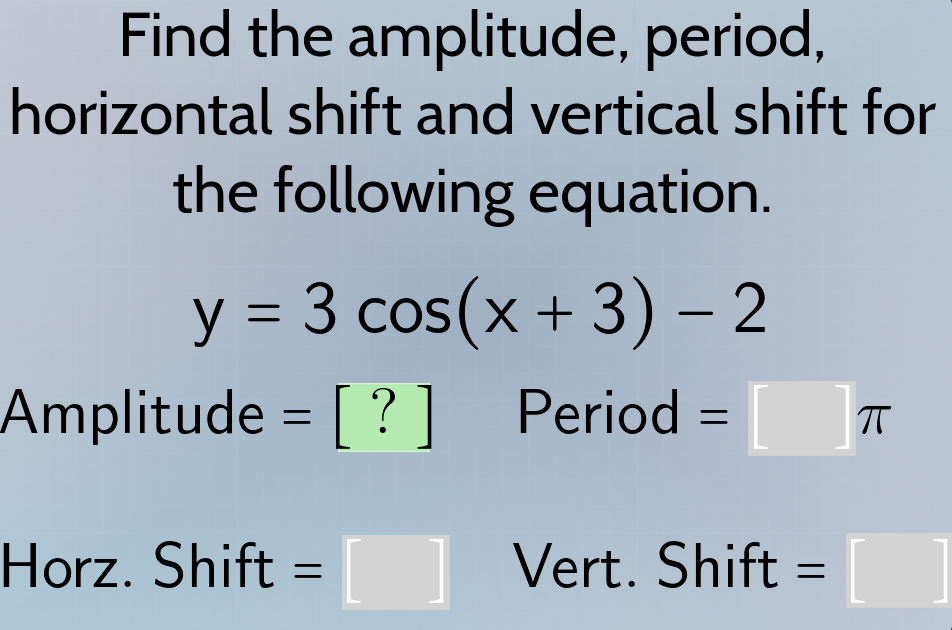
find the amplitude, period, horizontal shift and vertical shift for the following equation. y = 3 cos(x + 3) − 2 amplitude = ? period = π horz. shift = vert. shift =
Step1: Recall the general form of a cosine function
The general form of a cosine function is \( y = A\cos(B(x - C)) + D \), where:
- \( |A| \) is the amplitude,
- The period is \( \frac{2\pi}{|B|} \),
- \( C \) is the horizontal shift (positive to the right, negative to the left),
- \( D \) is the vertical shift (positive up, negative down).
Step2: Identify the values of A, B, C, D in the given equation
The given equation is \( y = 3\cos(x + 3) - 2 \). We can rewrite it as \( y = 3\cos(1 \cdot (x - (-3))) + (-2) \).
- Comparing with the general form, we have \( A = 3 \), \( B = 1 \), \( C = -3 \), \( D = -2 \).
Step3: Calculate the amplitude
The amplitude is \( |A| \). Since \( A = 3 \), the amplitude is \( |3| = 3 \).
Step4: Calculate the period
The period is \( \frac{2\pi}{|B|} \). Since \( B = 1 \), the period is \( \frac{2\pi}{|1|} = 2\pi \). In the form where the period is expressed as \( [\ ]\pi \), we have \( \frac{2\pi}{\pi} = 2 \), so the period is \( 2\pi \) (or in the box, it's 2).
Step5: Determine the horizontal shift
The horizontal shift is \( C \). Here, \( C = -3 \), which means the graph is shifted 3 units to the left.
Step6: Determine the vertical shift
The vertical shift is \( D \). Here, \( D = -2 \), which means the graph is shifted 2 units down.

Snap & solve any problem in the app
Get step-by-step solutions on Sovi AI
Photo-based solutions with guided steps
Explore more problems and detailed explanations
Amplitude = \( 3 \)
Period = \( 2 \pi \) (so the box for period is \( 2 \))
Horz. Shift = \( -3 \) (or 3 units left)
Vert. Shift = \( -2 \) (or 2 units down)
For the amplitude box specifically, the answer is \( \boldsymbol{3} \).