QUESTION IMAGE
Question
find the domain and range of the function:
Step1: Determine the domain
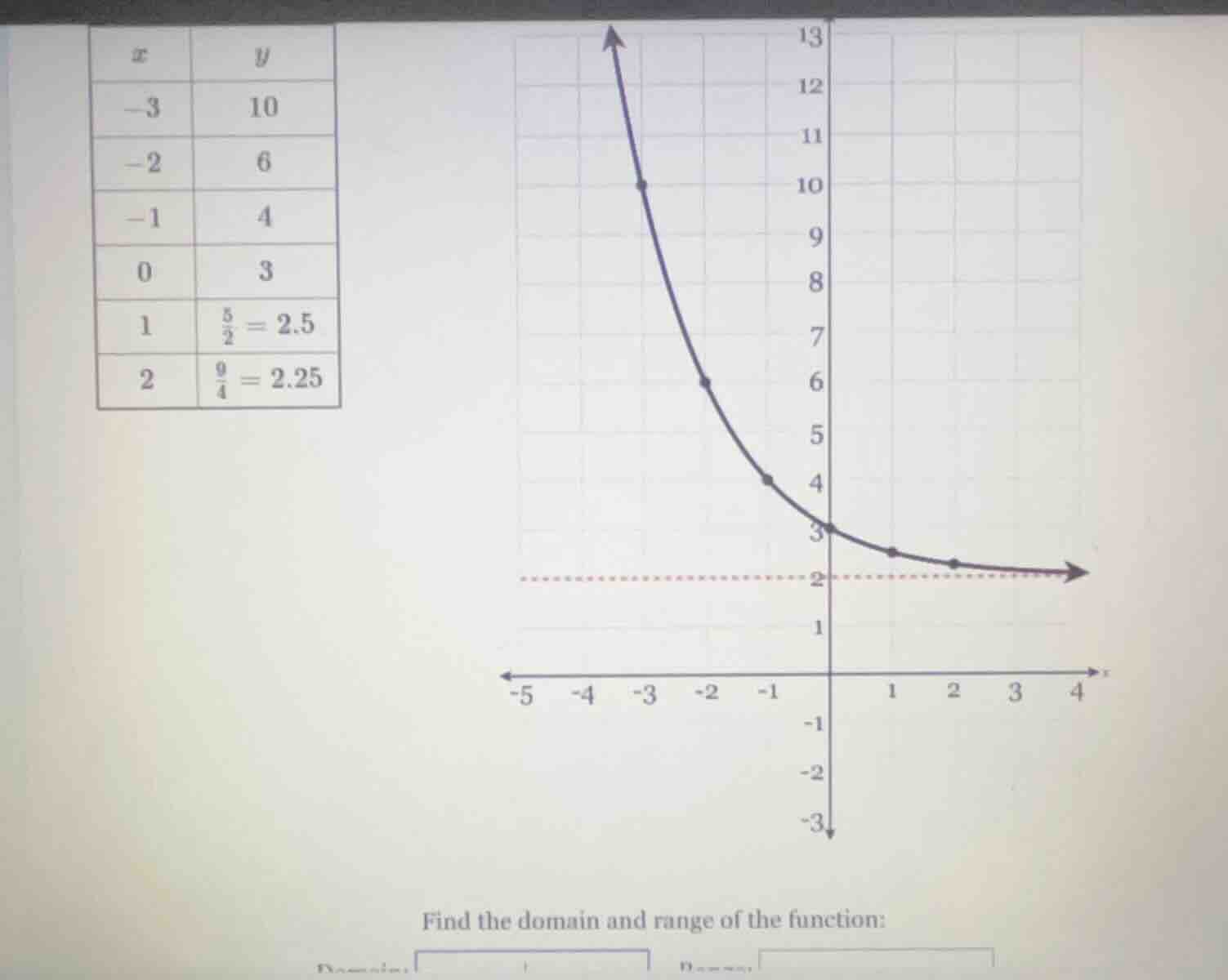
The domain of a function is the set of all possible \( x \)-values. From the table, the \( x \)-values are \(-3, -2, -1, 0, 1, 2\), and from the graph, the curve extends to the left (as \( x \) decreases) and to the right (as \( x \) increases). There are no restrictions on \( x \) (no breaks or holes indicating excluded values), so the domain is all real numbers. In interval notation, this is \( (-\infty, \infty) \).
Step2: Determine the range
The range of a function is the set of all possible \( y \)-values. From the table, the \( y \)-values are \( 10, 6, 4, 3, 2.5, 2.25 \), and from the graph, the curve approaches the horizontal dashed line \( y = 2 \) (a horizontal asymptote) as \( x \) increases, and as \( x \) decreases, \( y \) increases without bound. So the \( y \)-values are greater than \( 2 \) (since it approaches \( 2 \) but never reaches it) and go to infinity. In interval notation, the range is \( (2, \infty) \).

Snap & solve any problem in the app
Get step-by-step solutions on Sovi AI
Photo-based solutions with guided steps
Explore more problems and detailed explanations
Domain: \( (-\infty, \infty) \)
Range: \( (2, \infty) \)