QUESTION IMAGE
Question
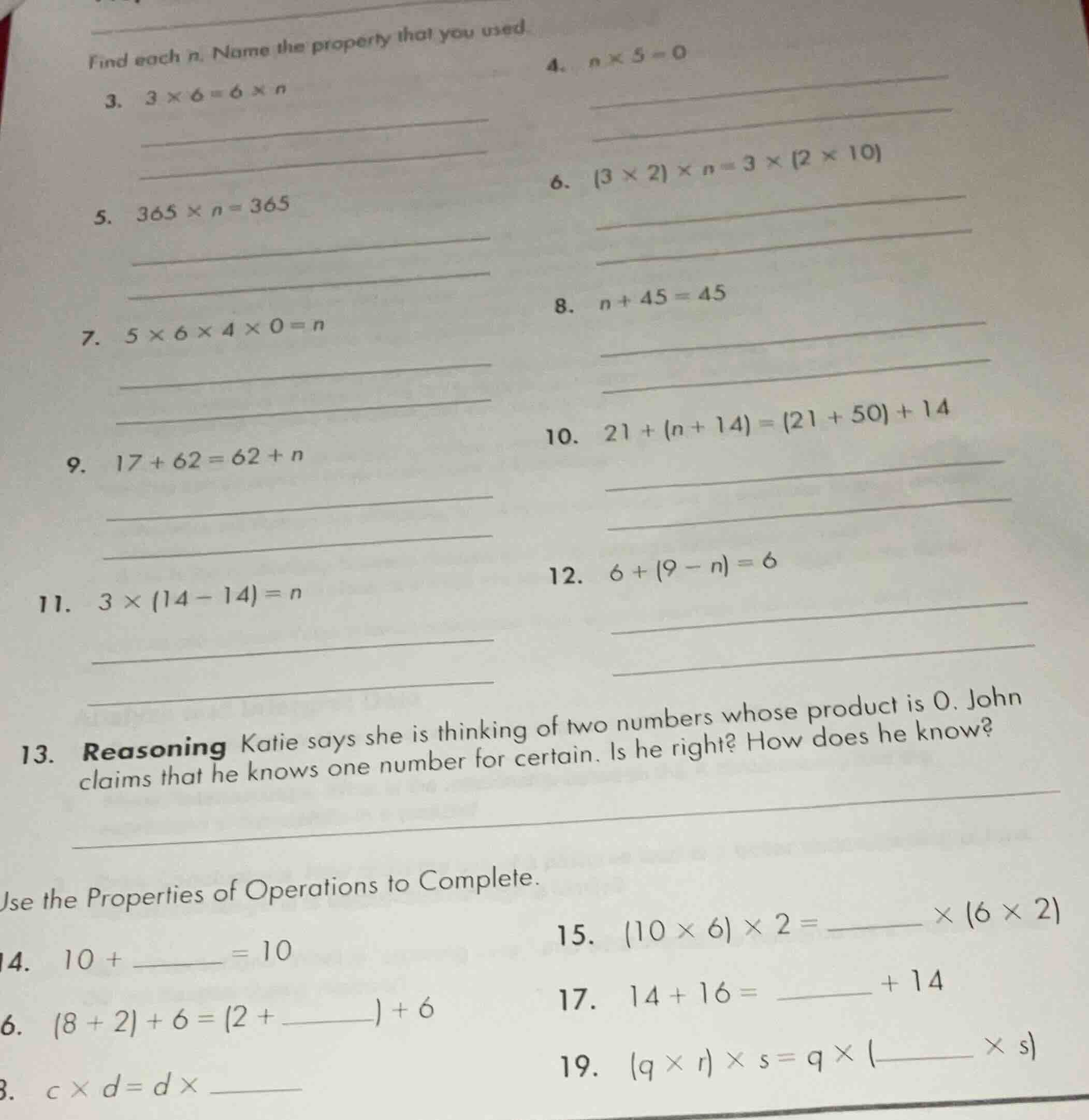
find each n. name the property that you used
- $3 \times 6 = 6 \times n$
- $n \times 5 = 0$
- $365 \times n = 365$
- $(3 \times 2) \times n = 3 \times (2 \times 10)$
- $5 \times 6 \times 4 \times 0 = n$
- $n + 45 = 45$
- $17 + 62 = 62 + n$
- $21 + (n + 14) = (21 + 50) + 14$
- $3 \times (14 - 14) = n$
- $6 + (9 - n) = 6$
- reasoning katie says she is thinking of two numbers whose product is 0. john claims that he knows one number for certain. is he right? how does he know?
use the properties of operations to complete.
- $10 + \underline{\quad\quad} = 10$
- $(10 \times 6) \times 2 = \underline{\quad\quad} \times (6 \times 2)$
- $(8 + 2) + 6 = (2 + \underline{\quad\quad}) + 6$
- $14 + 16 = \underline{\quad\quad} + 14$
- $c \times d = d \times \underline{\quad\quad}$
- $(q \times r) \times s = q \times (\underline{\quad\quad} \times s)$
Step1: Solve 3×6=6×n, use commutativity
$3 \times 6 = 6 \times n \implies 18 = 6n \implies n=3$
Property: Commutative Property of Multiplication
Step2: Solve n×5=0, use zero product rule
$n \times 5 = 0 \implies n=0$
Property: Zero Property of Multiplication
Step3: Solve 365×n=365, use identity property
$365 \times n = 365 \implies n=1$
Property: Multiplicative Identity Property
Step4: Solve (3×2)×n=3×(2×10), use associativity
$(3 \times 2) \times n = 3 \times (2 \times 10) \implies 6n = 60 \implies n=10$
Property: Associative Property of Multiplication
Step5: Solve 5×6×4×0=n, use zero property
$5 \times 6 \times 4 \times 0 = n \implies 0 = n$
Property: Zero Property of Multiplication
Step6: Solve n+45=45, use additive identity
$n + 45 = 45 \implies n=0$
Property: Additive Identity Property
Step7: Solve 17+62=62+n, use commutativity
$17 + 62 = 62 + n \implies 79 = 62 + n \implies n=17$
Property: Commutative Property of Addition
Step8: Solve 21+(n+14)=(21+50)+14, use associativity
$21 + (n + 14) = (21 + 50) + 14 \implies n + 35 = 85 \implies n=50$
Property: Associative Property of Addition
Step9: Solve 3×(14-14)=n, simplify first
$3 \times (14 - 14) = n \implies 3 \times 0 = n \implies n=0$
Property: Zero Property of Multiplication
Step10: Solve 6+(9-n)=6, isolate variable
$6 + (9 - n) = 6 \implies 9 - n = 0 \implies n=9$
Property: Additive Inverse Property
Step11: Answer reasoning question
By the Zero Property of Multiplication, if $a \times b = 0$, then at least one of $a$ or $b$ must be 0. So John is right—one of the two numbers must be 0.
Step12: Complete 10+__=10, use additive identity
$10 + 0 = 10$
Property: Additive Identity Property
Step13: Complete (10×6)×2=__×(6×2), use associativity
$(10 \times 6) \times 2 = 10 \times (6 \times 2)$
Property: Associative Property of Multiplication
Step14: Complete (8+2)+6=(2+__)+6, use commutativity
$(8 + 2) + 6 = (2 + 8) + 6$
Property: Commutative Property of Addition
Step15: Complete 14+16=__+14, use commutativity
$14 + 16 = 16 + 14$
Property: Commutative Property of Addition
Step16: Complete c×d=d×__, use commutativity
$c \times d = d \times c$
Property: Commutative Property of Multiplication
Step17: Complete (q×r)×s=q×(__×s), use associativity
$(q \times r) \times s = q \times (r \times s)$
Property: Associative Property of Multiplication

Snap & solve any problem in the app
Get step-by-step solutions on Sovi AI
Photo-based solutions with guided steps
Explore more problems and detailed explanations
- $n=3$, Commutative Property of Multiplication
- $n=0$, Zero Property of Multiplication
- $n=1$, Multiplicative Identity Property
- $n=10$, Associative Property of Multiplication
- $n=0$, Zero Property of Multiplication
- $n=0$, Additive Identity Property
- $n=17$, Commutative Property of Addition
- $n=50$, Associative Property of Addition
- $n=0$, Zero Property of Multiplication
- $n=9$, Additive Inverse Property
- John is right. By the Zero Property of Multiplication, if the product of two numbers is 0, at least one of the numbers must be 0, so he knows one number is 0 for certain.
- $0$ (Additive Identity Property)
- $10$ (Associative Property of Multiplication)
- $8$ (Commutative Property of Addition)
- $16$ (Commutative Property of Addition)
- $c$ (Commutative Property of Multiplication)
- $r$ (Associative Property of Multiplication)