QUESTION IMAGE
Question
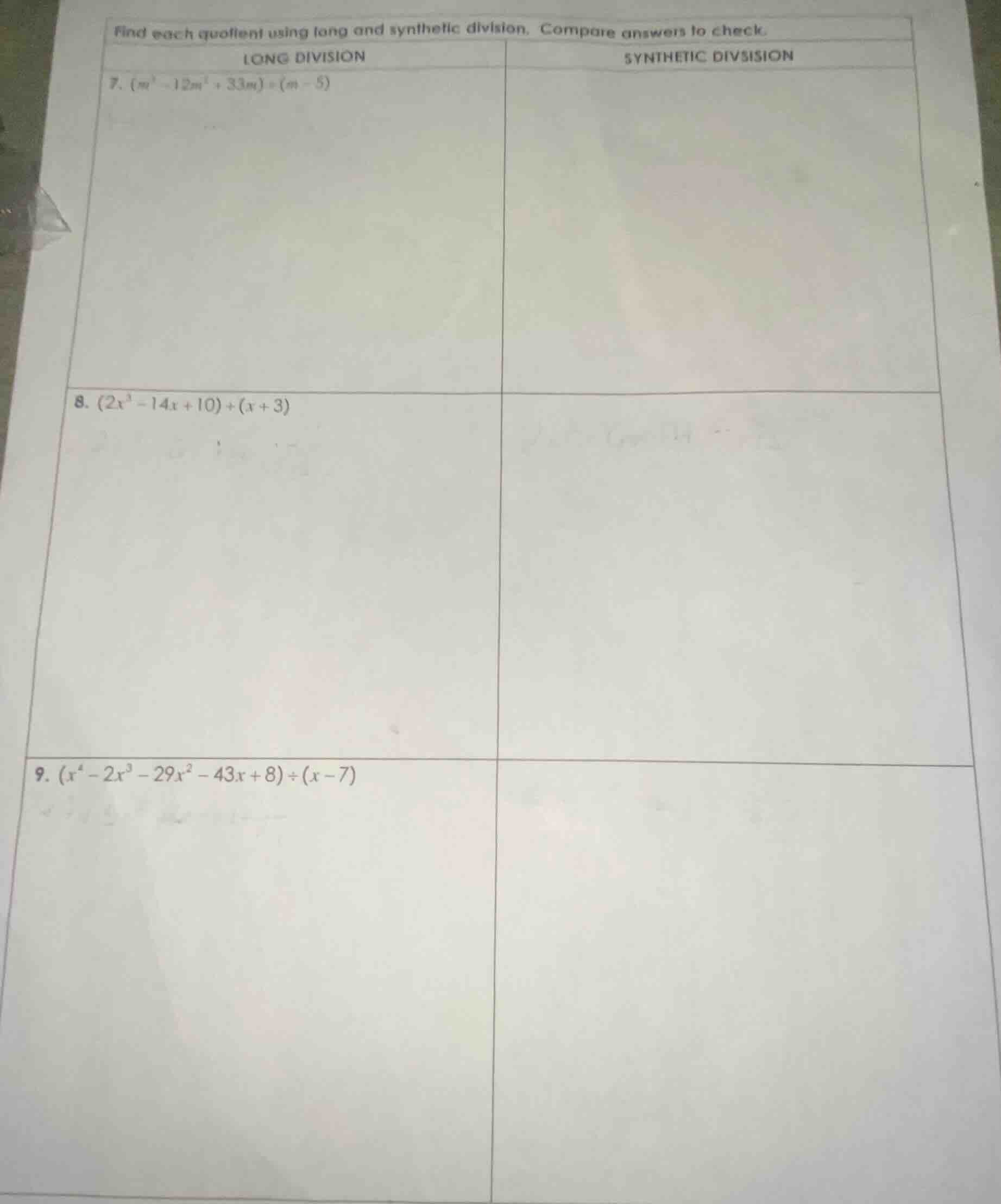
find each quotient using long and synthetic division. compare answers to check.
long division synthetic division
- $(m^3 - 12m^2 + 33m)\div(m - 5)$
- $(2x^3 - 14x + 10)\div(x + 3)$
- $(x^4 - 2x^3 - 29x^2 - 43x + 8)\div(x - 7)$
For Problem 7: $(m^3 - 12m^2 + 33m) \div (m - 5)$
Long Division
Step1: Divide leading terms
$\frac{m^3}{m} = m^2$
Step2: Multiply divisor by $m^2$
$m^2(m-5) = m^3 -5m^2$
Step3: Subtract from dividend
$(m^3 -12m^2 +33m) - (m^3 -5m^2) = -7m^2 +33m$
Step4: Divide new leading term
$\frac{-7m^2}{m} = -7m$
Step5: Multiply divisor by $-7m$
$-7m(m-5) = -7m^2 +35m$
Step6: Subtract from current polynomial
$(-7m^2 +33m) - (-7m^2 +35m) = -2m$
Step7: Divide new leading term
$\frac{-2m}{m} = -2$
Step8: Multiply divisor by $-2$
$-2(m-5) = -2m +10$
Step9: Subtract to get remainder
$(-2m) - (-2m +10) = -10$
Synthetic Division
Step1: List coefficients & root
Coefficients: $1, -12, 33, 0$; Root: $5$
Step2: Bring down leading coefficient
$1$
Step3: Multiply by root, add next term
$1 \times 5 = 5; -12 +5 = -7$
Step4: Multiply by root, add next term
$-7 \times5 = -35; 33 + (-35) = -2$
Step5: Multiply by root, add last term
$-2 \times5 = -10; 0 + (-10) = -10$
Long Division
Step1: Divide leading terms
$\frac{2x^3}{x} = 2x^2$
Step2: Multiply divisor by $2x^2$
$2x^2(x+3) = 2x^3 +6x^2$
Step3: Subtract from dividend
$(2x^3 +0x^2 -14x +10) - (2x^3 +6x^2) = -6x^2 -14x$
Step4: Divide new leading term
$\frac{-6x^2}{x} = -6x$
Step5: Multiply divisor by $-6x$
$-6x(x+3) = -6x^2 -18x$
Step6: Subtract from current polynomial
$(-6x^2 -14x) - (-6x^2 -18x) = 4x$
Step7: Divide new leading term
$\frac{4x}{x} = 4$
Step8: Multiply divisor by $4$
$4(x+3) = 4x +12$
Step9: Subtract to get remainder
$(4x +10) - (4x +12) = -2$
Synthetic Division
Step1: List coefficients & root
Coefficients: $2, 0, -14, 10$; Root: $-3$
Step2: Bring down leading coefficient
$2$
Step3: Multiply by root, add next term
$2 \times (-3) = -6; 0 + (-6) = -6$
Step4: Multiply by root, add next term
$-6 \times (-3) = 18; -14 +18 = 4$
Step5: Multiply by root, add last term
$4 \times (-3) = -12; 10 + (-12) = -2$
Long Division
Step1: Divide leading terms
$\frac{x^4}{x} = x^3$
Step2: Multiply divisor by $x^3$
$x^3(x-7) = x^4 -7x^3$
Step3: Subtract from dividend
$(x^4 -2x^3 -29x^2 -43x +8) - (x^4 -7x^3) = 5x^3 -29x^2$
Step4: Divide new leading term
$\frac{5x^3}{x} = 5x^2$
Step5: Multiply divisor by $5x^2$
$5x^2(x-7) = 5x^3 -35x^2$
Step6: Subtract from current polynomial
$(5x^3 -29x^2) - (5x^3 -35x^2) = 6x^2 -43x$
Step7: Divide new leading term
$\frac{6x^2}{x} = 6x$
Step8: Multiply divisor by $6x$
$6x(x-7) = 6x^2 -42x$
Step9: Subtract from current polynomial
$(6x^2 -43x) - (6x^2 -42x) = -x +8$
Step10: Divide new leading term
$\frac{-x}{x} = -1$
Step11: Multiply divisor by $-1$
$-1(x-7) = -x +7$
Step12: Subtract to get remainder
$(-x +8) - (-x +7) = 1$
Synthetic Division
Step1: List coefficients & root
Coefficients: $1, -2, -29, -43, 8$; Root: $7$
Step2: Bring down leading coefficient
$1$
Step3: Multiply by root, add next term
$1 \times7 =7; -2 +7=5$
Step4: Multiply by root, add next term
$5 \times7=35; -29 +35=6$
Step5: Multiply by root, add next term
$6 \times7=42; -43 +42=-1$
Step6: Multiply by root, add last term
$-1 \times7=-7; 8 + (-7)=1$

Snap & solve any problem in the app
Get step-by-step solutions on Sovi AI
Photo-based solutions with guided steps
Explore more problems and detailed explanations
Quotient: $m^2 -7m -2$, Remainder: $-10$
$\boldsymbol{m^2 -7m -2 - \frac{10}{m-5}}$
---