QUESTION IMAGE
Question
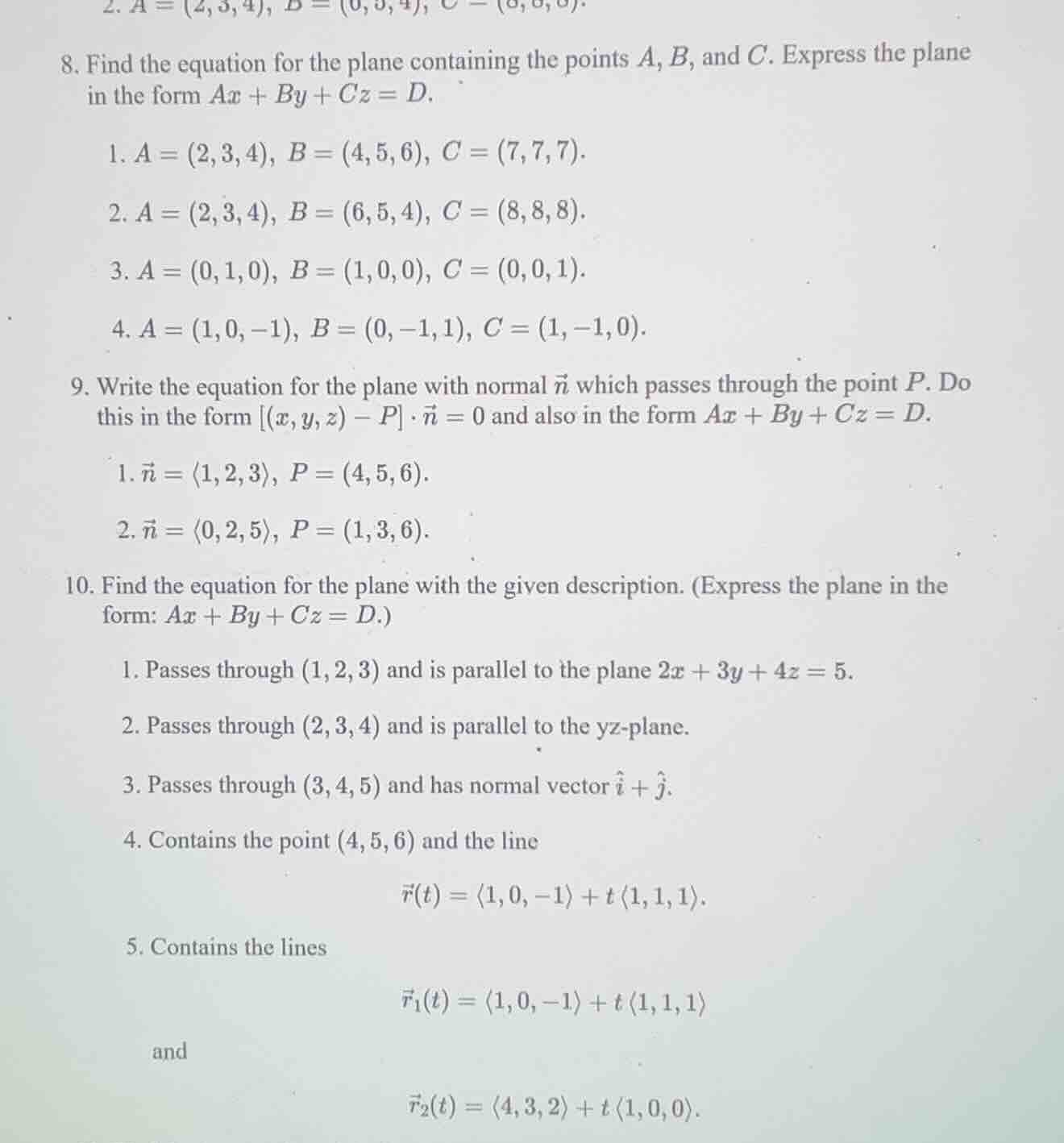
- find the equation for the plane containing the points a, b, and c. express the plane in the form $ax + by + cz = d$.
- $a = (2, 3, 4)$, $b = (4, 5, 6)$, $c = (7, 7, 7)$.
- $a = (2, 3, 4)$, $b = (6, 5, 4)$, $c = (8, 8, 8)$.
- $a = (0, 1, 0)$, $b = (1, 0, 0)$, $c = (0, 0, 1)$.
- $a = (1, 0, -1)$, $b = (0, -1, 1)$, $c = (1, -1, 0)$.
- write the equation for the plane with normal $vec{n}$ which passes through the point $p$. do this in the form $(x, y, z) - p cdot vec{n} = 0$ and also in the form $ax + by + cz = d$.
- $vec{n} = langle 1, 2, 3
angle$, $p = (4, 5, 6)$.
- $vec{n} = langle 0, 2, 5
angle$, $p = (1, 3, 6)$.
- find the equation for the plane with the given description. (express the plane in the form: $ax + by + cz = d$.)
- passes through $(1, 2, 3)$ and is parallel to the plane $2x + 3y + 4z = 5$.
- passes through $(2, 3, 4)$ and is parallel to the $yz$-plane.
- passes through $(3, 4, 5)$ and has normal vector $hat{i} + hat{j}$.
- contains the point $(4, 5, 6)$ and the line
$vec{r}(t) = langle 1, 0, -1
angle + t langle 1, 1, 1
angle$.
- contains the lines
$vec{r}_1(t) = langle 1, 0, -1
angle + t langle 1, 1, 1
angle$
and
$vec{r}_2(t) = langle 4, 3, 2
angle + t langle 1, 0, 0
angle$.
Problem 8:
1. $A=(2,3,4), B=(4,5,6), C=(7,7,7)$
Step1: Compute vectors $\overrightarrow{AB}, \overrightarrow{AC}$
$\overrightarrow{AB} = (4-2,5-3,6-4) = (2,2,2)$
$\overrightarrow{AC} = (7-2,7-3,7-4) = (5,4,3)$
Step2: Find normal vector $\vec{n}=\overrightarrow{AB} \times \overrightarrow{AC}$
Step3: Use point $A$ to find $D$
$-2(2) + 4(3) -2(4) = D \implies -4+12-8=0=D$
Step4: Simplify the plane equation
Divide by $-2$: $x - 2y + z = 0$
2. $A=(2,3,4), B=(6,5,4), C=(8,8,8)$
Step1: Compute vectors $\overrightarrow{AB}, \overrightarrow{AC}$
$\overrightarrow{AB} = (6-2,5-3,4-4) = (4,2,0)$
$\overrightarrow{AC} = (8-2,8-3,8-4) = (6,5,4)$
Step2: Find normal vector $\vec{n}=\overrightarrow{AB} \times \overrightarrow{AC}$
Step3: Use point $A$ to find $D$
$8(2) -16(3) +8(4) = D \implies 16-48+32=0=D$
Step4: Simplify the plane equation
Divide by $8$: $x - 2y + z = 0$
3. $A=(0,1,0), B=(1,0,0), C=(0,0,1)$
Step1: Compute vectors $\overrightarrow{AB}, \overrightarrow{AC}$
$\overrightarrow{AB} = (1-0,0-1,0-0) = (1,-1,0)$
$\overrightarrow{AC} = (0-0,0-1,1-0) = (0,-1,1)$
Step2: Find normal vector $\vec{n}=\overrightarrow{AB} \times \overrightarrow{AC}$
Step3: Use point $A$ to find $D$
$-1(0) -1(1) -1(0) = D \implies D=-1$
Step4: Simplify the plane equation
Multiply by $-1$: $x + y + z = 1$
4. $A=(1,0,-1), B=(0,-1,1), C=(1,-1,0)$
Step1: Compute vectors $\overrightarrow{AB}, \overrightarrow{AC}$
$\overrightarrow{AB} = (0-1,-1-0,1-(-1)) = (-1,-1,2)$
$\overrightarrow{AC} = (1-1,-1-0,0-(-1)) = (0,-1,1)$
Step2: Find normal vector $\vec{n}=\overrightarrow{AB} \times \overrightarrow{AC}$
Step3: Use point $A$ to find $D$
$1(1) +1(0) +1(-1) = D \implies 1+0-1=0=D$
Step4: Write the plane equation
$x + y + z = 0$
1. $\vec{n}=\langle1,2,3
angle, P=(4,5,6)$
Step1: Write vector form
$[(x,y,z)-(4,5,6)] \cdot \langle1,2,3
angle = 0$
Step2: Expand to $Ax+By+Cz=D$
$1(x-4)+2(y-5)+3(z-6)=0$
$x-4+2y-10+3z-18=0 \implies x+2y+3z=32$
2. $\vec{n}=\langle0,2,5
angle, P=(1,3,6)$
Step1: Write vector form
$[(x,y,z)-(1,3,6)] \cdot \langle0,2,5
angle = 0$
Step2: Expand to $Ax+By+Cz=D$
$0(x-1)+2(y-3)+5(z-6)=0$
$2y-6+5z-30=0 \implies 2y+5z=36$
1. Passes through $(1,2,3)$, parallel to $2x+3y+4z=5$
Step1: Use same normal vector $\vec{n}=(2,3,4)$
Step2: Calculate $D$ with the point
$2(1)+3(2)+4(3)=D \implies 2+6+12=20=D$
2. Passes through $(2,3,4)$, parallel to yz-plane
Step1: yz-plane has normal $\vec{n}=(1,0,0)$
Step2: Calculate $D$ with the point
$1(2)+0(3)+0(4)=D \implies D=2$
3. Passes through $(3,4,5)$, normal $\hat{i}+\hat{j}=(1,1,0)$
Step1: Calculate $D$ with the point
$1(3)+1(4)+0(5)=D \implies 3+4=7=D$
4. Contains $(4,5,6)$ and line $\vec{r}(t)=\langle1,0,-1
angle+t\langle1,1,1
angle$
Step1: Get two points on line: $Q=(1,0,-1), \vec{v}=(1,1,1)$
Step2: Compute $\overrightarrow{QP}=(4-1,5-0,6-(-1))=(3,5,7)$
Step3: Find normal $\vec{n}=\overrightarrow{QP} \times \vec{v}$
Step4: Use point $P$ to find $D$
$-2(4)+4(5)-2(6)=D \implies -8+20-12=0=D$
Step5: Simplify equation
Divide by $-2$: $x-2y+z=0$
5. Contains lines $\vec{r}_1(t)=\langle1,0,-1
angle+t\langle1,1,1
angle$ and $\vec{r}_2(t)=\langle4,3,2
angle+t\langle1,0,0
angle$
Step1: Get points $Q=(1,0,-1), R=(4,3,2)$; direction vectors $\vec{v}_1=(1,1,1), \vec{v}_2=(1,0,0)$
Step2: Compute $\overrightarrow{QR}=(4-1,3-0,2-(-1))=(3,3,3)$
Step3: Find normal $\vec{n}=\vec{v}_1 \times \vec{v}_2$
Step4: Use point $Q$ to find $D$
$0(1)+1(0)-1(-1)=D \implies 0+0+1=1=D$

Snap & solve any problem in the app
Get step-by-step solutions on Sovi AI
Photo-based solutions with guided steps
Explore more problems and detailed explanations
- $x - 2y + z = 0$
- $x - 2y + z = 0$
- $x + y + z = 1$
- $x + y + z = 0$
---