QUESTION IMAGE
Question
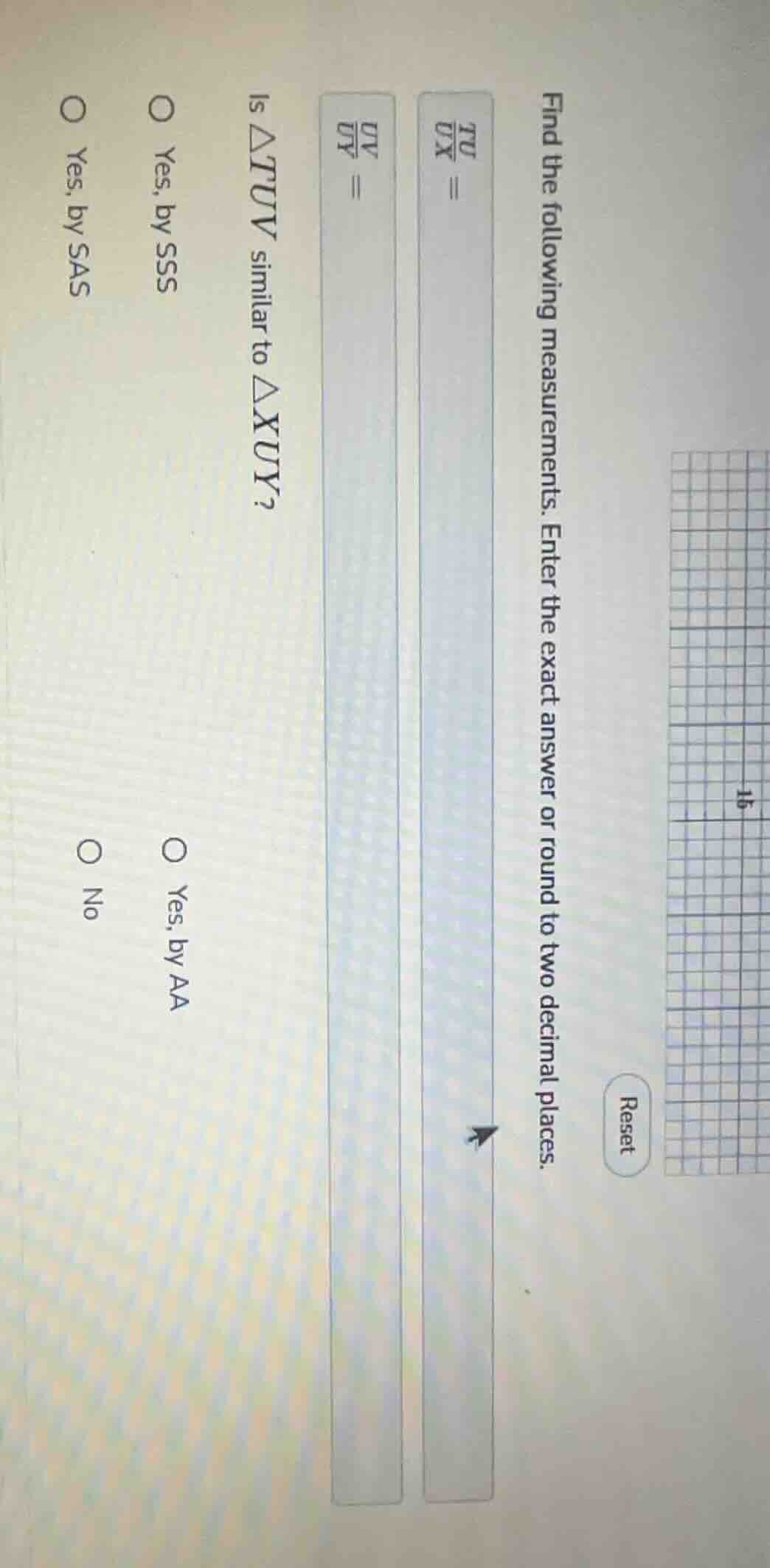
find the following measurements. enter the exact answer or round to two decimal places.
$\frac{tu}{ux} =$
$\frac{uv}{uy} =$
is $\triangle tuv$ similar to $\triangle xuy?$
\bigcirc yes, by sss
\bigcirc yes, by aa
\bigcirc yes, by sas
\bigcirc no
To determine if \(\triangle TUV\) is similar to \(\triangle XUY\), we analyze the given ratios and similarity criteria:
Step 1: Analyze the Ratios
We need to check the ratios \(\frac{TU}{UX}\) and \(\frac{UV}{UY}\) (assuming the triangles share the angle at \(U\), making it a common angle). If the ratios of the corresponding sides are equal and the included angle is equal, the triangles are similar by SAS (Side - Angle - Side) similarity criterion.
Step 2: Check the Similarity Criterion
- For SAS similarity, we need two sides of one triangle to be in proportion to two sides of the other triangle, and the included angle to be equal.
- If \(\frac{TU}{UX}=\frac{UV}{UY}\) and \(\angle TUV=\angle XUY\) (common angle), then by SAS similarity, \(\triangle TUV\sim\triangle XUY\).
Step 3: Evaluate the Options
- SSS (Side - Side - Side): Requires all three sides to be in proportion. We only have information about two sides, so SSS is not applicable.
- AA (Angle - Angle): Requires two angles to be equal. We do not have information about two angles, so AA is not applicable.
- SAS: Since we can have two sides in proportion (\(\frac{TU}{UX}\) and \(\frac{UV}{UY}\)) and the included angle (\(\angle U\)) equal, the triangles are similar by SAS.

Snap & solve any problem in the app
Get step-by-step solutions on Sovi AI
Photo-based solutions with guided steps
Explore more problems and detailed explanations
Yes, by SAS