QUESTION IMAGE
Question
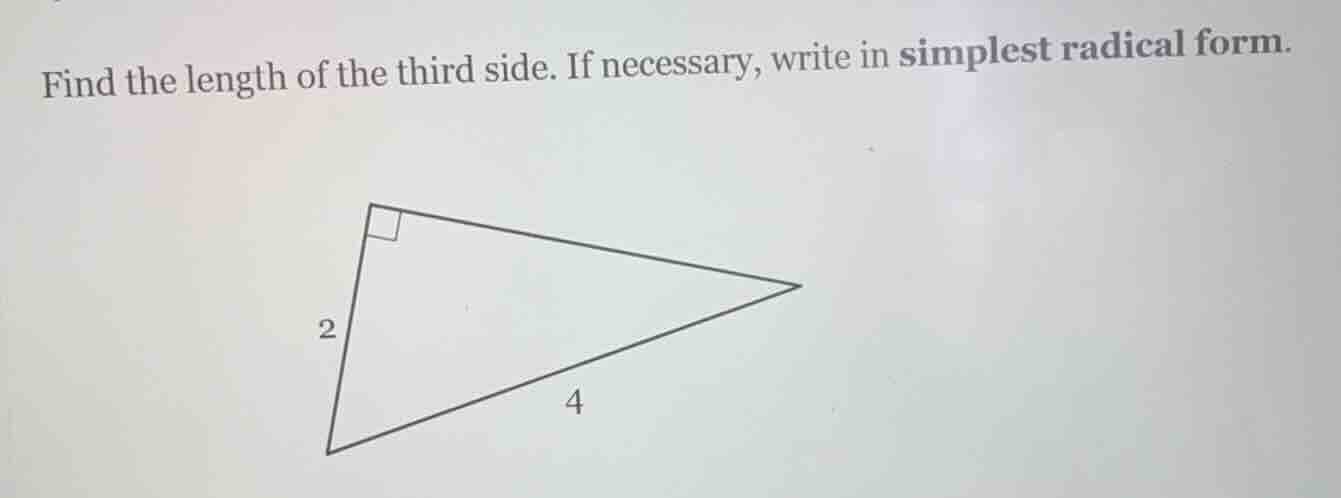
find the length of the third side. if necessary, write in simplest radical form. right triangle with legs 2 and hypotenuse 4 (or maybe one leg 2, hypotenuse 4? wait, the triangle has a right angle, one side labeled 2, the hypotenuse? wait, the diagram: right triangle, one leg 2, the other side (the hypotenuse?) labeled 4? wait, no, the right angle is between the side labeled 2 and the third side, and the side opposite? wait, the diagram: right triangle, one leg is 2, the hypotenuse is 4? wait, no, maybe the two sides: one leg 2, the other leg (the third side we need to find), and hypotenuse 4? wait, the problem is to find the length of the third side. the triangle is right-angled, with one leg 2, and the hypotenuse 4? wait, no, maybe the side labeled 4 is the hypotenuse, and one leg is 2, so we need to find the other leg. or maybe the side labeled 4 is a leg, and the other leg is 2, find hypotenuse? wait, the diagram: right angle, one side (vertical) labeled 2, the side opposite the right angle (hypotenuse) labeled 4? wait, no, the triangle: right angle at the top, so the two legs are the left side (2) and the bottom side (the third side we need to find), and the hypotenuse is the slant side (4). so using pythagorean theorem: a² + b² = c², where c is hypotenuse. so 2² + b² = 4² → 4 + b² = 16 → b² = 12 → b = 2√3. or maybe the side labeled 4 is a leg, and 2 is a leg, find hypotenuse: 2² + 4² = c² → 4 + 16 = c² → c² = 20 → c = 2√5. wait, the diagram: the right angle is at the top, so the two legs are the left (2) and the bottom (lets say x), and the hypotenuse is the right side (4). so then x² + 2² = 4² → x² = 16 - 4 = 12 → x = 2√3. so the ocr text is: find the length of the third side. if necessary, write in simplest radical form. diagram of right triangle with one leg 2, hypotenuse 4 (or maybe the other way?)
Step1: Identify known sides, hypotenuse
We have a right triangle: one leg $a=2$, hypotenuse $c=4$, unknown leg $b$.
Step2: Apply Pythagorean theorem
$$a^2 + b^2 = c^2$$
Substitute values: $2^2 + b^2 = 4^2$
Step3: Calculate squared terms
$4 + b^2 = 16$
Step4: Isolate $b^2$
$b^2 = 16 - 4 = 12$
Step5: Solve for $b$, simplify radical
$b = \sqrt{12} = \sqrt{4 \times 3} = 2\sqrt{3}$

Snap & solve any problem in the app
Get step-by-step solutions on Sovi AI
Photo-based solutions with guided steps
Explore more problems and detailed explanations
$2\sqrt{3}$