QUESTION IMAGE
Question
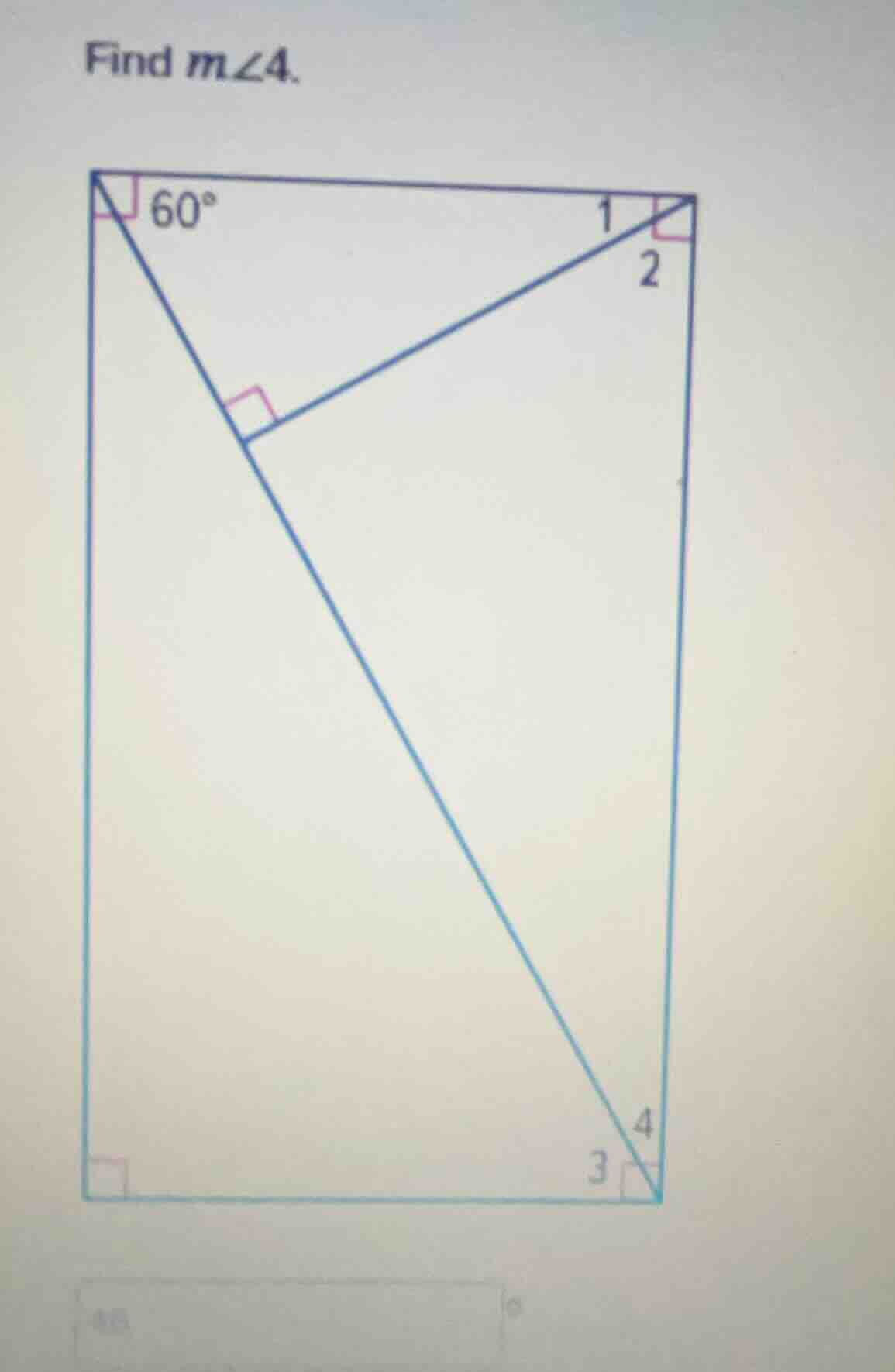
find ( mangle 4 ).
Step1: Analyze the top triangle
In the top right triangle with a right angle and a \(60^\circ\) angle, we can find \(\angle1\). Since the sum of angles in a triangle is \(180^\circ\), and one angle is \(90^\circ\), another is \(60^\circ\), so \(\angle1 = 180^\circ - 90^\circ - 60^\circ = 30^\circ\).
Step2: Analyze the right triangle with \(\angle1\)
In the right triangle containing \(\angle1\) and \(\angle2\), since it's a right triangle, \(\angle1 + \angle2 = 90^\circ\). We know \(\angle1 = 30^\circ\), so \(\angle2 = 90^\circ - 30^\circ = 60^\circ\).
Step3: Analyze the rectangle and angle relationships
The figure is a rectangle, so opposite sides are parallel and all angles are \(90^\circ\). The triangle at the bottom right: we can use the fact that the angles in a rectangle and the triangle relationships. Notice that \(\angle4\) should be equal to \(\angle1\) or we can use the angle sum. Wait, actually, looking at the bottom right, the right angle is \(90^\circ\), and if we consider the triangle, since the top part had a \(60^\circ\) and \(30^\circ\) relationship, and the rectangle's angles, \(\angle4 = 30^\circ\)? Wait, no, let's re - check. Wait, the top left triangle: the angle between the two right angles and \(60^\circ\), then the triangle with \(\angle1\) is a right triangle, so \(\angle1 = 30^\circ\). Then, in the bottom right, the triangle: since the side is parallel, the alternate interior angles or the fact that the rectangle's corner is \(90^\circ\), and the triangle's angle. Wait, actually, the key is that in the top right, the small triangle with \(60^\circ\) and right angle gives \(\angle1 = 30^\circ\), then the triangle with \(\angle2\) is right, so \(\angle2 = 60^\circ\). Then, in the bottom right, the triangle: the angle \(\angle4\) should be equal to \(\angle1\) because of the rectangle's properties (alternate interior angles or congruent triangles). Wait, another way: the bottom right triangle is a right triangle, and if we look at the angle corresponding to \(\angle1\), since the figure is a rectangle, the angle \(\angle4 = 30^\circ\)? Wait, no, let's do it properly. The rectangle has all angles \(90^\circ\), the diagonal or the line creates triangles. Wait, actually, the triangle at the bottom right: the angle \(\angle4\) is equal to \(\angle1\) which is \(30^\circ\)? Wait, no, let's re - calculate. Wait, in the top triangle, we had a \(60^\circ\) angle, right angle, so \(\angle1 = 30^\circ\). Then, the triangle with \(\angle2\) is right, so \(\angle2 = 60^\circ\). Now, in the bottom right, the triangle: the angle \(\angle4\), since the side is vertical, and the line is the same as the top line, so the angle \(\angle4\) should be \(30^\circ\)? Wait, no, maybe I made a mistake. Wait, let's start over.
Wait, the figure is a rectangle, so \(AB\parallel CD\) (assuming the rectangle has sides \(AB\) top, \(CD\) bottom, \(AD\) left, \(BC\) right). The line from the top left to bottom right is a diagonal? No, there are two lines. Wait, the top left has a right angle, a \(60^\circ\) angle, and a line to the middle, then a line to the top right. So the top triangle (top right) has angles \(90^\circ\), \(60^\circ\), so the third angle \(\angle1 = 30^\circ\). Then, the triangle with \(\angle1\) and \(\angle2\) is right - angled, so \(\angle2 = 60^\circ\). Now, in the bottom right, the triangle: the angle at the bottom right corner of the rectangle is \(90^\circ\), and the triangle formed there. Since the line from the middle to the top right and the line from the top left to bottom right, we can see that \(\angl…

Snap & solve any problem in the app
Get step-by-step solutions on Sovi AI
Photo-based solutions with guided steps
Explore more problems and detailed explanations
\(30^\circ\)