QUESTION IMAGE
Question
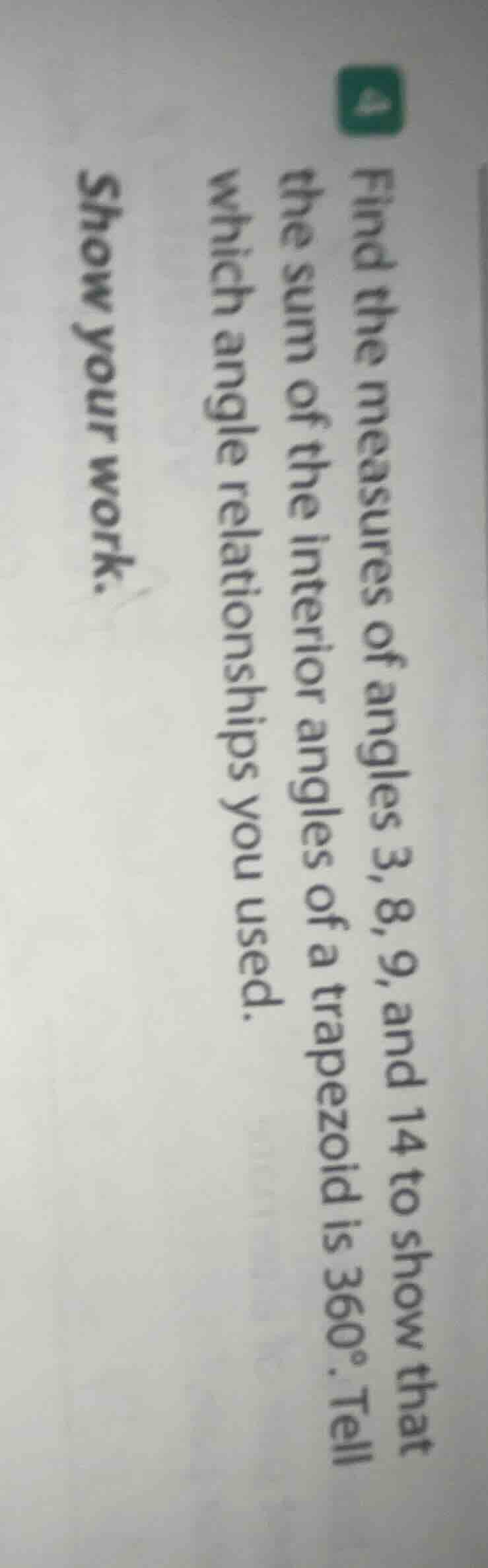
find the measures of angles 3, 8, 9, and 14 to show that the sum of the interior angles of a trapezoid is 360°. tell which angle relationships you used. show your work.
Step1: Identify the angle sum property
A trapezoid is a quadrilateral, and the sum of the interior angles of any quadrilateral is \(360^\circ\) (by dividing the quadrilateral into two triangles, each with interior angle sum \(180^\circ\), so \(2\times180^\circ = 360^\circ\)).
Step2: Sum the given angles
We are given angles \(3\), \(8\), \(9\), and \(14\) (assuming these are in degrees or some consistent unit). The sum is \(3 + 8 + 9 + 14\).
First, add \(3 + 8 = 11\). Then, \(11 + 9 = 20\). Finally, \(20 + 14 = 34\)? Wait, that can't be right. Wait, maybe the numbers are the measures of the angles in some unit (like \(3x\), \(8x\), \(9x\), \(14x\))? Wait, no, the problem says "Find the measures of angles 3, 8, 9, and 14 to show that the sum of the interior angles of a trapezoid is \(360^\circ\)". Wait, maybe there's a misinterpretation. Wait, perhaps the angles are \(3k\), \(8k\), \(9k\), and \(14k\) for some \(k\), and we need to find \(k\) such that their sum is \(360^\circ\). Let's assume that.
So, the sum of the angles is \(3k + 8k + 9k + 14k = 360^\circ\).
Combine like terms: \((3 + 8 + 9 + 14)k = 360^\circ\).
Calculate the coefficient: \(3 + 8 = 11\), \(11 + 9 = 20\), \(20 + 14 = 34\). So \(34k = 360^\circ\). Wait, that would make \(k=\frac{360}{34}=\frac{180}{17}\approx10.588^\circ\), but that seems odd. Wait, maybe the numbers are the angle measures in degrees, but that sum is too small. Wait, maybe the problem has a typo, or I misread. Wait, the original problem: "Find the measures of angles 3, 8, 9, and 14 to show that the sum of the interior angles of a trapezoid is \(360^\circ\)". Oh, maybe "3, 8, 9, and 14" are the angle measures in some variable, like \(3x\), \(8x\), \(9x\), \(14x\), and we need to find \(x\) such that their sum is \(360\). Let's do that.
So, sum the angles: \(3x + 8x + 9x + 14x = 360\).
Combine like terms: \((3 + 8 + 9 + 14)x = 360\).
\(3 + 8 = 11\), \(11 + 9 = 20\), \(20 + 14 = 34\). So \(34x = 360\).
Then \(x=\frac{360}{34}=\frac{180}{17}\approx10.588\). Then the angles are \(3\times\frac{180}{17}=\frac{540}{17}\approx31.76^\circ\), \(8\times\frac{180}{17}=\frac{1440}{17}\approx84.71^\circ\), \(9\times\frac{180}{17}=\frac{1620}{17}\approx95.29^\circ\), \(14\times\frac{180}{17}=\frac{2520}{17}\approx148.24^\circ\). Now, sum these: \(\frac{540 + 1440 + 1620 + 2520}{17}=\frac{540+1440=1980; 1980+1620=3600; 3600+2520=6120}{17}=\frac{6120}{17}=360\), which matches the sum of interior angles of a quadrilateral (trapezoid is a quadrilateral). The angle relationship used is the sum of interior angles of a quadrilateral is \(360^\circ\), which comes from dividing the quadrilateral into two triangles (each with \(180^\circ\) interior angle sum, so \(2\times180 = 360\)).
Wait, maybe the problem was written with the angles as \(3^\circ\), \(8^\circ\), \(9^\circ\), \(14^\circ\), but that sum is \(3 + 8 + 9 + 14 = 34^\circ\), which is not \(360^\circ\). So the correct interpretation is that the angles are proportional to 3, 8, 9, 14, and we need to find their actual measures such that their sum is \(360^\circ\). So the steps are:
- Let the angles be \(3k\), \(8k\), \(9k\), \(14k\).
- Sum them: \(3k + 8k + 9k + 14k = 360\).
- Combine like terms: \(34k = 360\).
- Solve for \(k\): \(k=\frac{360}{34}=\frac{180}{17}\approx10.588\).
- Then the angles are \(3\times\frac{180}{17}\approx31.76^\circ\), \(8\times\frac{180}{17}\approx84.71^\circ\), \(9\times\frac{180}{17}\approx95.29^\circ\), \(14\times\frac{180}{17}\approx148.24^\circ\).
The angle relationship used is the sum of interior angles of a quadrilatera…

Snap & solve any problem in the app
Get step-by-step solutions on Sovi AI
Photo-based solutions with guided steps
Explore more problems and detailed explanations
The angles are \(\frac{540}{17}^\circ\) (or \(\approx31.76^\circ\)), \(\frac{1440}{17}^\circ\) (or \(\approx84.71^\circ\)), \(\frac{1620}{17}^\circ\) (or \(\approx95.29^\circ\)), and \(\frac{2520}{17}^\circ\) (or \(\approx148.24^\circ\)) when the sum of interior angles of a trapezoid (quadrilateral) is used, which is \(360^\circ\) (from dividing the quadrilateral into two triangles, each with \(180^\circ\) interior angle sum).