QUESTION IMAGE
Question
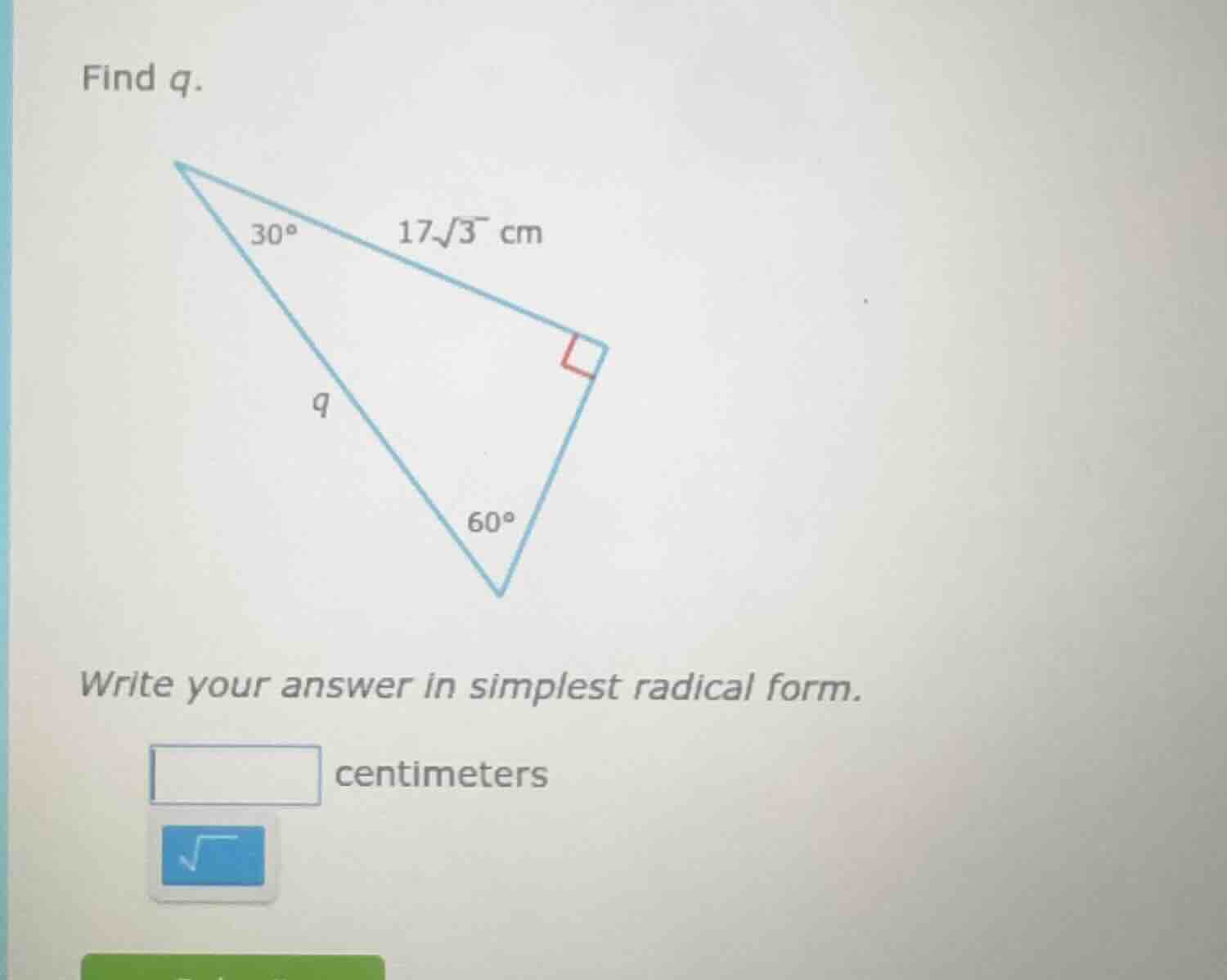
find q.
right triangle with angles 30°, 60°, 90°, side opposite 30° is 17√3 cm, side q is opposite 60°
write your answer in simplest radical form.
blank centimeters
Step1: Identify triangle type and trigonometric ratio
This is a 30-60-90 right triangle. We can use the tangent function for the 30° angle. The tangent of an angle in a right triangle is $\frac{\text{opposite}}{\text{adjacent}}$. For the 30° angle, the opposite side to 30° is the side opposite (let's say the side with length related to q, wait no: wait, the angle of 30°, the side adjacent to 30° is $17\sqrt{3}$ cm, and the side opposite to 30°? Wait no, wait the right angle, so the angles are 30°, 60°, 90°. Let's label the sides: the side opposite 30° is the shortest side, opposite 60° is longer, hypotenuse is longest. Wait, in the triangle, the side given is $17\sqrt{3}$ cm, which is adjacent to the 30° angle (since 30° angle has the adjacent side as $17\sqrt{3}$ and the opposite side as q? Wait no, wait the angle of 30°: the right angle is between the two legs. So angle 30°: one leg is adjacent (let's say the leg with length $17\sqrt{3}$), and the other leg is opposite (q). Wait, no, let's check: in a 30-60-90 triangle, the ratios are: sides are in the ratio $1 : \sqrt{3} : 2$, where the side opposite 30° is the shortest (length $x$), opposite 60° is $x\sqrt{3}$, hypotenuse is $2x$. Wait, alternatively, using trigonometry: $\tan(30^\circ) = \frac{\text{opposite}}{\text{adjacent}}$. Wait, angle 30°: opposite side is the side opposite 30°, which would be the side with length... Wait, the triangle has angles 30°, 60°, 90°. So the side opposite 30° is the leg opposite 30°, let's call that $a$, opposite 60° is $b$, hypotenuse $c$. Then $\tan(30^\circ) = \frac{a}{b}$, $\tan(60^\circ) = \frac{b}{a}$. Wait, but in the diagram, the side given is $17\sqrt{3}$ cm, which is adjacent to the 30° angle (since 30° angle is at the top, so the leg adjacent to 30° is $17\sqrt{3}$ cm, and the leg opposite to 30° is q? Wait no, wait the angle of 30°: the two legs are: one leg is adjacent to 30° (length $17\sqrt{3}$), the other leg is opposite to 30° (length q). Wait, no, actually, let's use the tangent of 30°: $\tan(30^\circ) = \frac{\text{opposite}}{\text{adjacent}} = \frac{q}{17\sqrt{3}}$? Wait no, that can't be. Wait, no, maybe I mixed up. Wait, the angle of 60°: let's use the tangent of 60°. $\tan(60^\circ) = \sqrt{3} = \frac{\text{opposite}}{\text{adjacent}}$. For angle 60°, the opposite side is $17\sqrt{3}$? No, wait, let's look at the diagram again. The triangle has a right angle, angle 30° at the top, angle 60° at the bottom, and the side between 30° and right angle is $17\sqrt{3}$ cm, and the side between 60° and right angle is q? Wait, no, the labels: the side labeled $17\sqrt{3}$ cm is adjacent to the 30° angle (since 30° angle is at the vertex where that side and the hypotenuse meet), and the side labeled q is adjacent to the 60° angle. Wait, maybe better to use the tangent of 30°: $\tan(30^\circ) = \frac{\text{opposite}}{\text{adjacent}}$. The angle 30°: opposite side is q (wait, no, if the right angle is between the two legs, then the leg opposite 30° is the one with length q? Wait, no, let's think again. In a 30-60-90 triangle, the sides are in the ratio: side opposite 30°: $x$, side opposite 60°: $x\sqrt{3}$, hypotenuse: $2x$. So if we consider the angle of 30°, the side adjacent to 30° is the side opposite 60°, which is $x\sqrt{3}$, and the side opposite 30° is $x$. So in this case, the side adjacent to 30° is $17\sqrt{3}$ cm, which should be equal to $x\sqrt{3}$ (since it's opposite 60°). So $x\sqrt{3} = 17\sqrt{3}$, so $x = 17$. Then the side opposite 30° (which is q? Wait no, wait the side opposite 30° is $x$, which would be 17?…

Snap & solve any problem in the app
Get step-by-step solutions on Sovi AI
Photo-based solutions with guided steps
Explore more problems and detailed explanations
51