QUESTION IMAGE
Question
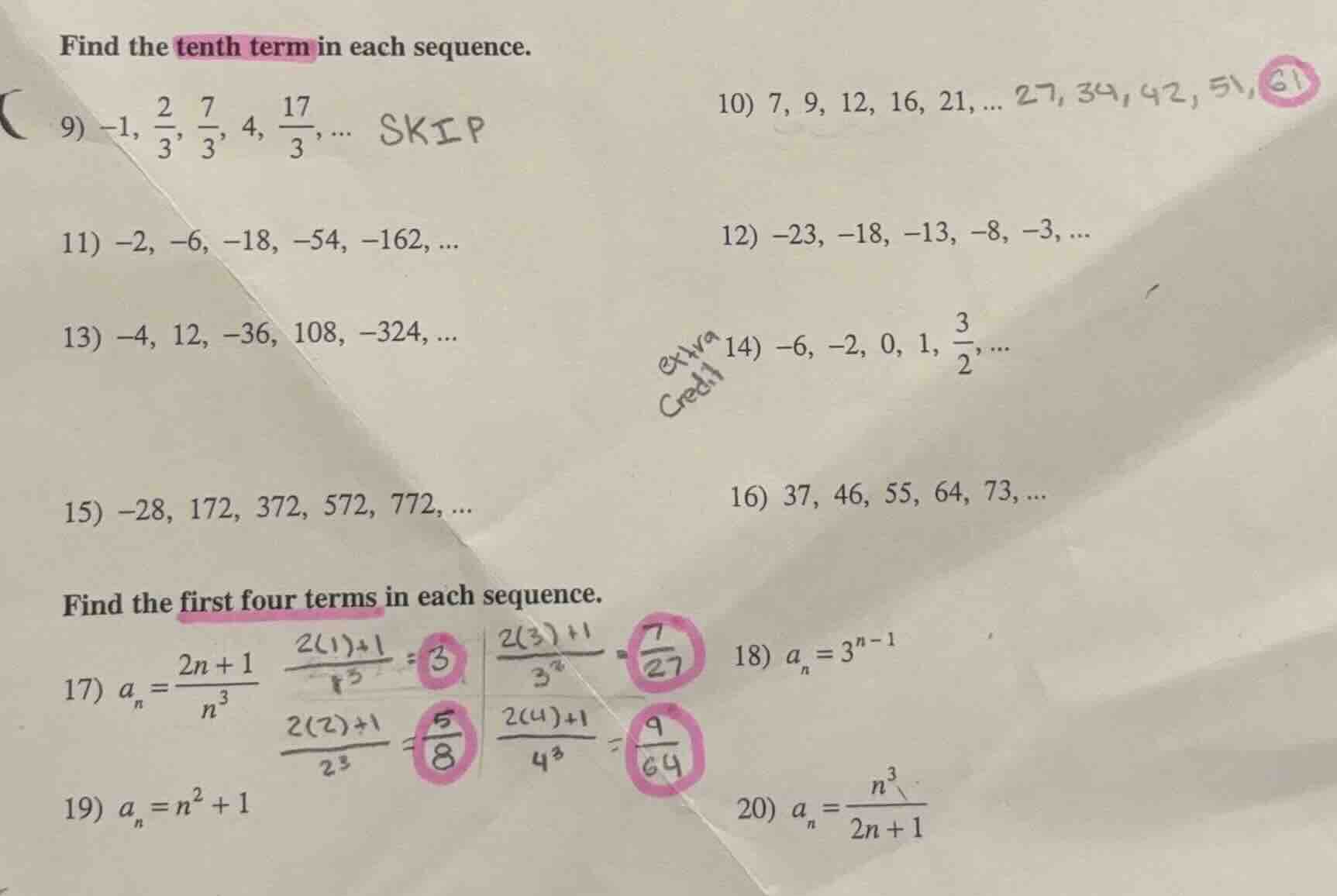
find the tenth term in each sequence.
- $-1, \frac{2}{3}, \frac{7}{3}, 4, \frac{17}{3},...$ skip
- $7, 9, 12, 16, 21,...$
- $-2, -6, -18, -54, -162,...$
- $-23, -18, -13, -8, -3,...$
- $-4, 12, -36, 108, -324,...$
extra credit 14) $-6, -2, 0, 1, \frac{3}{2},...$
- $-28, 172, 372, 572, 772,...$
- $37, 46, 55, 64, 73,...$
find the first four terms in each sequence.
- $a_n = \frac{2n + 1}{n^3}$
- $a_n = 3^{n - 1}$
- $a_n = n^2 + 1$
- $a_n = \frac{n^3}{2n + 1}$
Let's solve some of these sequence problems. Let's start with problem 10: Find the tenth term of the sequence \( 7, 9, 12, 16, 21, \dots \)
Step 1: Identify the pattern (differences between terms)
First, find the differences between consecutive terms:
- \( 9 - 7 = 2 \)
- \( 12 - 9 = 3 \)
- \( 16 - 12 = 4 \)
- \( 21 - 16 = 5 \)
So the differences are increasing by 1 each time: \( 2, 3, 4, 5, \dots \)
Step 2: Find the nth term formula
The nth term of the sequence can be found by summing the initial term and the sum of the differences. The initial term \( a_1 = 7 \). The differences form an arithmetic sequence with first term \( d_1 = 2 \) and common difference \( 1 \).
The sum of the first \( (n - 1) \) differences is the sum of an arithmetic series: \( S_{n-1} = \frac{(n - 1)}{2} \times [2 \times 2 + (n - 2) \times 1] \)
Simplify:
\( S_{n-1} = \frac{(n - 1)}{2} \times (4 + n - 2) = \frac{(n - 1)(n + 2)}{2} \)
Then the nth term \( a_n = 7 + \frac{(n - 1)(n + 2)}{2} \)
Step 3: Calculate the 10th term
Substitute \( n = 10 \) into the formula:
\( a_{10} = 7 + \frac{(10 - 1)(10 + 2)}{2} \)
\( a_{10} = 7 + \frac{9 \times 12}{2} \)
\( a_{10} = 7 + \frac{108}{2} \)
\( a_{10} = 7 + 54 \)
\( a_{10} = 61 \) (Wait, but let's check the handwritten note: 27, 34, 42, 51, 61. Wait, maybe another way. Let's list the terms:
Term 1: 7
Term 2: 7 + 2 = 9
Term 3: 9 + 3 = 12
Term 4: 12 + 4 = 16
Term 5: 16 + 5 = 21
Term 6: 21 + 6 = 27
Term 7: 27 + 7 = 34
Term 8: 34 + 8 = 42
Term 9: 42 + 9 = 51
Term 10: 51 + 10 = 61
Yes, that matches. So the 10th term is 61.
Now problem 11: \( -2, -6, -18, -54, -162, \dots \)
Step 1: Identify the pattern (common ratio)
Check the ratio between consecutive terms:
- \( \frac{-6}{-2} = 3 \)
- \( \frac{-18}{-6} = 3 \)
- \( \frac{-54}{-18} = 3 \)
- \( \frac{-162}{-54} = 3 \)
So it's a geometric sequence with first term \( a_1 = -2 \) and common ratio \( r = 3 \)
Step 2: Geometric sequence formula
The nth term of a geometric sequence is \( a_n = a_1 \times r^{n - 1} \)
Step 3: Calculate the 10th term
Substitute \( n = 10 \), \( a_1 = -2 \), \( r = 3 \):
\( a_{10} = -2 \times 3^{10 - 1} \)
\( a_{10} = -2 \times 3^9 \)
\( 3^9 = 19683 \)
\( a_{10} = -2 \times 19683 = -39366 \)
Problem 12: \( -23, -18, -13, -8, -3, \dots \)
Step 1: Identify the pattern (common difference)
Check the difference between consecutive terms:
- \( -18 - (-23) = 5 \)
- \( -13 - (-18) = 5 \)
- \( -8 - (-13) = 5 \)
- \( -3 - (-8) = 5 \)
So it's an arithmetic sequence with first term \( a_1 = -23 \) and common difference \( d = 5 \)
Step 2: Arithmetic sequence formula
The nth term of an arithmetic sequence is \( a_n = a_1 + (n - 1)d \)
Step 3: Calculate the 10th term
Substitute \( n = 10 \), \( a_1 = -23 \), \( d = 5 \):
\( a_{10} = -23 + (10 - 1) \times 5 \)
\( a_{10} = -23 + 9 \times 5 \)
\( a_{10} = -23 + 45 = 22 \)
Problem 13: \( -4, 12, -36, 108, -324, \dots \)

Snap & solve any problem in the app
Get step-by-step solutions on Sovi AI
Photo-based solutions with guided steps
Explore more problems and detailed explanations
s:
- \( \boldsymbol{61} \)
- \( \boldsymbol{-39366} \)
- \( \boldsymbol{22} \)
- \( \boldsymbol{78732} \)
- \( \boldsymbol{\frac{127}{64}} \) (or 1.984375)
- \( \boldsymbol{1772} \)
- \( \boldsymbol{118} \)
- First four terms: \( \boldsymbol{1, 3, 9, 27} \)
- First four terms: \( \boldsymbol{2, 5, 10, 17} \)
- First four terms: \( \boldsymbol{\frac{1}{3}, \frac{8}{5}, \frac{27}{7}, \frac{64}{9}} \)