QUESTION IMAGE
Question
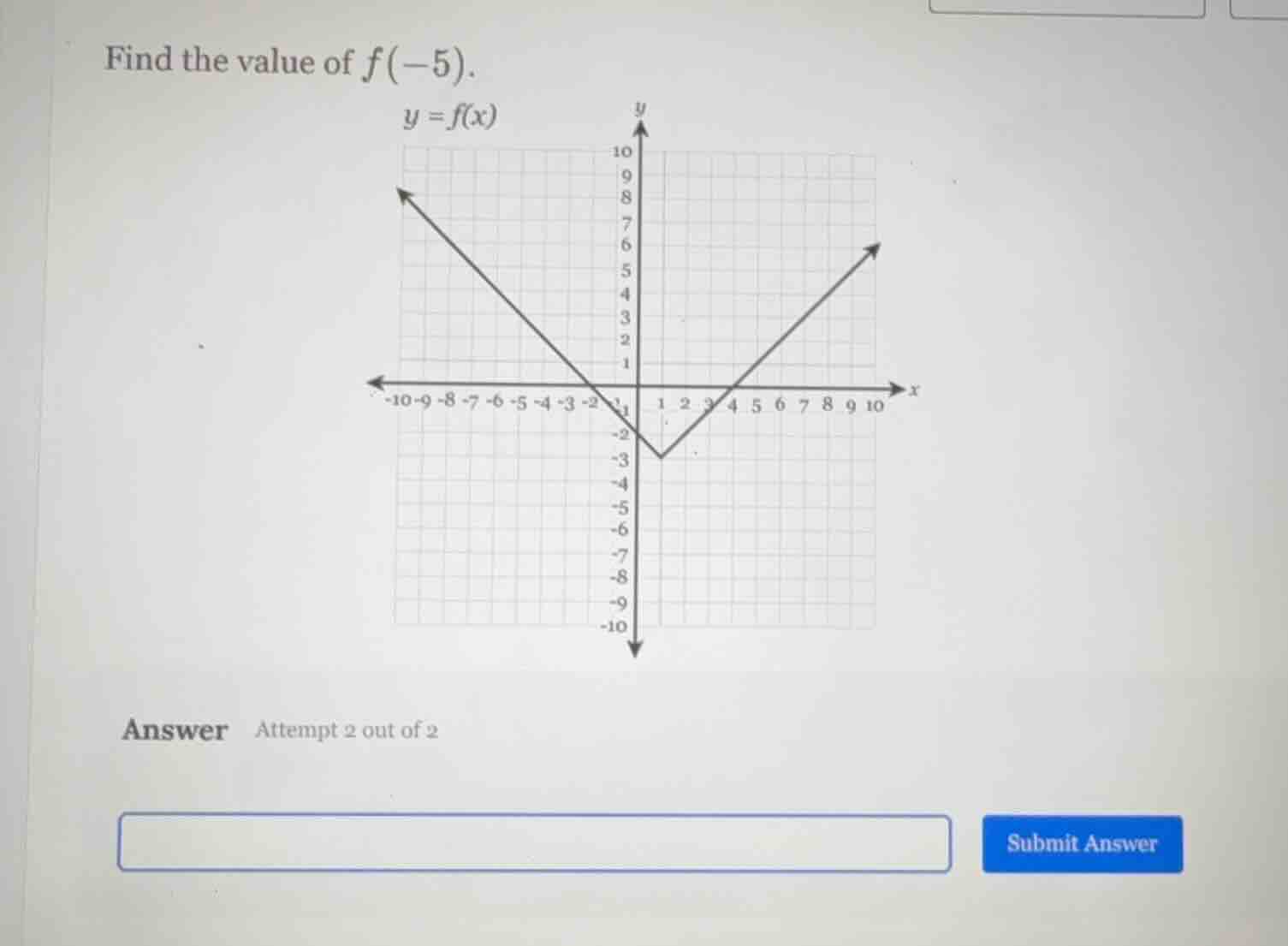
find the value of $f(-5)$.
$y = f(x)$
(there is a graph of the function $y = f(x)$ with a coordinate grid, showing a piece - wise linear function. the x - axis ranges from - 10 to 10 and the y - axis ranges from - 10 to 10. there is also an answer section with attempt 2 out of 2 and a submit answer button.)
Step1: Locate x = -5 on the graph
Find the vertical line corresponding to \( x = -5 \) on the coordinate plane.
Step2: Find the intersection with the function
Determine the point where the vertical line \( x = -5 \) intersects the graph of \( y = f(x) \). From the graph, when \( x = -5 \), we look at the left - hand line segment (the line with a negative slope). By observing the grid, we can see that the y - coordinate at \( x=-5 \) is 2. Wait, no, let's re - examine. Wait, the left - hand line: let's find the equation of the left - hand line. The left - hand line passes through, for example, when \( x=-2 \), \( y = 0 \) (the x - intercept) and when \( x = 0 \), \( y=-3 \)? Wait, no, the vertex of the absolute - value - like graph is at \( (0,-3) \)? Wait, no, looking at the graph, the left - hand line: let's take two points. Let's see, when \( x=-2 \), \( y = 0 \) and when \( x = 0 \), \( y=-3 \)? Wait, no, maybe I made a mistake. Wait, the left - hand line: let's find two points on the left - hand line. Let's see, when \( x=-4 \), what's the y - value? Wait, the graph: the left - hand line goes from the top left towards the vertex. Wait, actually, to find \( f(-5) \), we look at the x - value of - 5. On the graph, the left - hand line (the line with negative slope) at \( x=-5 \): let's count the grid. Each grid square is 1 unit. Let's see, the left - hand line: when \( x=-2 \), \( y = 0 \); when \( x=-3 \), \( y = 1 \); when \( x=-4 \), \( y = 2 \); when \( x=-5 \), \( y = 3 \)? Wait, no, wait, maybe the slope of the left - hand line: let's calculate the slope. The left - hand line passes through \( (-2,0) \) and \( (0, - 3) \)? No, that can't be. Wait, the vertex is at \( (0,-3) \)? Wait, no, looking at the graph, the two lines: the left - hand line and the right - hand line. The right - hand line passes through \( (4,0) \) and \( (8,4) \), so its slope is \( \frac{4 - 0}{8 - 4}=1 \). The left - hand line: let's take two points. Let's see, when \( x=-2 \), \( y = 0 \); when \( x=-6 \), \( y = 4 \)? Wait, no, maybe I should look at the graph again. Wait, the problem is to find \( f(-5) \). Let's look at the x - axis: at \( x=-5 \), we move up to the graph. The left - hand line: from the x - intercept at \( x=-2 \) (where \( y = 0 \)) going left, each unit of x decrease (going to the left) increases y by 1? Wait, when \( x=-3 \), \( y = 1 \); \( x=-4 \), \( y = 2 \); \( x=-5 \), \( y = 3 \)? Wait, no, that doesn't seem right. Wait, maybe the left - hand line has a slope of - 1? Wait, if the left - hand line passes through \( (-2,0) \) and \( (0,-2) \)? No, the vertex is at \( (0,-3) \). Wait, I think I messed up. Let's start over. The graph is a piece - wise linear function. The left - hand part: let's find two points on the left - hand line. Let's see, when \( x=-2 \), \( y = 0 \) (the x - intercept) and when \( x = 0 \), \( y=-3 \)? No, the distance from \( x=-2 \) to \( x = 0 \) is 2 units in x, and from \( y = 0 \) to \( y=-3 \) is 3 units in y, so slope is \( \frac{-3 - 0}{0-(-2)}=-\frac{3}{2} \). But that might be complicated. Alternatively, just look at the graph: at \( x=-5 \), what is the y - value? Let's count the grid. Each square is 1. So, moving to \( x=-5 \) on the x - axis, then moving up to the graph. The left - hand line at \( x=-5 \): let's see, the line on the left: when \( x=-2 \), \( y = 0 \); when \( x=-3 \), \( y = 1 \); \( x=-4 \), \( y = 2 \); \( x=-5 \), \( y = 3 \)? Wait, no, maybe I had it wrong. Wait, the correct way: the left - hand line (the line with negative slope) at \( x=-5 \): let's see, the…

Snap & solve any problem in the app
Get step-by-step solutions on Sovi AI
Photo-based solutions with guided steps
Explore more problems and detailed explanations
\( 3 \)