QUESTION IMAGE
Question
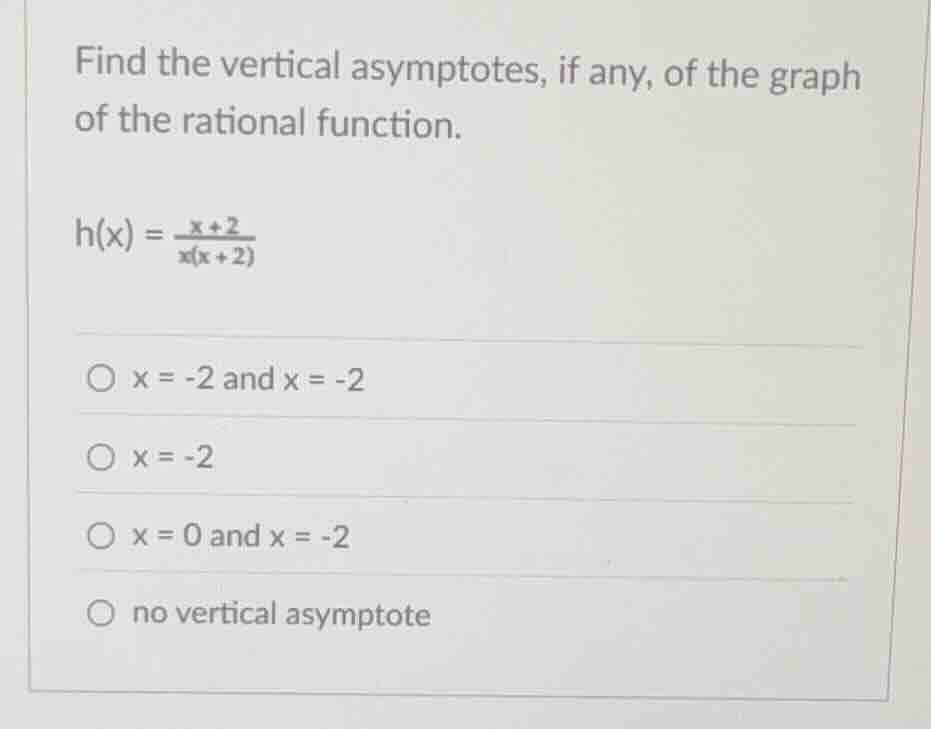
find the vertical asymptotes, if any, of the graph of the rational function.\\(h(x) = \frac{x + 2}{x(x + 2)}\\)\\(\bigcirc\\) \\(x = -2\\) and \\(x = -2\\)\\(\bigcirc\\) \\(x = -2\\)\\(\bigcirc\\) \\(x = 0\\) and \\(x = -2\\)\\(\bigcirc\\) no vertical asymptote
Step1: Simplify the rational function
First, cancel out the common factor $(x+2)$ (note $x
eq -2$ to avoid division by zero):
$h(x) = \frac{x+2}{x(x+2)} = \frac{1}{x}, \quad x
eq -2$
Step2: Find vertical asymptotes
Vertical asymptotes occur where the denominator is 0 (after simplifying, and the numerator is not 0 at that point). Set denominator equal to 0:
$x = 0$
The value $x=-2$ is a hole, not a vertical asymptote, since the factor canceled out.

Snap & solve any problem in the app
Get step-by-step solutions on Sovi AI
Photo-based solutions with guided steps
Explore more problems and detailed explanations
None of the provided options match the correct result. The correct vertical asymptote is $x=0$.
Note: If forced to select from the given options, there is no correct choice. The option "x = 0 and x = -2" is incorrect because $x=-2$ is a removable discontinuity (hole), not a vertical asymptote.