QUESTION IMAGE
Question
finding the sum of rational expressions with common denominators
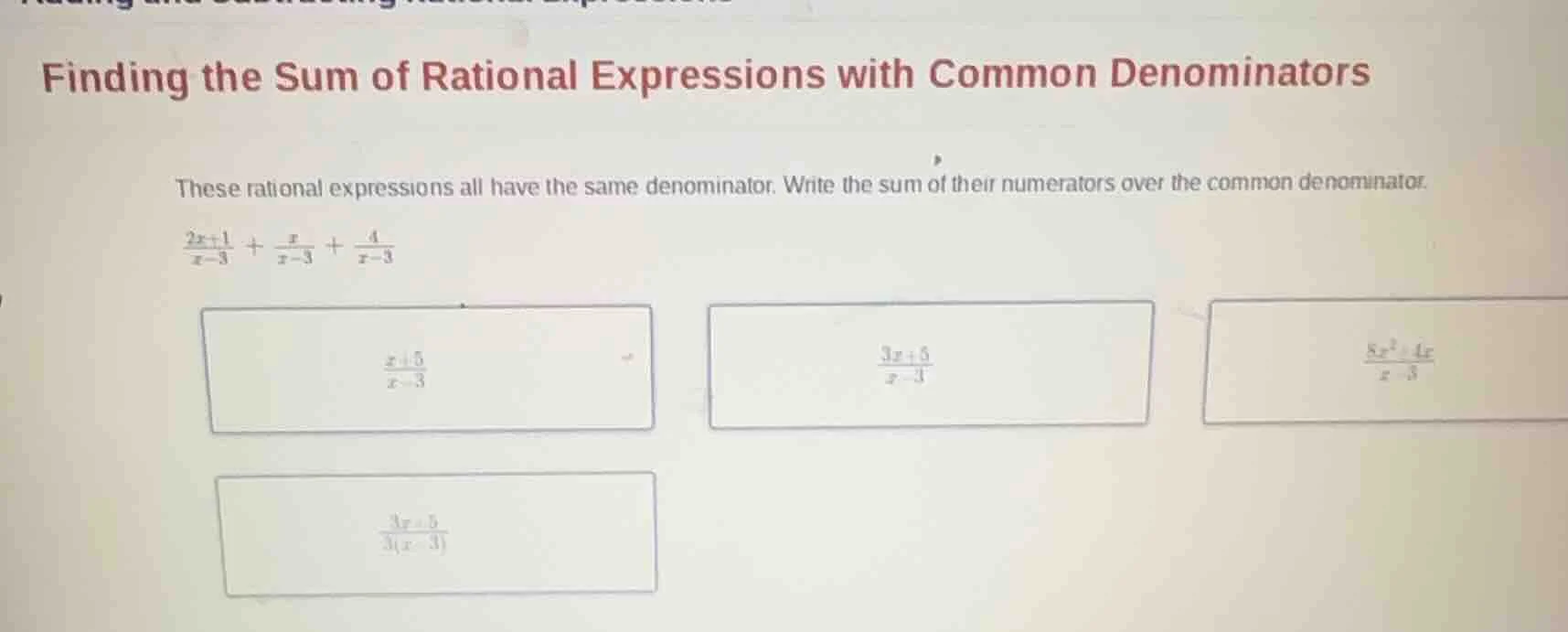
these rational expressions all have the same denominator. write the sum of their numerators over the common denominator.
\\(\frac{2x + 1}{x - 3} + \frac{x}{x - 3} + \frac{4}{x - 3}\\)
options:
\\(\frac{x + 5}{x - 3}\\)
\\(\frac{3x + 5}{x - 3}\\)
\\(\frac{8x^2 + 4x}{x - 3}\\)
\\(\frac{3x + 5}{3(x - 3)}\\)
Step1: Identify the rule for adding rational expressions with common denominators
When adding rational expressions with the same denominator, we use the rule: \(\frac{a}{c}+\frac{b}{c}+\frac{d}{c}=\frac{a + b + d}{c}\). Here, the common denominator is \(x - 3\), and the numerators are \(2x+1\), \(x\), and \(4\).
Step2: Add the numerators
Add the numerators together: \((2x + 1)+x + 4\). Combine like terms: \(2x+x=3x\) and \(1 + 4=5\). So the sum of the numerators is \(3x+5\).
Step3: Write the sum over the common denominator
Using the rule from Step 1, we write the sum of the numerators over the common denominator \(x - 3\). So the result is \(\frac{3x + 5}{x - 3}\).

Snap & solve any problem in the app
Get step-by-step solutions on Sovi AI
Photo-based solutions with guided steps
Explore more problems and detailed explanations
\(\frac{3x + 5}{x - 3}\) (corresponding to the option with this expression)