QUESTION IMAGE
Question
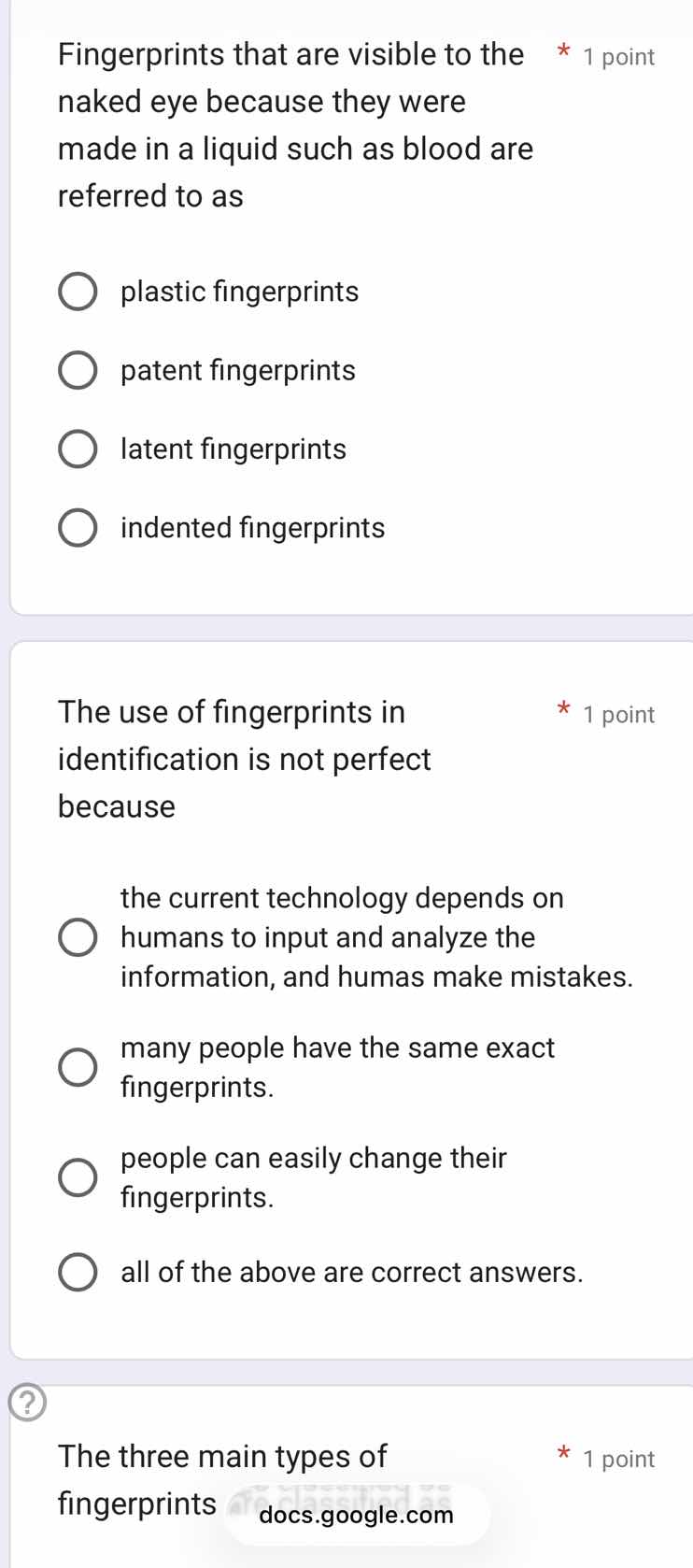
fingerprints that are visible to the naked eye because they were made in a liquid such as blood are referred to as
plastic fingerprints
patent fingerprints
latent fingerprints
indented fingerprints
the use of fingerprints in identification is not perfect because
the current technology depends on humans to input and analyze the information, and humas make mistakes.
many people have the same exact fingerprints.
people can easily change their fingerprints.
all of the above are correct answers.
the three main types of fingerprints docs.google.com
Brief Explanations
- For the first question: Patent fingerprints are defined as visible prints left in a substance like blood, ink, or grease that can be seen with the naked eye. Plastic fingerprints are impressed into soft material, latent fingerprints are invisible to the naked eye, and indented fingerprints are not a standard classification term for this context.
- For the second question: Fingerprint identification relies on human analysts to input and examine fingerprint data, and human error is a known limitation. Fingerprints are unique to each individual, so no two people have identical fingerprints, and it is extremely difficult to intentionally change one's fingerprints permanently.
- For the third question, the prompt is incomplete, but the three main standard types of fingerprints are patent (visible), latent (invisible), and plastic (impressed into soft surfaces).

Snap & solve any problem in the app
Get step-by-step solutions on Sovi AI
Photo-based solutions with guided steps
Explore more problems and detailed explanations
- B. patent fingerprints
- A. the current technology depends on humans to input and analyze the information, and humans make mistakes.
- (Note: The third question is incomplete. The standard three main types of fingerprints are patent fingerprints, latent fingerprints, and plastic fingerprints.)