QUESTION IMAGE
Question
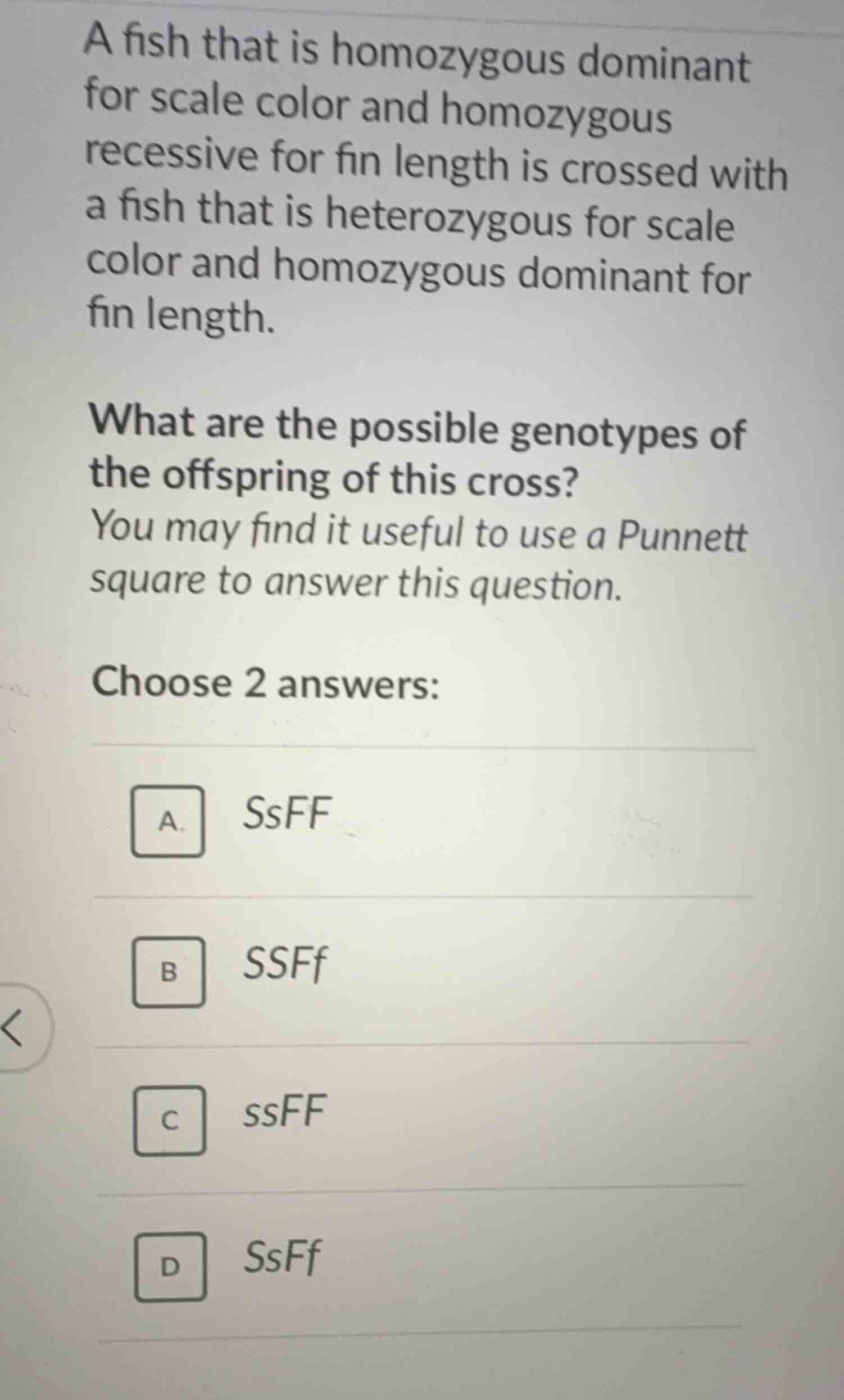
a fish that is homozygous dominant for scale color and homozygous recessive for fin length is crossed with a fish that is heterozygous for scale color and homozygous dominant for fin length. what are the possible genotypes of the offspring of this cross? you may find it useful to use a punnett square to answer this question. choose 2 answers: a. ssff b ssff c ssff d ssff
Step1: Define Genotypes of Parents
Let's assume:
- For scale color: Dominant allele = \( S \), Recessive allele = \( s \)
- For fin length: Dominant allele = \( F \), Recessive allele = \( f \)
First parent: Homozygous dominant (scale color) = \( SS \); Homozygous recessive (fin length) = \( ff \). So genotype: \( SSff \)
Second parent: Heterozygous (scale color) = \( Ss \); Homozygous dominant (fin length) = \( FF \). So genotype: \( SsFF \)
Step2: Determine Gametes
First parent (\( SSff \)) can produce gametes: \( S f \) (only one type since \( SS \) gives \( S \) and \( ff \) gives \( f \))
Second parent (\( SsFF \)) can produce gametes: \( S F \) and \( s F \) (from \( Ss \) → \( S \) or \( s \); from \( FF \) → \( F \))
Step3: Perform Punnett Square
| \( S F \) | \( s F \) |
|---|
Wait, wait, maybe I made a mistake. Wait, first parent: \( SSff \) (gametes: \( S f \) only). Second parent: \( SsFF \) (gametes: \( S F \) and \( s F \))
So cross \( S f \) with \( S F \): \( SS Ff \)
Cross \( S f \) with \( s F \): \( Ss Ff \)
Wait, but the options are A: \( SsFF \), B: \( SSFf \), C: \( ssFF \), D: \( SsFf \)
Wait, maybe I assigned the alleles wrong. Let's re - assign: Maybe scale color: let's say first parent is \( SS \) (homozygous dominant) for scale, \( ff \) (homozygous recessive) for fin. Second parent: \( Ss \) (heterozygous) for scale, \( FF \) (homozygous dominant) for fin.
Wait, maybe the fin length: first parent is \( ff \) (recessive), second is \( FF \) (dominant). Scale color: first \( SS \) (dominant), second \( Ss \) (heterozygous).
Wait, maybe I mixed up the fin length alleles. Let's re - do gametes:
First parent: \( SSff \) → gametes: \( S f \) (all gametes have \( S \) from \( SS \) and \( f \) from \( ff \))
Second parent: \( SsFF \) → gametes: \( S F \) (from \( S \) and \( F \)) and \( s F \) (from \( s \) and \( F \))
Now, when we cross:
- \( S f \) (first parent) × \( S F \) (second parent) → \( SS Ff \) (genotype: \( SSFf \))
- \( S f \) (first parent) × \( s F \) (second parent) → \( Ss Ff \) (genotype: \( SsFf \))
Now check the options:
Option B: \( SSFf \) – valid (from the cross)
Option D: \( SsFf \) – valid (from the cross)
Wait, but the original options: A: \( SsFF \), B: \( SSFf \), C: \( ssFF \), D: \( SsFf \)
So the possible genotypes are \( SSFf \) (option B) and \( SsFf \) (option D)
Wait, but maybe I had the fin length and scale color reversed. Let's try another approach. Let's assume scale color: \( S \) (dominant), \( s \) (recessive); fin length: \( F \) (dominant), \( f \) (recessive).
First fish: homozygous dominant for scale (\( SS \)), homozygous recessive for fin (\( ff \)) → \( SSff \)
Second fish: heterozygous for scale (\( Ss \)), homozygous dominant for fin (\( FF \)) → \( SsFF \)
Gametes of first fish: \( S f \) (only)
Gametes of second fish: \( S F \), \( s F \)
Now, when we combine:
- \( S f \) and \( S F \): \( SS Ff \) (option B)
- \( S f \) and \( s F \): \( Ss Ff \) (option D)
So the two possible genotypes are \( SSFf \) (option B) and \( SsFf \) (option D)

Snap & solve any problem in the app
Get step-by-step solutions on Sovi AI
Photo-based solutions with guided steps
Explore more problems and detailed explanations
B. \( SSFf \), D. \( SsFf \)