QUESTION IMAGE
Question
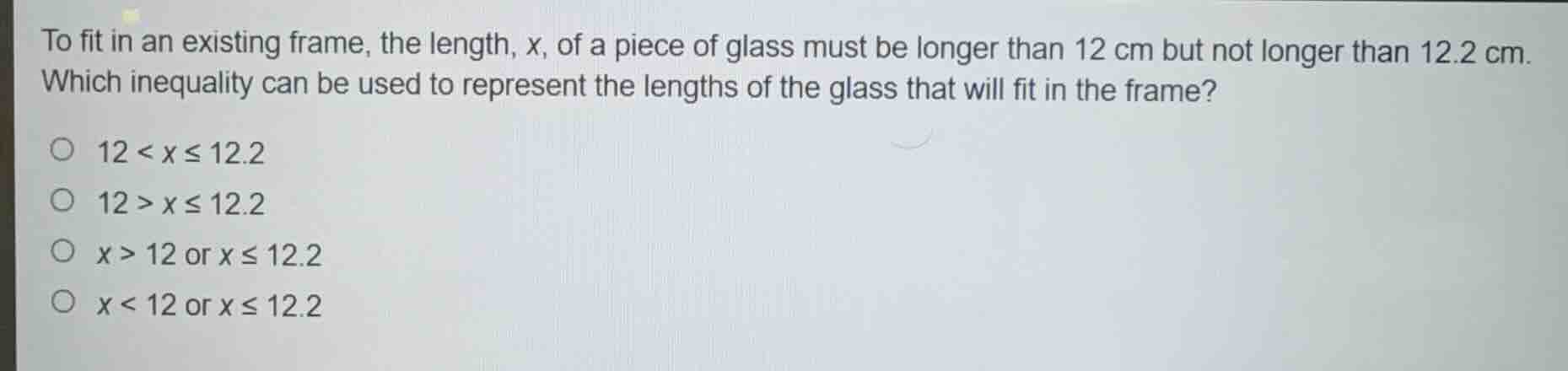
to fit in an existing frame, the length, x, of a piece of glass must be longer than 12 cm but not longer than 12.2 cm. which inequality can be used to represent the lengths of the glass that will fit in the frame?\
\\( 12 < x \leq 12.2 \\)\
\\( 12 > x \leq 12.2 \\)\
\\( x > 12 \\) or \\( x \leq 12.2 \\)\
\\( x < 12 \\) or \\( x \leq 12.2 \\)
Step1: Analyze "longer than 12 cm"
"Longer than 12 cm" means \( x > 12 \) (since \( x \) can't be equal to 12, we use the strict inequality \( > \)).
Step2: Analyze "not longer than 12.2 cm"
"Not longer than 12.2 cm" means \( x \leq 12.2 \) ( \( x \) can be equal to 12.2, so we use the non - strict inequality \( \leq \)).
Step3: Combine the two conditions
We need to find the values of \( x \) that satisfy both conditions simultaneously. So we combine \( x > 12 \) and \( x \leq 12.2 \) into a compound inequality \( 12 < x \leq 12.2 \).
Let's analyze the other options:
- Option \( 12>x\leq12.2 \): This would mean \( x \) is less than 12 and at most 12.2, which is the opposite of what we need.
- Option \( x > 12 \) or \( x\leq12.2 \): The "or" here means values that are either greater than 12 or less than or equal to 12.2, which includes all real numbers (since any number is either greater than 12 or less than or equal to 12.2), and this is not the correct range.
- Option \( x < 12 \) or \( x\leq12.2 \): This includes all numbers less than or equal to 12.2, which is not the correct range.

Snap & solve any problem in the app
Get step-by-step solutions on Sovi AI
Photo-based solutions with guided steps
Explore more problems and detailed explanations
A. \( 12 < x \leq 12.2 \)