QUESTION IMAGE
Question
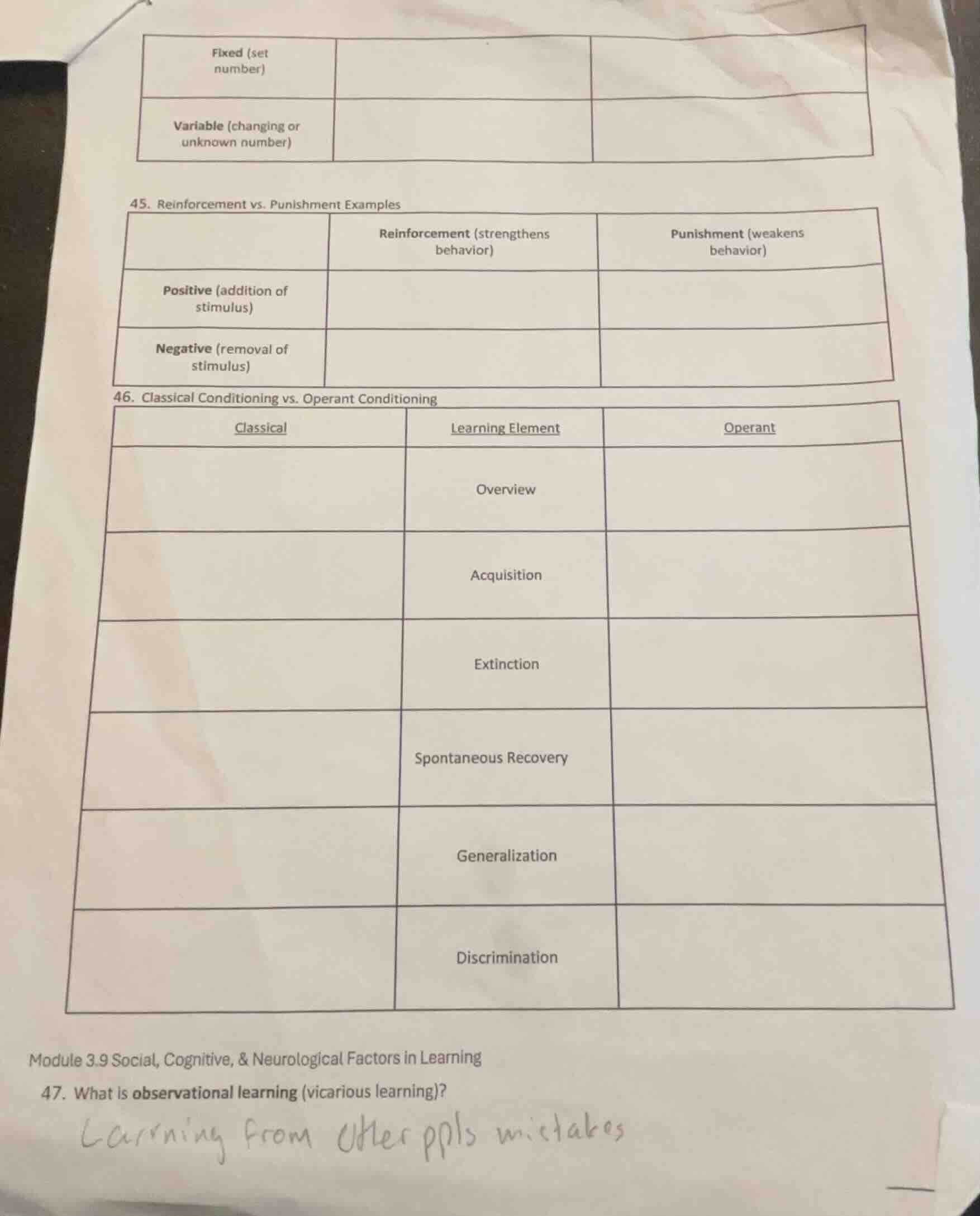
fixed (set number)
variable (changing or unknown number)
- reinforcement vs. punishment examples
\t\t\treinforcement (strengthens behavior)\t\t\tpunishment (weakens behavior)
positive (addition of stimulus)
negative (removal of stimulus)
- classical conditioning vs. operant conditioning
\t\t\tclassical\t\t\tlearning element\t\t\toperant
\t\t\t\t\t\toverview
\t\t\t\t\t\tacquisition
\t\t\t\t\t\textinction
\t\t\t\t\t\tspontaneous recovery
\t\t\t\t\t\tgeneralization
\t\t\t\t\t\tdiscrimination
module 3.9 social, cognitive, & neurological factors in learning
- what is observational learning (vicarious learning)?
learning from other ppls mistakes
Question 45: Reinforcement vs. Punishment Examples
Positive Reinforcement (strengthens behavior - addition of stimulus)
- Example: A child gets a sticker (stimulus added) for completing their homework. This makes them more likely to do homework in the future.
- Example: An employee receives a bonus (stimulus added) for meeting sales targets, increasing the chance they'll meet targets again.
Positive Punishment (weakens behavior - addition of stimulus)
- Example: A student gets detention (stimulus added) for skipping class. This makes them less likely to skip class.
- Example: A driver gets a ticket (stimulus added) for speeding, reducing the likelihood of speeding.
Negative Reinforcement (strengthens behavior - removal of stimulus)
- Example: A person takes a painkiller to remove a headache (stimulus removed). They'll be more likely to take a painkiller next time they have a headache.
- Example: A dog stops barking to have its muzzle removed (stimulus removed), so it learns to stop barking to avoid the muzzle.
Negative Punishment (weakens behavior - removal of stimulus)
- Example: A teenager loses phone privileges (stimulus removed) for breaking curfew, making them less likely to break curfew.
- Example: A child has their favorite toy taken away (stimulus removed) for misbehaving, reducing misbehavior.
Question 46: Classical Conditioning vs. Operant Conditioning
Overview
- Classical Conditioning: Learning through association, where a neutral stimulus becomes associated with a meaningful stimulus to produce a response (e.g., Pavlov's dogs salivating at the sound of a bell after it was paired with food).
- Operant Conditioning: Learning through consequences (rewards or punishments) of behavior, where behavior is strengthened or weakened by its outcomes (e.g., a rat pressing a lever to get food).
Acquisition
- Classical Conditioning: The process of learning the association between the neutral stimulus and the unconditioned stimulus. For example, a dog starts to salivate at the bell after several pairings with food.
- Operant Conditioning: The process of learning a new behavior through trial and error, where the behavior is strengthened by reinforcement or weakened by punishment. For example, a rat learns to press a lever to get food through repeated attempts.
Extinction
- Classical Conditioning: The disappearance of the conditioned response when the conditioned stimulus is presented without the unconditioned stimulus. For example, the dog stops salivating at the bell if the bell is repeatedly rung without food.
- Operant Conditioning: The disappearance of a learned behavior when it is no longer reinforced. For example, a rat stops pressing a lever if it no longer receives food for doing so.
Spontaneous Recovery
- Classical Conditioning: The reappearance of the conditioned response after a period of extinction, without further conditioning. For example, the dog might start salivating at the bell again after a break, even if it wasn't paired with food recently.
- Operant Conditioning: The reappearance of a previously extinguished behavior after a rest period, often in the presence of cues associated with the original reinforcement. For example, a rat might start pressing the lever again after a break, especially if it's in the same environment where it was reinforced before.
Generalization
- Classical Conditioning: The tendency to respond to stimuli similar to the conditioned stimulus. For example, a dog conditioned to salivate at a specific b…

Snap & solve any problem in the app
Get step-by-step solutions on Sovi AI
Photo-based solutions with guided steps
Explore more problems and detailed explanations
Question 45: Reinforcement vs. Punishment Examples
Positive Reinforcement (strengthens behavior - addition of stimulus)
- Example: A child gets a sticker (stimulus added) for completing their homework. This makes them more likely to do homework in the future.
- Example: An employee receives a bonus (stimulus added) for meeting sales targets, increasing the chance they'll meet targets again.
Positive Punishment (weakens behavior - addition of stimulus)
- Example: A student gets detention (stimulus added) for skipping class. This makes them less likely to skip class.
- Example: A driver gets a ticket (stimulus added) for speeding, reducing the likelihood of speeding.
Negative Reinforcement (strengthens behavior - removal of stimulus)
- Example: A person takes a painkiller to remove a headache (stimulus removed). They'll be more likely to take a painkiller next time they have a headache.
- Example: A dog stops barking to have its muzzle removed (stimulus removed), so it learns to stop barking to avoid the muzzle.
Negative Punishment (weakens behavior - removal of stimulus)
- Example: A teenager loses phone privileges (stimulus removed) for breaking curfew, making them less likely to break curfew.
- Example: A child has their favorite toy taken away (stimulus removed) for misbehaving, reducing misbehavior.
Question 46: Classical Conditioning vs. Operant Conditioning
Overview
- Classical Conditioning: Learning through association, where a neutral stimulus becomes associated with a meaningful stimulus to produce a response (e.g., Pavlov's dogs salivating at the sound of a bell after it was paired with food).
- Operant Conditioning: Learning through consequences (rewards or punishments) of behavior, where behavior is strengthened or weakened by its outcomes (e.g., a rat pressing a lever to get food).
Acquisition
- Classical Conditioning: The process of learning the association between the neutral stimulus and the unconditioned stimulus. For example, a dog starts to salivate at the bell after several pairings with food.
- Operant Conditioning: The process of learning a new behavior through trial and error, where the behavior is strengthened by reinforcement or weakened by punishment. For example, a rat learns to press a lever to get food through repeated attempts.
Extinction
- Classical Conditioning: The disappearance of the conditioned response when the conditioned stimulus is presented without the unconditioned stimulus. For example, the dog stops salivating at the bell if the bell is repeatedly rung without food.
- Operant Conditioning: The disappearance of a learned behavior when it is no longer reinforced. For example, a rat stops pressing a lever if it no longer receives food for doing so.
Spontaneous Recovery
- Classical Conditioning: The reappearance of the conditioned response after a period of extinction, without further conditioning. For example, the dog might start salivating at the bell again after a break, even if it wasn't paired with food recently.
- Operant Conditioning: The reappearance of a previously extinguished behavior after a rest period, often in the presence of cues associated with the original reinforcement. For example, a rat might start pressing the lever again after a break, especially if it's in the same environment where it was reinforced before.
Generalization
- Classical Conditioning: The tendency to respond to stimuli similar to the conditioned stimulus. For example, a dog conditioned to salivate at a specific bell might also salivate at a similar - sounding bell.
- Operant Conditioning: The tendency to perform a behavior in similar situations or environments. For example, a rat that learned to press a lever for food in one cage might press a similar lever in a different cage.
Discrimination
- Classical Conditioning: The ability to distinguish between the conditioned stimulus and other similar stimuli. For example, a dog learns to salivate only at a specific bell and not at other similar - sounding bells.
- Operant Conditioning: The ability to perform a behavior only in the appropriate situation or environment. For example, a rat learns to press a lever only when a green light is on (and not when a red light is on) to get food.
Question 47: What is observational learning (vicarious learning)?
Observational learning, also known as vicarious learning, is a type of learning that occurs through observing the behavior of others (models), as well as the consequences of their behavior. It involves four key processes: attention (paying attention to the model's behavior), retention (remembering the behavior), reproduction (being able to perform the behavior), and motivation (having a reason to perform the behavior). For example, a child learns to play a game by watching their friends play, or a person learns to cook a new recipe by watching a cooking show. The initial answer "Learning from other ppls mistakes" is a partial view - observational learning can also involve learning from others' successes (e.g., learning a new dance move by watching a skilled dancer) as well as their mistakes.