QUESTION IMAGE
Question
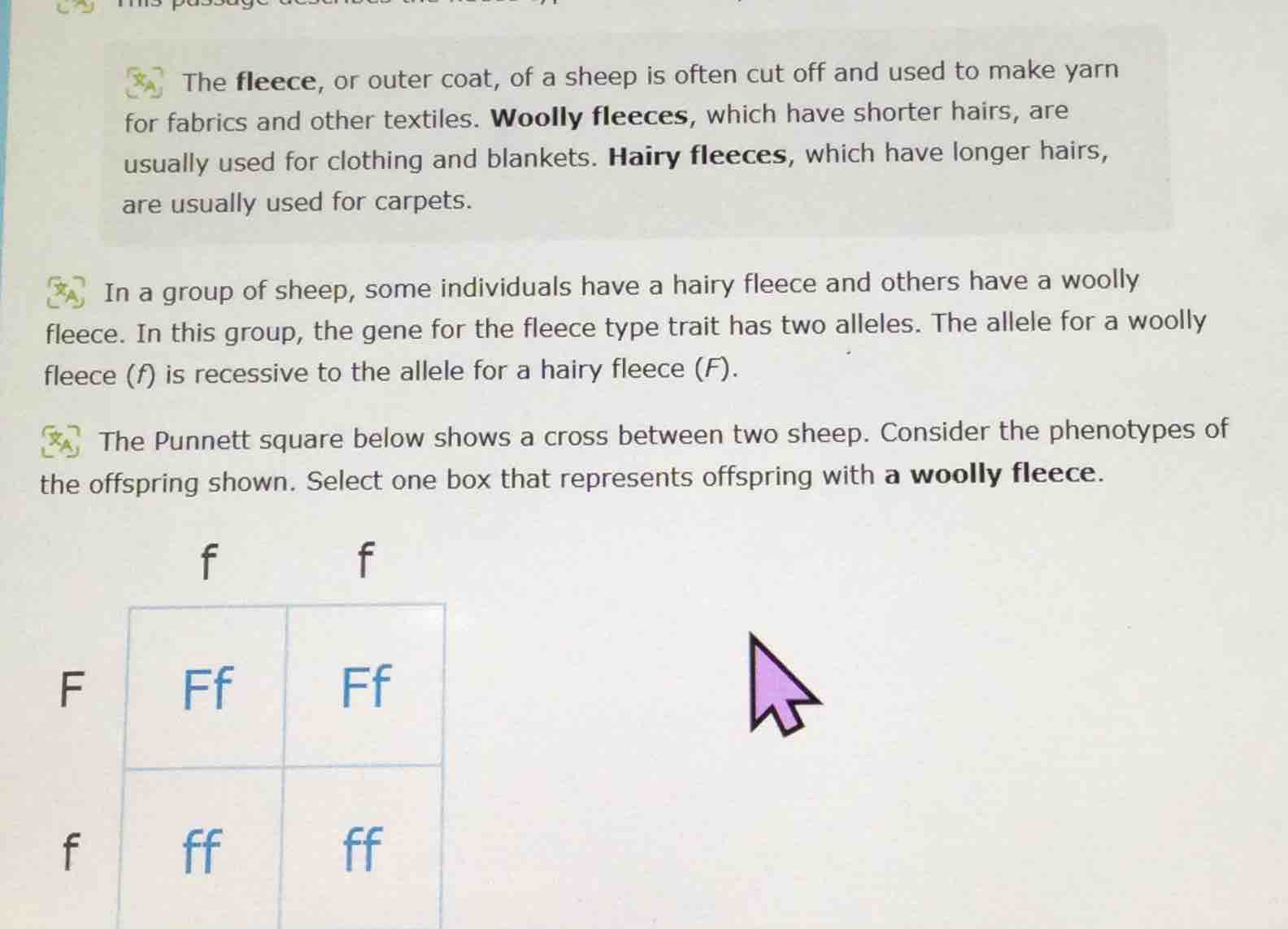
the fleece, or outer coat, of a sheep is often cut off and used to make yarn for fabrics and other textiles. woolly fleeces, which have shorter hairs, are usually used for clothing and blankets. hairy fleeces, which have longer hairs, are usually used for carpets. in a group of sheep, some individuals have a hairy fleece and others have a woolly fleece. in this group, the gene for the fleece type trait has two alleles. the allele for a woolly fleece (f) is recessive to the allele for a hairy fleece (f). the punnett square below shows a cross between two sheep. consider the phenotypes of the offspring shown. select one box that represents offspring with a woolly fleece. punnett square with columns f, f and rows f, f; cells: ff, ff, ff, ff
Step1: Recuerda la herencia de alelos
El alelo para pelaje lanoso (\( f \)) es recesivo, así que el fenotipo lanoso se expresa solo cuando el genotipo es \( ff \) (homozygoto recesivo). Los genotipos \( Ff \) tienen alelo dominante (\( F \)) y muestran pelaje peludo.
Step2: Identifica el genotipo lanoso en el cuadrado de Punnett
En el cuadrado de Punnett dado, los cuadrados con genotipo \( ff \) (la tercera y cuarta casillas, o la segunda fila, primera y segunda columnas) representan offspring con pelaje lanoso, ya que tienen dos alelos recesivos (\( f \)).

Snap & solve any problem in the app
Get step-by-step solutions on Sovi AI
Photo-based solutions with guided steps
Explore more problems and detailed explanations
Las casillas con genotipo \( \boldsymbol{ff} \) (por ejemplo, la casilla con \( ff \) en la segunda fila, primera columna o la segunda fila, segunda columna del cuadrado de Punnett) representan offspring con pelaje lanoso.