QUESTION IMAGE
Question
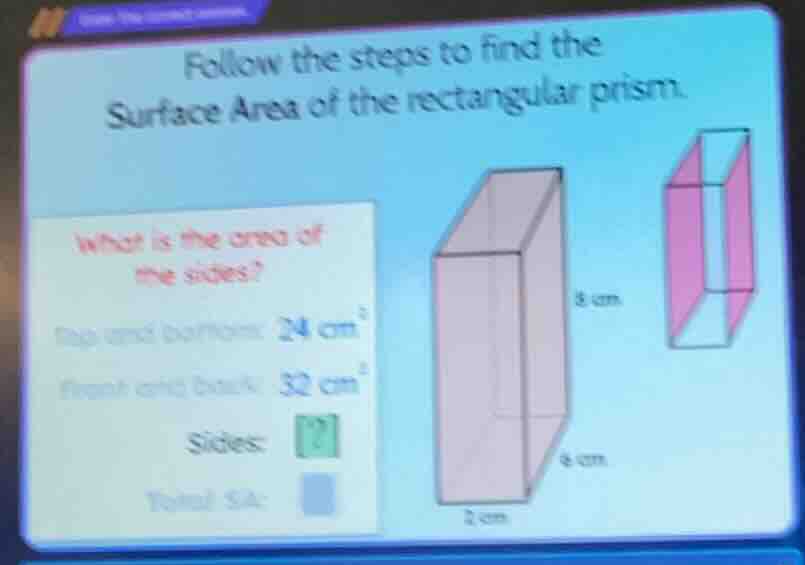
follow the steps to find the surface area of the rectangular prism. what is the area of the sides? top and bottom: 24 cm² front and back: 32 cm² sides:? total sa: 8 cm 4 cm 2 cm
Step1: Identify the dimensions
The rectangular prism has length \( l = 4 \, \text{cm} \), width \( w = 2 \, \text{cm} \), and height \( h = 8 \, \text{cm} \). The sides (left and right faces) are rectangles with dimensions width and height, i.e., \( w = 2 \, \text{cm} \) and \( h = 8 \, \text{cm} \)? Wait, no, wait. Wait, the top and bottom area is \( 24 \, \text{cm}^2 \), let's check: top and bottom are length times width. If length is \( 4 \) and width is \( 2 \), \( 4\times2 = 8 \), no. Wait, maybe length is \( 6 \)? Wait, no, the diagram shows length \( 4 \, \text{cm} \), width \( 2 \, \text{cm} \), height \( 8 \, \text{cm} \)? Wait, no, the front and back area is \( 32 \, \text{cm}^2 \). Front and back are length times height. If front area is \( 32 \), and height is \( 8 \), then length is \( 32\div8 = 4 \, \text{cm} \). Top and bottom area is \( 24 \, \text{cm}^2 \), top and bottom are length times width, so \( 4\times w = 24 \)? No, \( 24\div4 = 6 \), so width is \( 6 \)? Wait, maybe I misread the diagram. Wait, the sides (left and right) are width times height. Wait, let's use the formula for the area of the sides (lateral faces: left and right). The formula for the area of the sides (left and right) of a rectangular prism is \( 2\times(\text{width}\times\text{height}) \)? Wait, no, the three pairs of faces: top/bottom (length×width), front/back (length×height), left/right (width×height). We know top/bottom area is \( 24 \, \text{cm}^2 \), front/back is \( 32 \, \text{cm}^2 \). Let's denote:
Let length \( l \), width \( w \), height \( h \).
Top/bottom area: \( 2(lw) = 24 \) ⇒ \( lw = 12 \).
Front/back area: \( 2(lh) = 32 \) ⇒ \( lh = 16 \).
We need to find the area of the sides (left/right), which is \( 2(wh) \).
From \( lw = 12 \) and \( lh = 16 \), divide the two equations: \( \frac{lh}{lw} = \frac{16}{12} \) ⇒ \( \frac{h}{w} = \frac{4}{3} \) ⇒ \( h = \frac{4}{3}w \).
But maybe easier: let's find \( w \) and \( h \). From \( lw = 12 \) and \( lh = 16 \), let's assume \( l = 4 \) (from front area: \( 4\times h = 16 \) ⇒ \( h = 4 \)? No, front area is \( 32 \), so \( l\times h = 16 \)? Wait, no, the front and back area is \( 32 \, \text{cm}^2 \), so each front face is \( 16 \, \text{cm}^2 \). So \( l\times h = 16 \). Top and bottom area is \( 24 \, \text{cm}^2 \), so each top face is \( 12 \, \text{cm}^2 \), so \( l\times w = 12 \). Then, if we divide \( lh \) by \( lw \), we get \( h/w = 16/12 = 4/3 \), so \( h = (4/3)w \). But maybe the dimensions are \( l = 4 \), \( w = 3 \), \( h = 4 \)? No, that doesn't make sense. Wait, maybe the diagram has length \( 4 \), width \( 3 \), height \( 8 \)? No, front area is \( 32 \), so \( 4\times8 = 32 \), yes! So length \( l = 4 \), height \( h = 8 \), so front area is \( 4\times8 = 32 \), which matches. Then top and bottom area: \( l\times w = 24 \), so \( 4\times w = 24 \) ⇒ \( w = 6 \)? Wait, no, \( 4\times6 = 24 \), yes. So length \( l = 4 \), width \( w = 6 \), height \( h = 8 \)? But the diagram shows width as \( 2 \)? Wait, maybe I misread the diagram. Wait, the diagram has a prism with length \( 4 \, \text{cm} \), width \( 2 \, \text{cm} \), height \( 8 \, \text{cm} \)? No, the numbers on the diagram: 4 cm (length), 2 cm (width), 8 cm (height). Wait, top and bottom area: length×width = 4×2 = 8, but it's given as 24. So maybe the length is 6, width 4, height 8? No, front area is 32, 8×4=32, yes. Then top and bottom area: 6×4=24, yes! So length \( l = 6 \), width \( w = 4 \), height \( h = 8 \)? No, the diagram shows 4 cm, 2 cm, 8 cm. Wait, maybe the diagram has length…

Snap & solve any problem in the app
Get step-by-step solutions on Sovi AI
Photo-based solutions with guided steps
Explore more problems and detailed explanations
The area of the sides is \( \boldsymbol{24 \, \text{cm}^2} \) and the total surface area is \( \boldsymbol{80 \, \text{cm}^2} \).