QUESTION IMAGE
Question
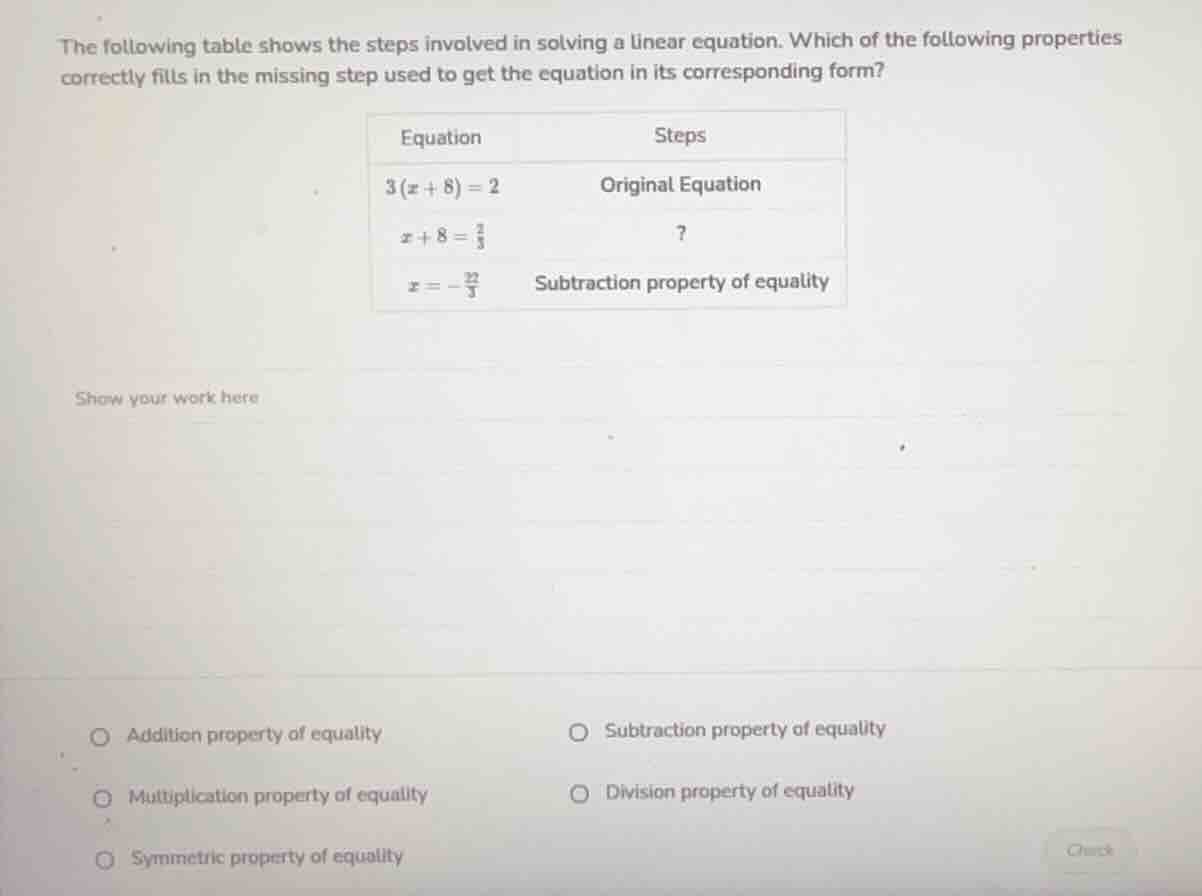
the following table shows the steps involved in solving a linear equation. which of the following properties correctly fills in the missing step used to get the equation in its corresponding form?
| equation | steps |
|---|---|
| $x + 8 = \frac{2}{3}$ | ? |
| $x = -\frac{22}{3}$ | subtraction property of equality |
show your work here
\\(\bigcirc\\) addition property of equality \\(\bigcirc\\) subtraction property of equality
\\(\bigcirc\\) multiplication property of equality \\(\bigcirc\\) division property of equality
\\(\bigcirc\\) symmetric property of equality
Step1: Recall properties of equality
The original equation is \(3(x + 8)=2\). To get to \(x + 8=\frac{2}{3}\), we need to perform an operation on both sides of the equation.
Step2: Identify the operation
We divide both sides of the equation \(3(x + 8)=2\) by 3. By the division property of equality, if \(a = b\), then \(\frac{a}{c}=\frac{b}{c}\) (where \(c
eq0\)). Here, \(a = 3(x + 8)\), \(b = 2\), and \(c = 3\). So dividing both sides by 3 gives \(x + 8=\frac{2}{3}\).

Snap & solve any problem in the app
Get step-by-step solutions on Sovi AI
Photo-based solutions with guided steps
Explore more problems and detailed explanations
Division property of equality