QUESTION IMAGE
Question
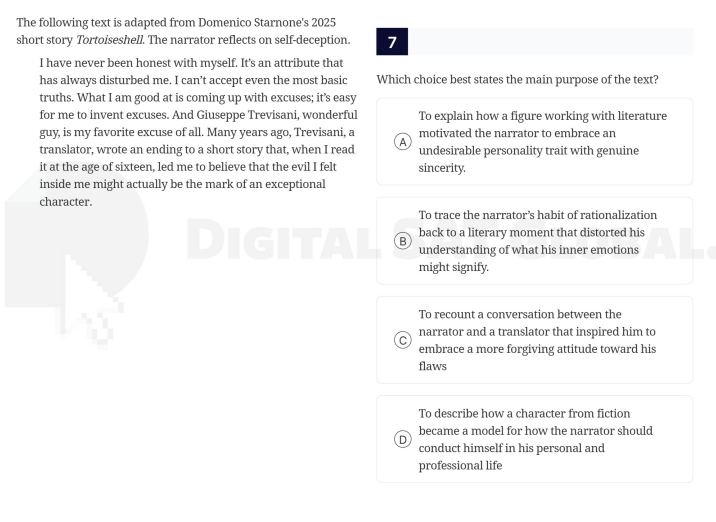
the following text is adapted from domenico starnone’s 2025 short story tortoiseshell. the narrator reflects on self - deception.
i have never been honest with myself. it’s an attribute that has always disturbed me. i can’t accept even the most basic truths. what i am good at is coming up with excuses; it’s easy for me to invent excuses. and giuseppe trevisani, wonderful guy, is my favorite excuse of all. many years ago, trevisani, a translator, wrote an ending to a short story that, when i read it at the age of sixteen, led me to believe that the evil i felt inside me might actually be the mark of an exceptional character.
7
which choice best states the main purpose of the text?
a to explain how a figure working with literature motivated the narrator to embrace an undesirable personality trait with genuine sincerity.
b to trace the narrator’s habit of rationalization back to a literary moment that distorted his understanding of what his inner emotions might signify.
c to recount a conversation between the narrator and a translator that inspired him to embrace a more forgiving attitude toward his flaws
d to describe how a character from fiction became a model for how the narrator should conduct himself in his personal and professional life
- Option A: The text is about the narrator's self - deception (rationalization) habit, not about embracing an undesirable trait with sincerity. The narrator's self - deception is a habit of making excuses, not a sincere embrace.
- Option B: The narrator has a habit of rationalizing (making excuses) for himself. The literary moment (reading Trevisani's ending to a short story at sixteen) made him think his evil inside was a mark of an exceptional character, which distorted his understanding of his inner emotions (he used this to rationalize his flaws instead of accepting them). This option matches the main purpose.
- Option C: There is no conversation between the narrator and the translator. The narrator read something the translator wrote, so this option is incorrect.
- Option D: The text is about the narrator's self - deception and how a literary moment affected his understanding of his inner self, not about a fictional character being a model for his conduct in life.

Snap & solve any problem in the app
Get step-by-step solutions on Sovi AI
Photo-based solutions with guided steps
Explore more problems and detailed explanations
B. To trace the narrator's habit of rationalization back to a literary moment that distorted his understanding of what his inner emotions might signify.