QUESTION IMAGE
Question
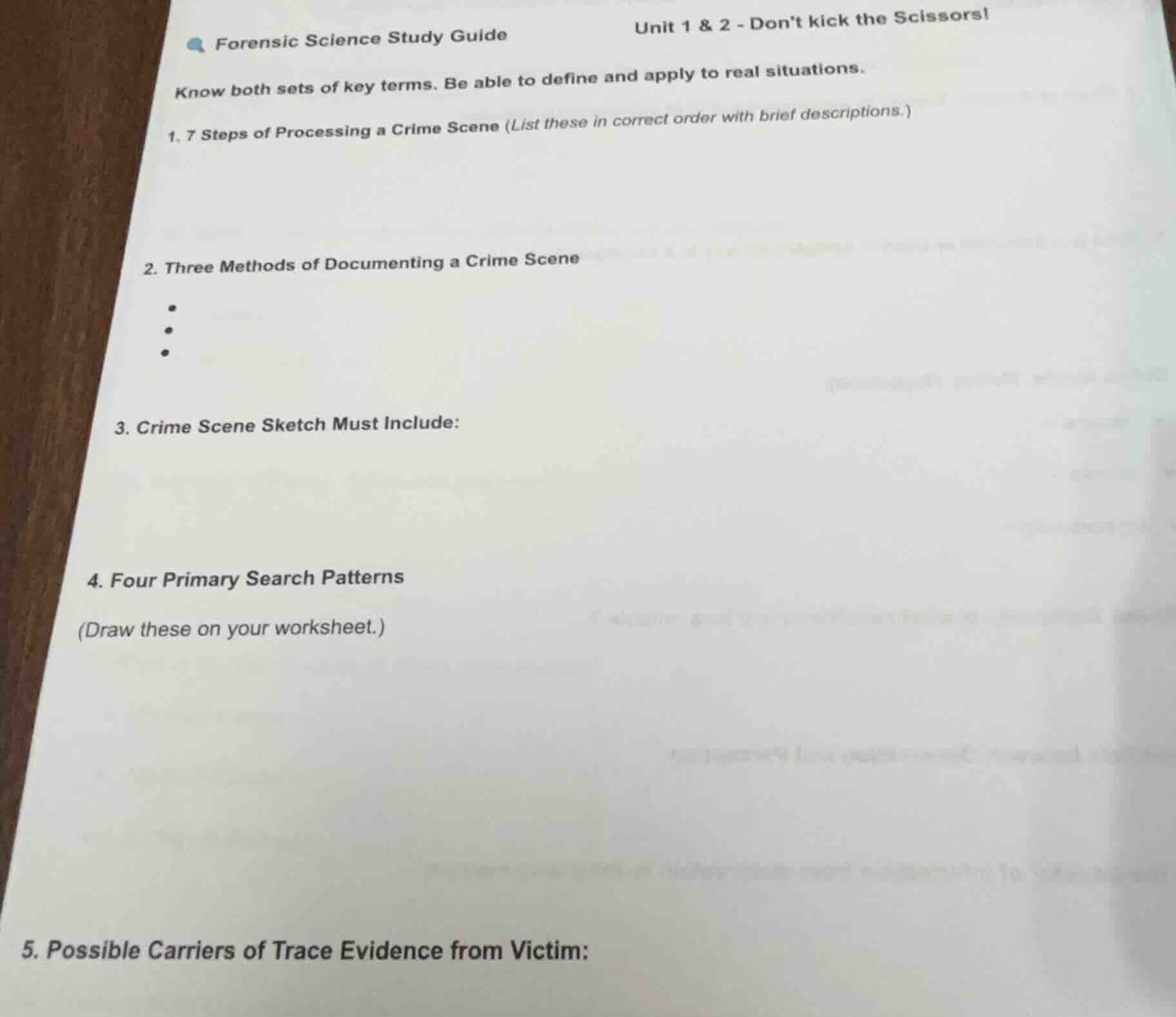
forensic science study guideunit 1 & 2 - dont kick the scissors!know both sets of key terms. be able to define and apply to real situations.1. 7 steps of processing a crime scene (list these in correct order with brief descriptions.)2. three methods of documenting a crime scene•••3. crime scene sketch must include:4. four primary search patterns(draw these on your worksheet.)5. possible carriers of trace evidence from victim:
Brief Explanations
- For crime scene processing steps, the standard ordered steps follow securing, documenting, searching, collecting, preserving, analyzing, and reporting.
- The three main crime scene documentation methods are the standard practices for recording the scene.
- Crime scene sketches require core identifying and spatial details for validity.
- The four primary search patterns are the established systematic methods for evidence recovery.
- Trace evidence carriers from a victim are common surfaces that retain transferable material.

Snap & solve any problem in the app
Get step-by-step solutions on Sovi AI
Photo-based solutions with guided steps
Explore more problems and detailed explanations
- 7 Steps of Processing a Crime Scene:
- Secure the scene: Restrict access to preserve evidence.
- Document the scene: Record initial state via notes/photos.
- Conduct a primary search: Locate obvious evidence.
- Collect and preserve evidence: Package items to avoid contamination.
- Conduct a secondary search: Verify no evidence is missed.
- Analyze evidence: Test and examine collected materials.
- Release the scene: Approve once processing is complete.
- Three Methods of Documenting a Crime Scene:
- Photographic documentation (overall, medium, close-up photos)
- Written notes (detailed, chronological observations)
- Sketching (diagram of scene layout and evidence locations)
- Crime Scene Sketch Must Include:
- Case file number and date/time of creation
- Location and orientation of the scene (e.g., north arrow)
- Measurements of the scene and evidence positions
- Labels for evidence, fixed objects, and entry/exit points
- Name and signature of the sketch creator
- Four Primary Search Patterns:
- Strip/Line Search: Parallel lines sweep across the scene
- Grid Search: Overlapping perpendicular lines (double strip search)
- Spiral Search: Outward or inward spiral from a central point
- Zone Search: Divide scene into sections to search individually
- Possible Carriers of Trace Evidence from Victim:
- Clothing (fibers, hair, debris caught in fabric)
- Hair and scalp (foreign hair, fibers, or chemicals)
- Fingernails (skin cells, debris from scratching an attacker)
- Skin (transferable substances like paint, drugs, or soil)
- Jewelry (trace material caught on settings or surfaces)