QUESTION IMAGE
Question
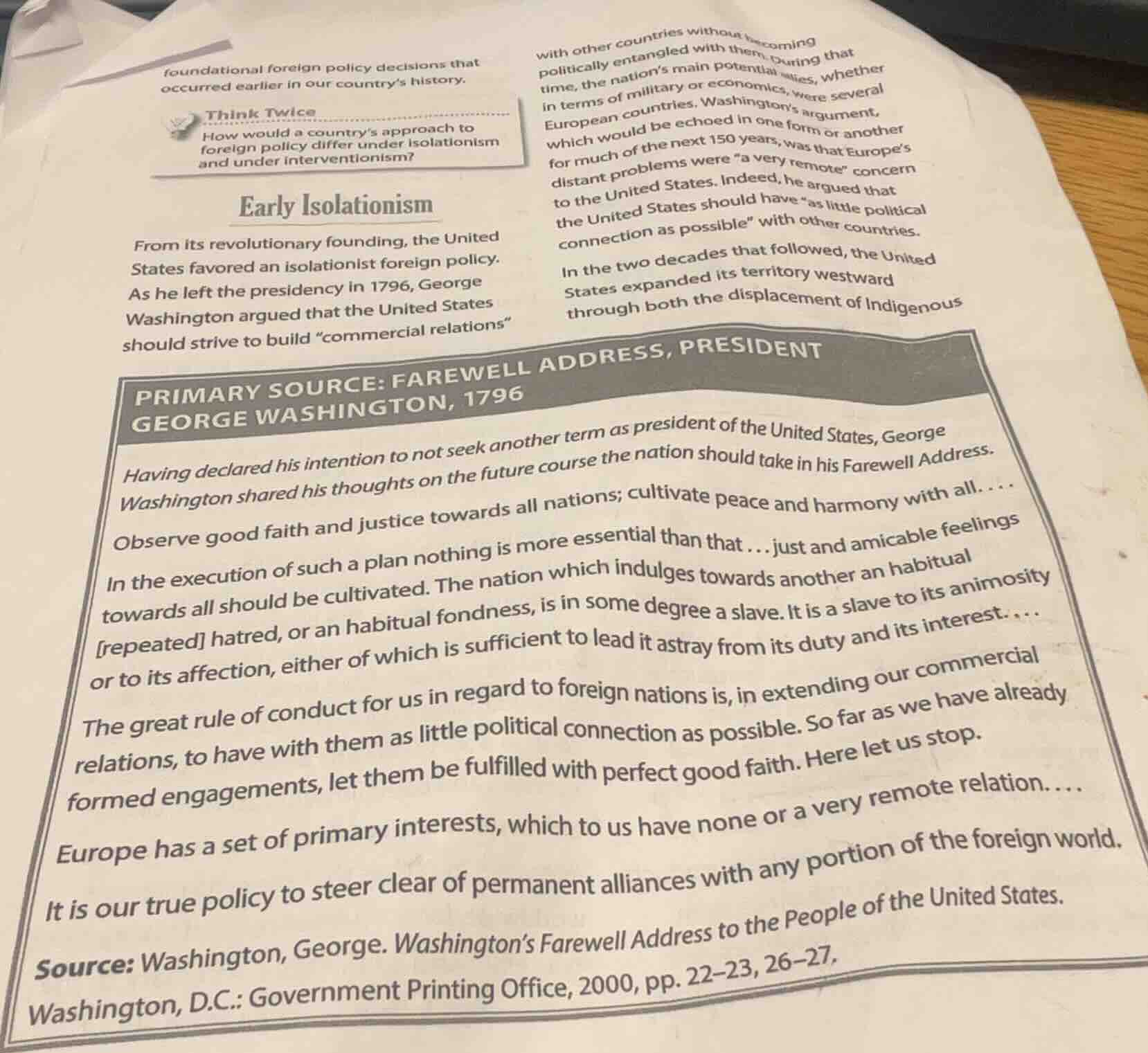
foundational foreign policy decisions that occurred earlier in our countrys history.
think twice
how would a countrys approach to foreign policy differ under isolationism and under interventionism?
early isolationism
from its revolutionary founding, the united states favored an isolationist foreign policy. as he left the presidency in 1796, george washington argued that the united states should strive to build \commercial relations\ with other countries without becoming politically entangled with them. during that time, the nations main potential allies, whether in terms of military or economics, were several european countries. washingtons argument, which would be echoed in one form or another for much of the next 150 years, was that europes distant problems were \a very remote\ concern to the united states. indeed, he argued that the united states should have \as little political connection as possible\ with other countries.
in the two decades that followed, the united states expanded its territory westward through both the displacement of indigenous
primary source: farewell address, president george washington, 1796
having declared his intention to not seek another term as president of the united states, george washington shared his thoughts on the future course the nation should take in his farewell address.
observe good faith and justice towards all nations; cultivate peace and harmony with all....
in the execution of such a plan nothing is more essential than that... just and amicable feelings towards all should be cultivated. the nation which indulges towards another an habitual repeated hatred, or an habitual fondness, is in some degree a slave. it is a slave to its animosity or to its affection, either of which is sufficient to lead it astray from its duty and its interest....
the great rule of conduct for us in regard to foreign nations is, in extending our commercial relations, to have with them as little political connection as possible. so far as we have already formed engagements, let them be fulfilled with perfect good faith. here let us stop.
europe has a set of primary interests, which to us have none or a very remote relation....
it is our true policy to steer clear of permanent alliances with any portion of the foreign world.
source: washington, george. washington’s farewell address to the people of the united states.
washington, d.c.: government printing office, 2000, pp. 22–23, 26–27.
To answer the "Think Twice" question about how a country’s foreign policy approach differs under isolationism and interventionism, we analyze the concepts:
Isolationism (e.g., U.S. early history):
- Focus: Prioritizes domestic affairs, avoiding foreign political/military entanglements.
- Actions: Limits alliances (e.g., Washington’s call for “little political connection” with Europe), emphasizes commerce over politics, and stays neutral in foreign conflicts.
Interventionism:
- Focus: Actively engages in global affairs (politically, militarily, or economically) to advance national interests, spread values, or address global issues.
- Actions: Forms alliances, intervenes in foreign conflicts (e.g., U.S. in World Wars, modern peacekeeping), and uses diplomacy/military power to shape international outcomes.
Key Differences:
| Aspect | Isolationism | Interventionism |
|---|---|---|
| Alliances | Avoid permanent alliances | Form/join alliances (e.g., NATO) |
| Conflict Involvement | Neutral/stay out of foreign conflicts | Intervene in conflicts (e.g., military action) |
| Foreign Policy Goal | Self - sufficiency, avoid entanglement | Influence global order, advance interests |
For example, isolationist U.S. focused on westward expansion post - Washington, while interventionist U.S. later led in global conflicts and diplomacy.

Snap & solve any problem in the app
Get step-by-step solutions on Sovi AI
Photo-based solutions with guided steps
Explore more problems and detailed explanations
Under isolationism, a country focuses on domestic affairs, limits political/military involvement with other nations, avoids permanent alliances, and stays neutral in foreign conflicts (prioritizing commerce over politics, as seen in early U.S. policy). Under interventionism, a country actively engages in global affairs, forms alliances, intervenes in foreign conflicts, and uses diplomacy/military power to shape international outcomes (e.g., U.S. involvement in World Wars, modern peacekeeping).