QUESTION IMAGE
Question
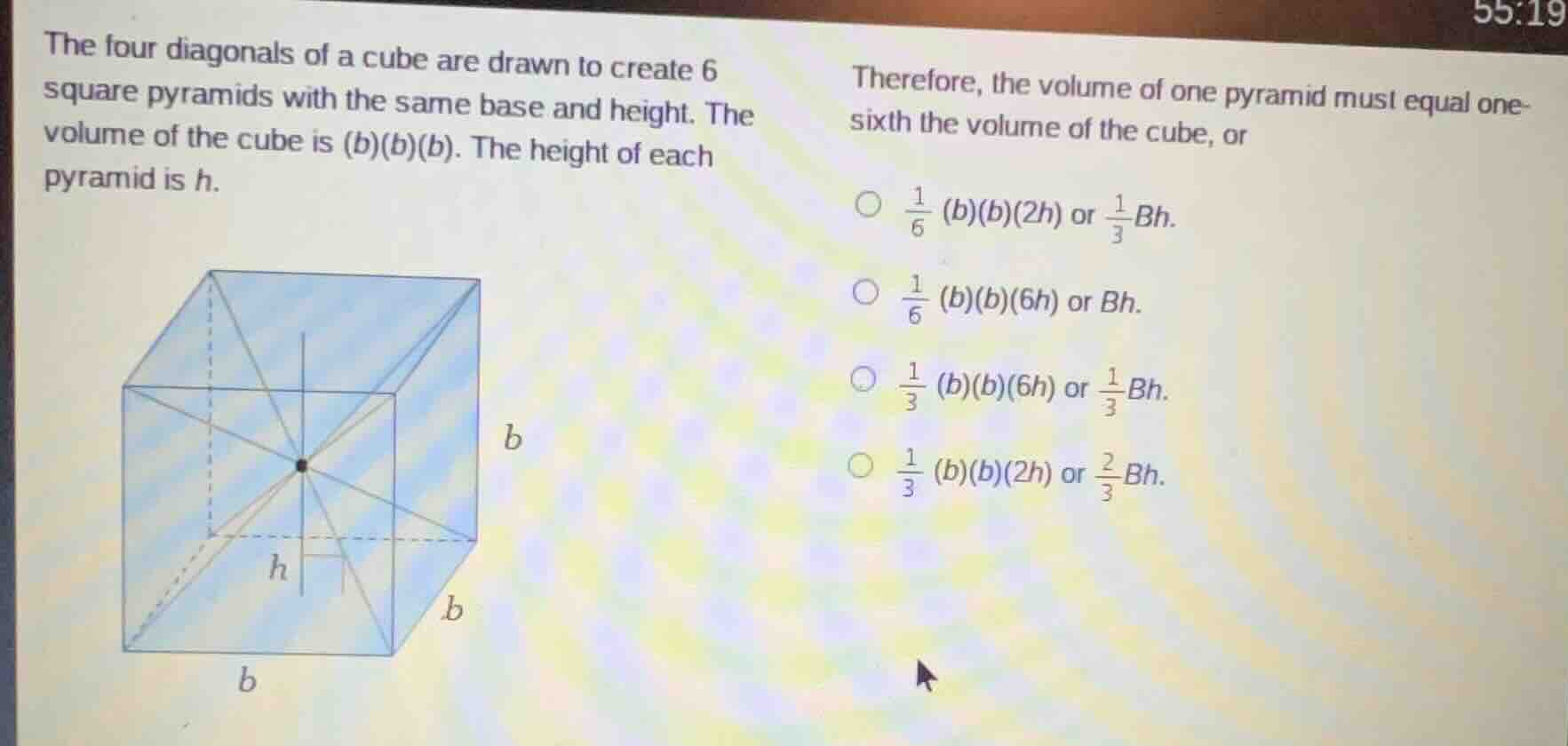
the four diagonals of a cube are drawn to create 6 square pyramids with the same base and height. the volume of the cube is (b)(b)(b). the height of each pyramid is h. therefore, the volume of one pyramid must equal one - sixth the volume of the cube, or ○ \\(\frac{1}{6} (b)(b)(2h)\\) or \\(\frac{1}{3}bh\\). ○ \\(\frac{1}{6} (b)(b)(6h)\\) or \\(bh\\). ○ \\(\frac{1}{3} (b)(b)(6h)\\) or \\(\frac{1}{3}bh\\). ○ \\(\frac{1}{3} (b)(b)(2h)\\) or \\(\frac{2}{3}bh\\).
Step1: Find the volume of the cube
The volume of the cube is given by \( V_{\text{cube}} = b \times b \times b = b^3 \).
Step2: Determine the volume of one pyramid
We know that 6 pyramids make up the cube, so the volume of one pyramid \( V_{\text{pyramid}} \) is \( \frac{1}{6} \) of the volume of the cube. So \( V_{\text{pyramid}}=\frac{1}{6}V_{\text{cube}}=\frac{1}{6}b^3 \).
Now, let's analyze the height of the pyramid. From the cube's structure, the total height of the cube (from one face to the opposite face) is \( 2h \) (since the height of each pyramid is \( h \), and two pyramids' heights make up the cube's edge in that direction? Wait, actually, looking at the options, we can also use the formula for the volume of a pyramid \( V = \frac{1}{3}Bh \), where \( B \) is the base area. The base area of the square pyramid is \( b \times b = b^2 \).
Let's check the first option: \( \frac{1}{6}(b)(b)(2h) \). Let's simplify this: \( \frac{1}{6} \times b^2 \times 2h=\frac{1}{3}b^2h \). And since \( B = b^2 \), this is \( \frac{1}{3}Bh \), which matches the pyramid volume formula. Also, since the volume of the cube is \( b^3 \), and \( \frac{1}{6}b^3=\frac{1}{6}(b \times b \times b) \), but if we consider that the total height related to the pyramid's height: in the cube, the distance from the base of a pyramid to the opposite face is \( 2h \) (because the pyramid's height is \( h \), and there's another pyramid on the other side with height \( h \)), so substituting \( 2h \) as the total "height" related to the cube's edge? Wait, maybe another way: the volume of the cube is \( b \times b \times (2h) \)? No, the cube's edge is \( b \), so the volume is \( b^3 \). But the first option is \( \frac{1}{6}(b)(b)(2h) \). Let's see: if we consider that the cube's volume can also be expressed as \( b \times b \times (2h) \)? Wait, no, the cube's edge is \( b \), so \( 2h = b \)? Wait, maybe the diagram shows that the height of the pyramid is \( h \), and the edge of the cube is \( b = 2h \)? Wait, maybe that's the case. So if \( b = 2h \), then the volume of the cube is \( (2h)(2h)(2h)=8h^3 \), but no, maybe not. Wait, let's just check the algebra.
The volume of one pyramid is \( \frac{1}{6} \) of the cube's volume. The cube's volume is \( b^3 \), so pyramid volume is \( \frac{b^3}{6} \). Now, the first option: \( \frac{1}{6}(b)(b)(2h)=\frac{2b^2h}{6}=\frac{b^2h}{3} \). For this to equal \( \frac{b^3}{6} \), we need \( \frac{b^2h}{3}=\frac{b^3}{6} \), which implies \( 2h = b \), so \( h=\frac{b}{2} \). Which makes sense because in the cube, the height of each pyramid (from the center to a face) is half the edge length? Wait, the center of the cube is at a distance of \( \frac{b}{2} \) from each face, so \( h = \frac{b}{2} \), so \( 2h = b \). Therefore, substituting \( b = 2h \) into the cube's volume: \( (2h)(2h)(2h)=8h^3 \), and the pyramid's volume is \( \frac{1}{6} \times 8h^3=\frac{4h^3}{3} \), but using the first option: \( \frac{1}{6}(2h)(2h)(2h)=\frac{1}{6} \times 8h^3=\frac{4h^3}{3} \), which matches. Wait, no, the first option is \( \frac{1}{6}(b)(b)(2h) \), if \( b = 2h \), then it's \( \frac{1}{6}(2h)(2h)(2h)=\frac{8h^3}{6}=\frac{4h^3}{3} \), which is the pyramid's volume. And the formula \( \frac{1}{3}Bh \), where \( B = b^2=(2h)^2 = 4h^2 \), so \( \frac{1}{3} \times 4h^2 \times h=\frac{4h^3}{3} \), which matches. So the first option is correct.
Let's check the other options:
Second option: \( \frac{1}{6}(b)(b)(6h)=\frac{1}{6} \times 6b^2h = b^2h \), which is not equal to \( \frac{1}{3}Bh \) (since \( B = b^2 \), this wou…

Snap & solve any problem in the app
Get step-by-step solutions on Sovi AI
Photo-based solutions with guided steps
Explore more problems and detailed explanations
\( \boldsymbol{\frac{1}{6} (b)(b)(2h) \text{ or } \frac{1}{3}Bh} \) (the first option)