QUESTION IMAGE
Question
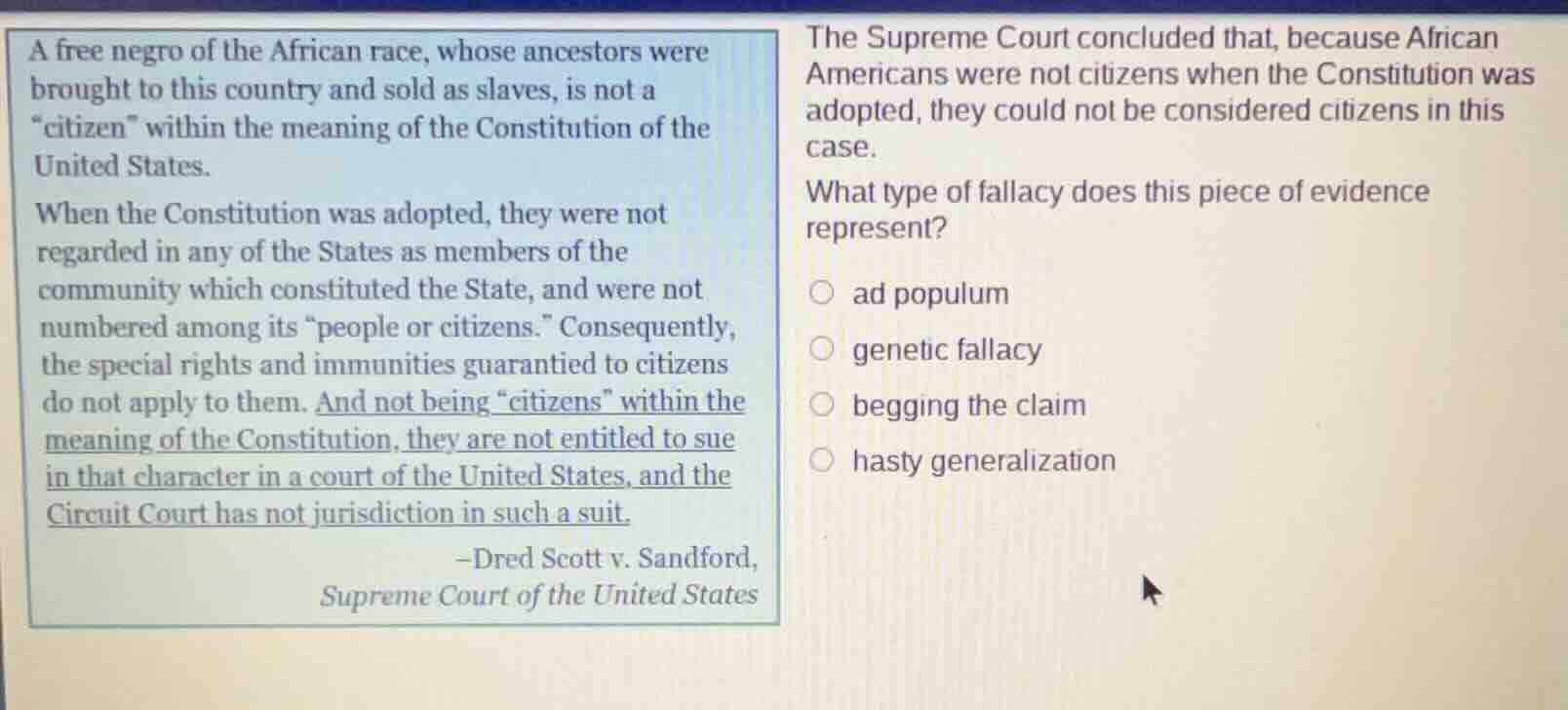
a free negro of the african race, whose ancestors were brought to this country and sold as slaves, is not a \citizen\ within the meaning of the constitution of the united states.
when the constitution was adopted, they were not regarded in any of the states as members of the community which constituted the state, and were not numbered among its \people or citizens.\ consequently, the special rights and immunities guarantied to citizens do not apply to them. and not being \citizens\ within the meaning of the constitution, they are not entitled to sue in that character in a court of the united states, and the circuit court has not jurisdiction in such a suit.
—dred scott v. sandford, supreme court of the united states
the supreme court concluded that, because african americans were not citizens when the constitution was adopted, they could not be considered citizens in this case.
what type of fallacy does this piece of evidence represent?
○ ad populum
○ genetic fallacy
○ begging the claim
○ hasty generalization
To determine the fallacy, we analyze each option:
- ad populum: Appeals to popular opinion; not relevant here.
- genetic fallacy: Judges a claim by its origin (e.g., "they weren’t citizens then, so not now"). The Supreme Court argues African Americans can’t be citizens now because they weren’t at the Constitution’s adoption (judging by origin).
- begging the claim: Assumes the conclusion in the premise; the argument here relies on historical status (origin) rather than circular reasoning.
- hasty generalization: Draws a conclusion from insufficient evidence; this is about origin, not overgeneralizing.

Snap & solve any problem in the app
Get step-by-step solutions on Sovi AI
Photo-based solutions with guided steps
Explore more problems and detailed explanations
genetic fallacy