QUESTION IMAGE
Question
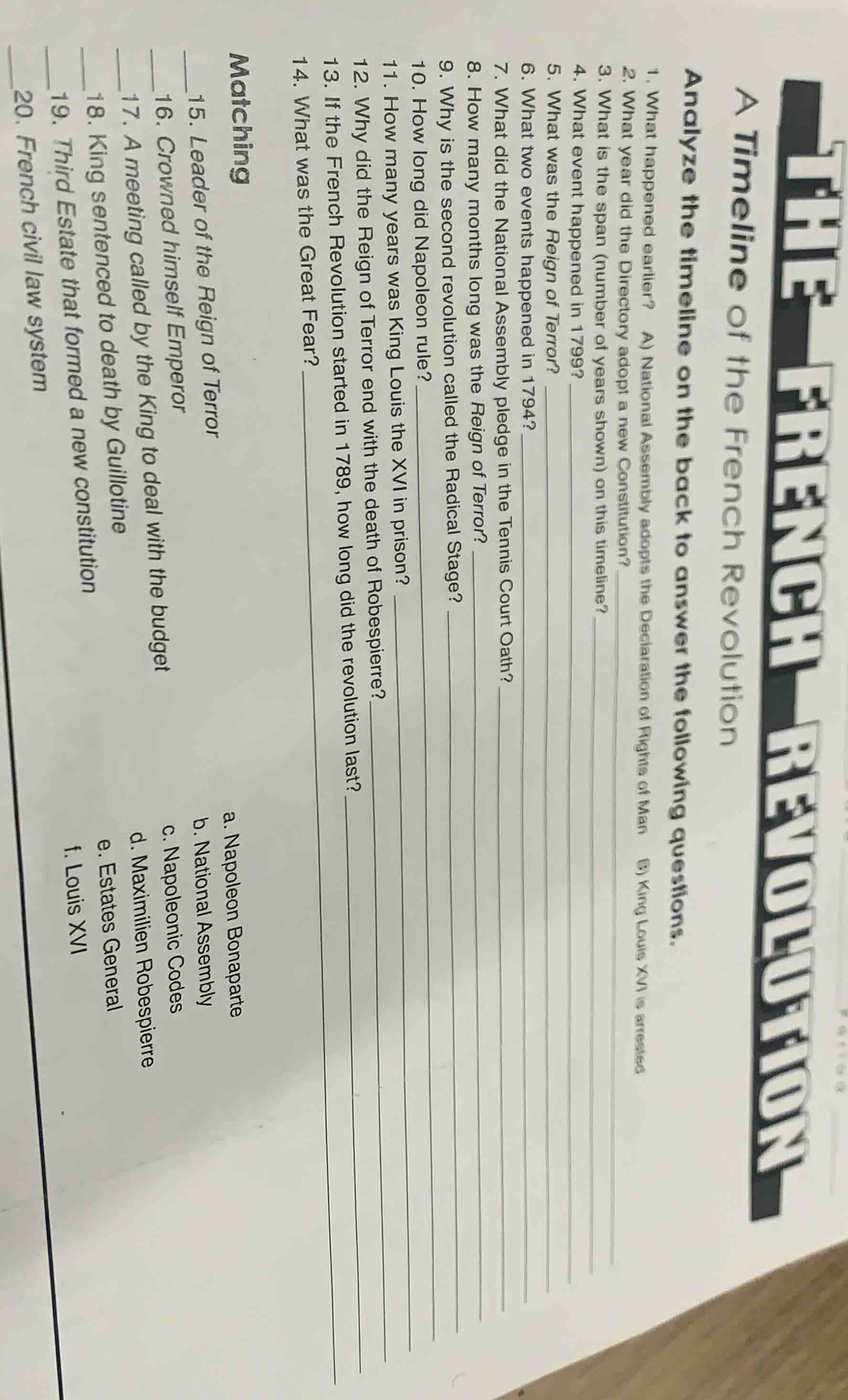
the french revolution
a timeline of the french revolution
analyze the timeline on the back to answer the following questions.
- what happened earlier? a) national assembly adopts the declaration of rights of man b) king louis xvi is arrested
- what year did the directory adopt a new constitution?
- what is the span (number of years shown) on this timeline?
- what event happened in 1799?
- what was the reign of terror?
- what two events happened in 1794?
- what did the national assembly pledge in the tennis court oath?
- how many months long was the reign of terror?
- why is the second revolution called the radical stage?
- how long did napoleon rule?
- how many years was king louis the xvi in prison?
- why did the reign of terror end with the death of robespierre?
- if the french revolution started in 1789, how long did the revolution last?
- what was the great fear?
matching
- leader of the reign of terror
- crowned himself emperor
- a meeting called by the king to deal with the budget
- king sentenced to death by guillotine
- third estate that formed a new constitution
- french civil law system
a. napoleon bonaparte
b. national assembly
c. napoleonic codes
d. maximilien robespierre
e. estates general
f. louis xvi
Brief Explanations
- Compare the dates of the two events: the Declaration of the Rights of Man (1789) and the arrest of Louis XVI (1792).
- The Directory adopted its new constitution in 1795.
- The standard timeline of the French Revolution spans from 1789 to 1799.
- 1799 marked the end of the Directory and start of Napoleon's rule.
- The Reign of Terror was a period of violent repression during the revolution.
- Key events in 1794 include the end of the Reign of Terror and Robespierre's execution.
- The Tennis Court Oath was a pivotal early revolutionary pledge.
- The Reign of Terror ran from September 1793 to July 1794.
- The Radical Stage (second revolution) was driven by radical Jacobins seeking to protect the revolution.
- Napoleon ruled as Emperor from 1804 to 1814, with a brief return in 1815 (the Hundred Days, not counted in standard long-form rule).
- Louis XVI was imprisoned in 1792 and executed in 1793.
- Robespierre was the leader of the Committee of Public Safety during the Terror; his execution ended the period.
- The revolution is generally considered to end with Napoleon's seizure of power in 1799.
- The Great Fear was a wave of peasant uprisings early in the revolution.
- Maximilien Robespierre led the Committee of Public Safety during the Reign of Terror.
- Napoleon Bonaparte crowned himself Emperor of the French in 1804.
- The Estates General was the traditional meeting of France's three social orders, called by Louis XVI in 1789.
- King Louis XVI was sentenced to death by guillotine in 1793.
- The Third Estate formed the National Assembly, which drafted a new constitution.
- The Napoleonic Codes established a standardized civil law system in France.

Snap & solve any problem in the app
Get step-by-step solutions on Sovi AI
Photo-based solutions with guided steps
Explore more problems and detailed explanations
- A) National Assembly adopts the Declaration of Rights of Man
- 1795
- 10 years (1789-1799)
- Napoleon Bonaparte staged a coup d'état (the Coup of 18 Brumaire) and seized power, ending the Directory.
- A period of violent repression and mass executions (via guillotine) of perceived enemies of the French Revolution, led by the Committee of Public Safety.
- The execution of Maximilien Robespierre and the end of the Reign of Terror.
- They pledged not to disband until they had drafted a new constitution for France.
- 10 months
- It was driven by radical Jacobins who wanted to protect the revolution from internal and external threats, using extreme measures.
- 10 years (1804-1814)
- 1 year (1792-1793)
- Robespierre, the leader of the Committee of Public Safety and architect of the Terror, was arrested and executed.
- 10 years (1789-1799)
- A wave of widespread panic and peasant uprisings across France in 1789, sparked by rumors of aristocratic plots against the revolution.
- d. Maximilien Robespierre
- a. Napoleon Bonaparte
- e. Estates General
- f. Louis XVI
- b. National Assembly
- c. Napoleonic Codes