QUESTION IMAGE
Question
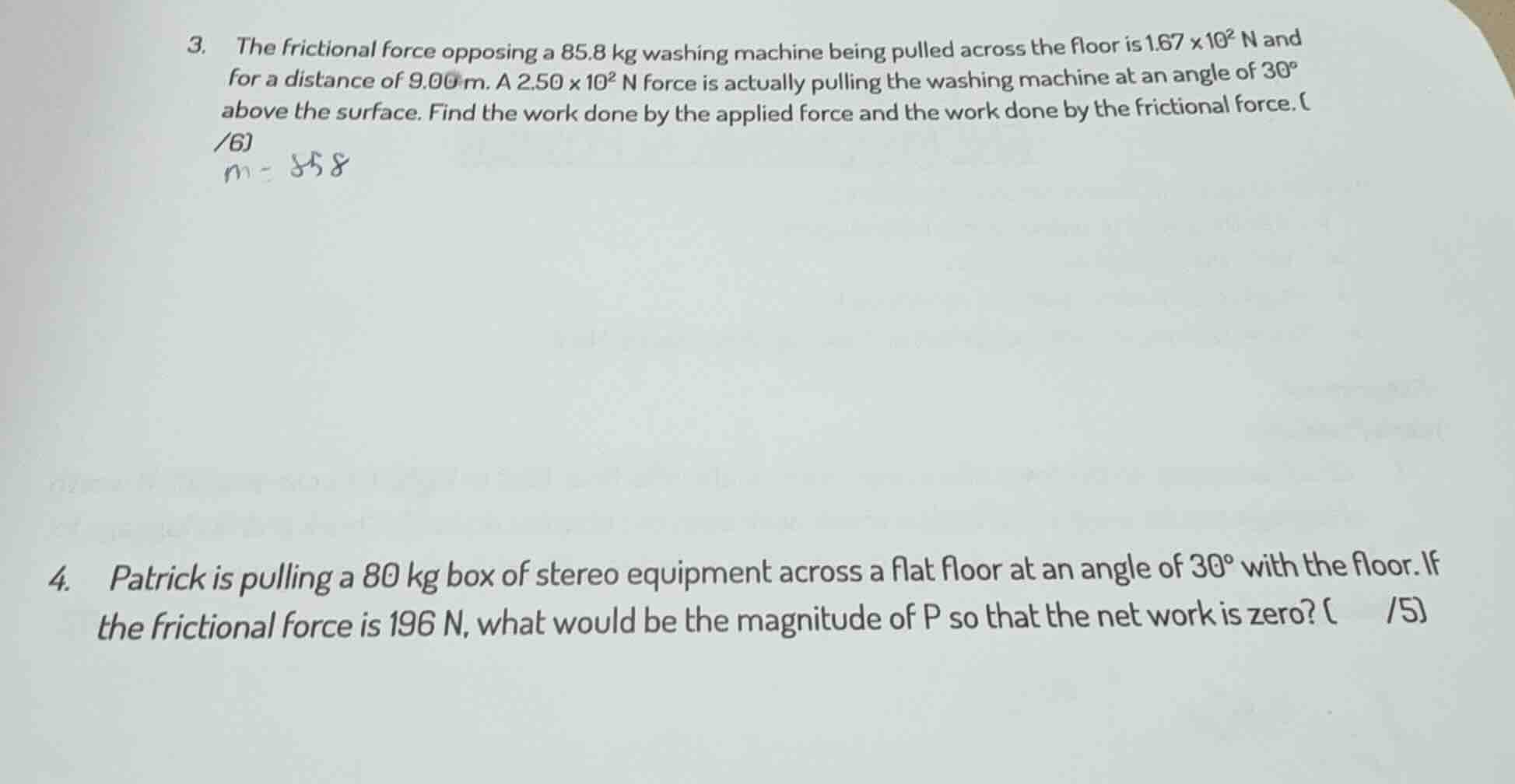
- the frictional force opposing a 85.8 kg washing machine being pulled across the floor is 1.67 x 10² n and for a distance of 9.00 m. a 2.50 x 10² n force is actually pulling the washing machine at an angle of 30° above the surface. find the work done by the applied force and the work done by the frictional force. (/6)
m = 858
- patrick is pulling a 80 kg box of stereo equipment across a flat floor at an angle of 30° with the floor. if the frictional force is 196 n, what would be the magnitude of p so that the net work is zero? ( /5)
Problem 3
Step1: Recall the work formula
The formula for work is \( W = Fd\cos\theta \), where \( F \) is the force, \( d \) is the distance, and \( \theta \) is the angle between the force and the displacement.
Step2: Work done by the applied force
Given: \( F_{\text{applied}} = 2.50 \times 10^2 \, \text{N} \), \( d = 9.00 \, \text{m} \), \( \theta = 30^\circ \)
Using \( W_{\text{applied}} = F_{\text{applied}} d \cos\theta \)
\( W_{\text{applied}} = (250 \, \text{N})(9.00 \, \text{m})\cos(30^\circ) \)
\( \cos(30^\circ) = \frac{\sqrt{3}}{2} \approx 0.8660 \)
\( W_{\text{applied}} = 250 \times 9.00 \times 0.8660 \)
\( W_{\text{applied}} = 250 \times 7.794 \)
\( W_{\text{applied}} = 1948.5 \, \text{J} \approx 1.95 \times 10^3 \, \text{J} \)
Step3: Work done by the frictional force
The frictional force is opposite to the displacement, so \( \theta = 180^\circ \), \( \cos(180^\circ) = -1 \)
Given: \( F_{\text{friction}} = 1.67 \times 10^2 \, \text{N} = 167 \, \text{N} \), \( d = 9.00 \, \text{m} \)
Using \( W_{\text{friction}} = F_{\text{friction}} d \cos\theta \)
\( W_{\text{friction}} = (167 \, \text{N})(9.00 \, \text{m})\cos(180^\circ) \)
\( W_{\text{friction}} = 167 \times 9.00 \times (-1) \)
\( W_{\text{friction}} = -1503 \, \text{J} \approx -1.50 \times 10^3 \, \text{J} \)
Step1: Net work is zero condition
Net work \( W_{\text{net}} = W_{\text{applied}} + W_{\text{friction}} = 0 \)
So \( W_{\text{applied}} = -W_{\text{friction}} \)
Step2: Work formulas
\( W_{\text{applied}} = Fd\cos\theta \) (applied force at \( 30^\circ \) to displacement)
\( W_{\text{friction}} = F_{\text{friction}} d \cos(180^\circ) = -F_{\text{friction}} d \) (friction opposite to displacement)
Step3: Set up equation
\( Fd\cos(30^\circ) = F_{\text{friction}} d \)
Cancel \( d \) from both sides: \( F\cos(30^\circ) = F_{\text{friction}} \)
Step4: Solve for \( F \) (magnitude of \( P \))
\( F = \frac{F_{\text{friction}}}{\cos(30^\circ)} \)
Given \( F_{\text{friction}} = 196 \, \text{N} \), \( \cos(30^\circ) = \frac{\sqrt{3}}{2} \approx 0.8660 \)
\( F = \frac{196}{0.8660} \approx 226 \, \text{N} \)

Snap & solve any problem in the app
Get step-by-step solutions on Sovi AI
Photo-based solutions with guided steps
Explore more problems and detailed explanations
Work done by applied force: \( \approx 1.95 \times 10^3 \, \text{J} \)
Work done by frictional force: \( \approx -1.50 \times 10^3 \, \text{J} \)