QUESTION IMAGE
Question
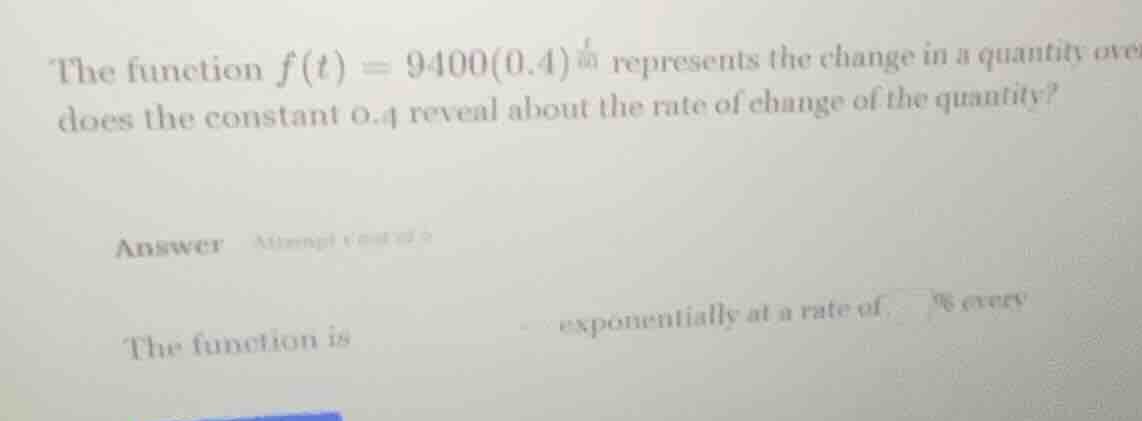
the function $f(t) = 9400(0.4)^{\frac{t}{30}}$ represents the change in a quantity over does the constant 0.4 reveal about the rate of change of the quantity? answer the function is exponentially at a rate of % every
Step1: Identify the type of exponential function
The general form of an exponential decay function is \( f(t) = a(b)^t \), where \( 0 < b < 1 \). Here, the function is \( f(t)=9400(0.4)^{\frac{t}{30}} \), and \( b = 0.4 \), which is less than 1, so it's a decay function.
Step2: Calculate the decay rate
The formula for the rate of change in exponential decay is \( \text{Decay rate}=(1 - b)\times100\% \). Substituting \( b = 0.4 \), we get \( (1 - 0.4)\times100\%= 0.6\times100\% = 60\% \) decay rate. The base \( 0.4 \) indicates that after each time period (here, the time period is related to the exponent \( \frac{t}{30} \), meaning the time unit for the rate is 30 units of \( t \)), the quantity is multiplied by \( 0.4 \), so it's decreasing (decaying) exponentially.

Snap & solve any problem in the app
Get step-by-step solutions on Sovi AI
Photo-based solutions with guided steps
Explore more problems and detailed explanations
The function is decaying exponentially at a rate of \( 60\% \) every 30 units of \( t \) (the time variable in the function). The constant \( 0.4 \) shows that the quantity is \( 40\% \) of its previous value after each 30 - unit time interval, so the rate of decay is \( 100\% - 40\%=60\% \) per 30 - unit time period.