QUESTION IMAGE
Question
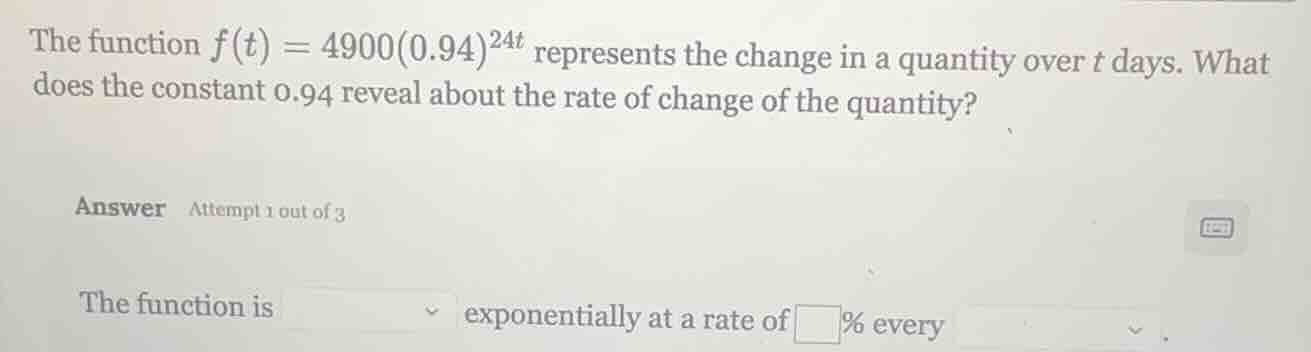
the function $f(t) = 4900(0.94)^{24t}$ represents the change in a quantity over $t$ days. what does the constant 0.94 reveal about the rate of change of the quantity?
answer attempt 1 out of 3
the function is $quad$ exponentially at a rate of $square%$ every $quad$.
Step1: Identify the type of exponential function
The general form of an exponential decay function is \( f(t) = a(b)^{kt} \), where \( 0 < b < 1 \) indicates decay. Here, \( b = 0.94 \), which is less than 1, so the function is decaying.
Step2: Calculate the decay rate
The decay rate per period is \( 1 - b \). So, \( 1 - 0.94 = 0.06 \), which is \( 6\% \) when converted to a percentage.
Step3: Determine the time period
The exponent is \( 24t \), which means the base \( 0.94 \) is applied every \( \frac{1}{24} \) of a day? Wait, no. Wait, in the exponential function \( f(t)=a(b)^{nt} \), the time period for the base \( b \) is such that when \( t \) increases by 1, the exponent increases by \( n \). Wait, actually, let's think again. Let's rewrite the function as \( f(t) = 4900(0.94^{24})^t \). Let's calculate \( 0.94^{24} \). But maybe a better way: the exponent is \( 24t \), so for each unit increase in \( t \) (each day), the exponent increases by 24. So the base \( 0.94 \) is raised to the power of 24 for each day. Wait, no, actually, the time period for the decay factor \( 0.94 \) is per \( \frac{1}{24} \) day? Wait, no, let's recall: if we have \( f(t) = a(b)^{kt} \), then the decay (or growth) factor per \( \frac{1}{k} \) time unit. So here, \( k = 24 \), so the time unit for the base \( b = 0.94 \) is per \( \frac{1}{24} \) day? Wait, that doesn't make sense. Wait, maybe the exponent is \( 24t \), meaning that every hour (since 24 hours in a day), the quantity is multiplied by \( 0.94 \). Wait, \( t \) is in days, so when \( t = 1 \) day, the exponent is \( 24 \times 1 = 24 \), so the quantity is \( 4900(0.94)^{24} \) after 1 day. So the base \( 0.94 \) is applied every hour (since 24 hours in a day). So the time period for the decay factor \( 0.94 \) is 1 hour.
So putting it together: the function is decaying exponentially at a rate of \( 6\% \) every hour.

Snap & solve any problem in the app
Get step-by-step solutions on Sovi AI
Photo-based solutions with guided steps
Explore more problems and detailed explanations
The function is \(\boldsymbol{\text{decaying}}\) exponentially at a rate of \(\boldsymbol{6}\%\) every \(\boldsymbol{\text{hour}}\).