QUESTION IMAGE
Question
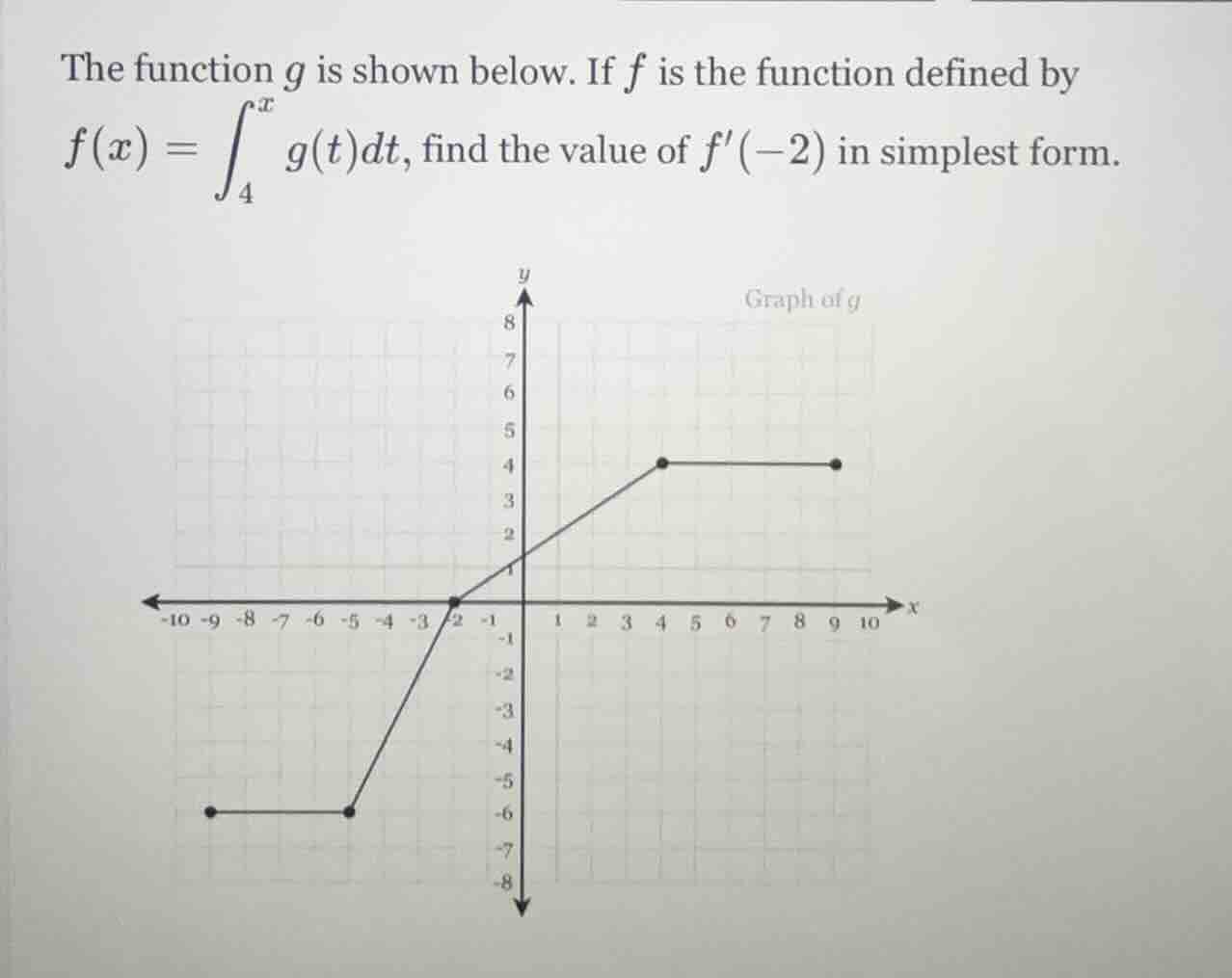
the function g is shown below. if f is the function defined by $f(x)=\int_{4}^{x}g(t)dt$, find the value of $f(-2)$ in simplest form.
Step1: Apply Fundamental Theorem of Calculus
By the Fundamental Theorem of Calculus, if \( f(x)=\int_{a}^{x}g(t)dt \), then \( f'(x) = g(x) \). So we need to find \( g(-2) \).
Step2: Analyze the graph at \( x = -2 \)
Looking at the graph of \( g \), at \( x=-2 \), the point is on the line segment. We can find the slope or directly read the value. From the graph, when \( x = -2 \), \( g(-2)=0 \)? Wait, no, wait. Wait, the graph: let's check the line. Wait, the graph has a segment from, let's see, the point at \( x=-2 \) is the vertex? Wait, no, looking at the graph, the line from \( x=-2 \) (where it crosses the x-axis) up to \( x = 3 \) or 4? Wait, no, the graph: at \( x=-2 \), the function \( g(t) \) at \( t=-2 \): let's see the graph. Wait, the graph has a part where from \( x=-10 \) to \( x=-4 \), it's a horizontal line at \( y=-6 \)? No, wait the black dots: one at \( x=-10, y=-6 \), another at \( x=-4, y=-6 \), then a line from \( x=-4 \) to \( x=-2 \) (where it crosses the x-axis), then a line from \( x=-2 \) to \( x = 3 \) (or 4) where \( y = 4 \), then horizontal. Wait, at \( x=-2 \), the function \( g(t) \) at \( t=-2 \): the line from \( x=-4 \) to \( x=-2 \): let's find the slope. From \( x=-4 \), what's the y-value? At \( x=-4 \), the point is \( (-4, -6) \)? Wait no, the black dot at \( x=-4 \) is \( (-4, -6) \)? Then at \( x=-2 \), it's \( (-2, 0) \). So the line from \( (-4, -6) \) to \( (-2, 0) \). The slope is \( \frac{0 - (-6)}{-2 - (-4)}=\frac{6}{2}=3 \). Wait, but at \( x=-2 \), the value of \( g(-2) \) is 0? Wait no, when \( x=-2 \), the graph crosses the x-axis, so \( g(-2)=0 \)? Wait, no, the Fundamental Theorem says \( f'(x)=g(x) \), so we need \( g(-2) \). Looking at the graph, at \( t=-2 \), the function \( g(t) \) is 0? Wait, no, let's re-examine. The graph: the line from \( x=-4 \) (black dot) to \( x=-2 \) (where it meets the x-axis) – so at \( x=-2 \), \( g(-2)=0 \)? Wait, no, maybe I misread. Wait, the problem is \( f(x)=\int_{4}^{x}g(t)dt \), so by Fundamental Theorem of Calculus, Part 1, \( f'(x)=g(x) \). So we need to find \( g(-2) \). Now, looking at the graph of \( g \), at \( x=-2 \), what's \( g(-2) \)? The graph has a segment from \( x=-4 \) (let's say the point is \( (-4, -6) \)) to \( x=-2 \) (where it's on the x-axis, so \( y=0 \)). So at \( x=-2 \), \( g(-2)=0 \)? Wait, no, that can't be. Wait, maybe the line from \( x=-2 \) to \( x=3 \) (or 4) is increasing. Wait, no, let's check the graph again. The graph: the part from \( x=-2 \) to \( x=3 \) (or 4) is a line with positive slope. Wait, no, the key is that \( f'(x)=g(x) \), so \( f'(-2)=g(-2) \). Now, looking at the graph, at \( x=-2 \), the function \( g(t) \) at \( t=-2 \): the graph crosses the x-axis at \( x=-2 \), so \( g(-2)=0 \)? Wait, no, maybe I made a mistake. Wait, the graph: the left part: from \( x=-10 \) to \( x=-4 \), it's horizontal at \( y=-6 \). Then from \( x=-4 \) to \( x=-2 \), it's a line going up to \( x=-2 \) (where \( y=0 \)). Then from \( x=-2 \) to \( x=3 \) (or 4), it's a line going up to \( y=4 \), then horizontal. So at \( x=-2 \), \( g(-2)=0 \)? Wait, no, when \( t=-2 \), the value of \( g(t) \) is 0? Then \( f'(-2)=g(-2)=0 \)? Wait, that can't be. Wait, no, maybe I misread the limits. The integral is from 4 to x, so \( f(x)=\int_{4}^{x}g(t)dt \). So by Fundamental Theorem of Calculus, \( f'(x)=g(x) \), regardless of the lower limit (as long as it's a constant). So we need \( g(-2) \). Now, looking at the graph, at \( t=-2 \), what's \( g(t) \)? Let's look at the graph again. The graph: at \( x=-2 \), t…

Snap & solve any problem in the app
Get step-by-step solutions on Sovi AI
Photo-based solutions with guided steps
Explore more problems and detailed explanations
\( \boxed{0} \)