QUESTION IMAGE
Question
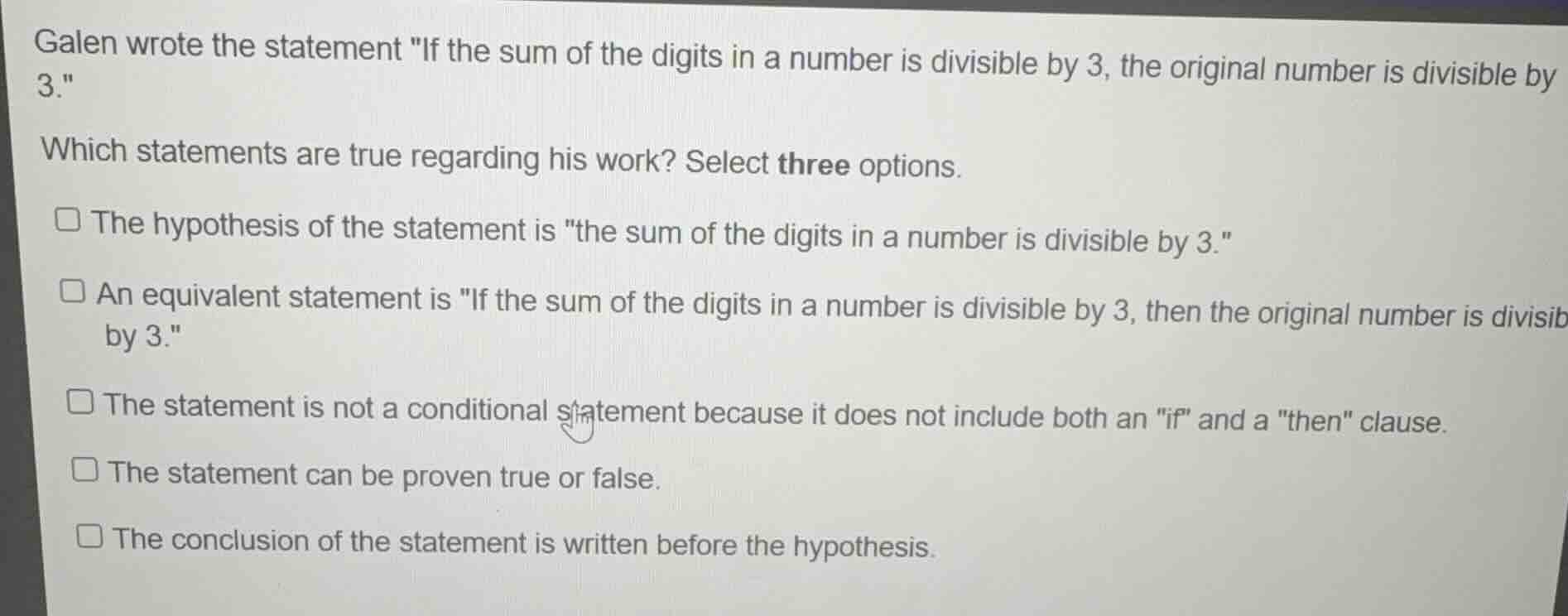
galen wrote the statement \if the sum of the digits in a number is divisible by 3, the original number is divisible by 3.\
which statements are true regarding his work? select three options.
□ the hypothesis of the statement is \the sum of the digits in a number is divisible by 3.\
□ an equivalent statement is \if the sum of the digits in a number is divisible by 3, then the original number is divisible by 3.\
□ the statement is not a conditional statement because it does not include both an \if\ and a \then\ clause.
□ the statement can be proven true or false.
□ the conclusion of the statement is written before the hypothesis.
- In a conditional statement "If P, Q", P is the hypothesis. Here, P is "the sum of the digits in a number is divisible by 3."
- Adding "then" to the original statement creates an equivalent explicit conditional form without changing meaning.
- Mathematical statements like this divisibility rule are provable as true or false (this one is provably true).
- The original statement is a conditional (implied "then"), so the claim it is not conditional is false.
- The hypothesis ("If..." part) comes first, so the conclusion is not before the hypothesis.

Snap & solve any problem in the app
Get step-by-step solutions on Sovi AI
Photo-based solutions with guided steps
Explore more problems and detailed explanations
- The hypothesis of the statement is "the sum of the digits in a number is divisible by 3."
- An equivalent statement is "If the sum of the digits in a number is divisible by 3, then the original number is divisible by 3."
- The statement can be proven true or false.