QUESTION IMAGE
Question
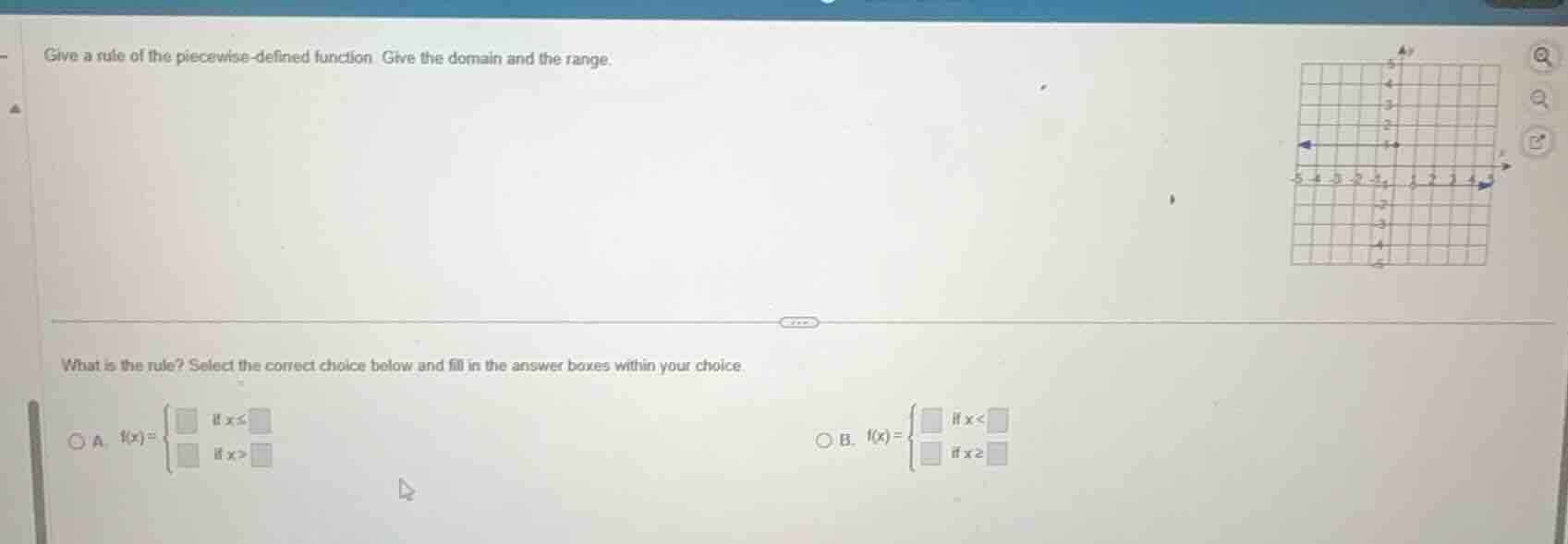
give a rule of the piecewise - defined function. give the domain and the range.
what is the rule? select the correct choice below and fill in the answer boxes within your choice.
\\(\bigcirc\\) a. \\(f(x)=\
\\)
\\(\bigcirc\\) b. \\(f(x)=\
\\)
Step1: Analyze the Graph
From the graph, we can see that there is a horizontal line at \( y = 1 \) for \( x < - 1 \) (assuming the vertex is at \( x=-1 \)) and a horizontal line at \( y = - 1 \) for \( x\geq - 1 \)? Wait, no, looking at the grid, the left part (arrow going left) is at \( y = 1 \) and the right part (arrow going right) is at \( y=-1 \)? Wait, maybe I misread. Wait, the graph: let's assume the point is at \( x = - 1 \), \( y = 1 \) on the left segment and \( y=-1 \) on the right? Wait, no, the standard piecewise function with two horizontal lines. Let's re - examine.
Wait, the graph has two horizontal segments. Let's assume the break point is at \( x=-1 \). For \( x < - 1 \), the function value is \( 1 \), and for \( x\geq - 1 \), the function value is \( - 1 \)? Wait, no, maybe the other way. Wait, the left arrow (as \( x\to-\infty\)) is at \( y = 1 \), and the right arrow (as \( x\to\infty\)) is at \( y=-1 \), with a point at \( x = - 1,y = 1 \) (closed circle) and open circle? Wait, the options are A: \( f(x)=
\) and B: \( f(x)=
\)
Let's assume the break point is at \( x=-1 \). Let's say for \( x < - 1 \), \( f(x)=1 \), and for \( x\geq - 1 \), \( f(x)=-1 \). So the rule would be \( f(x)=
\), which matches option B.
Step2: Determine the Domain and Range
- Domain: The domain of a piecewise function is the set of all real numbers for which the function is defined. Since the function is defined for all real numbers (the left segment goes to \( -\infty \) and the right segment goes to \( \infty \)), the domain is \( (-\infty,\infty) \) or \( \mathbb{R} \).
- Range: The range is the set of all output values. The function takes two values, \( y = 1 \) and \( y=-1 \), so the range is \( \{ - 1,1\} \)
For the rule:
For option B, \( f(x)=
\)

Snap & solve any problem in the app
Get step-by-step solutions on Sovi AI
Photo-based solutions with guided steps
Explore more problems and detailed explanations
The rule is \( f(x)=
\) (corresponding to option B: \( f(x)=
\))
Domain: \( (-\infty,\infty) \)
Range: \( \{ - 1,1\} \)