QUESTION IMAGE
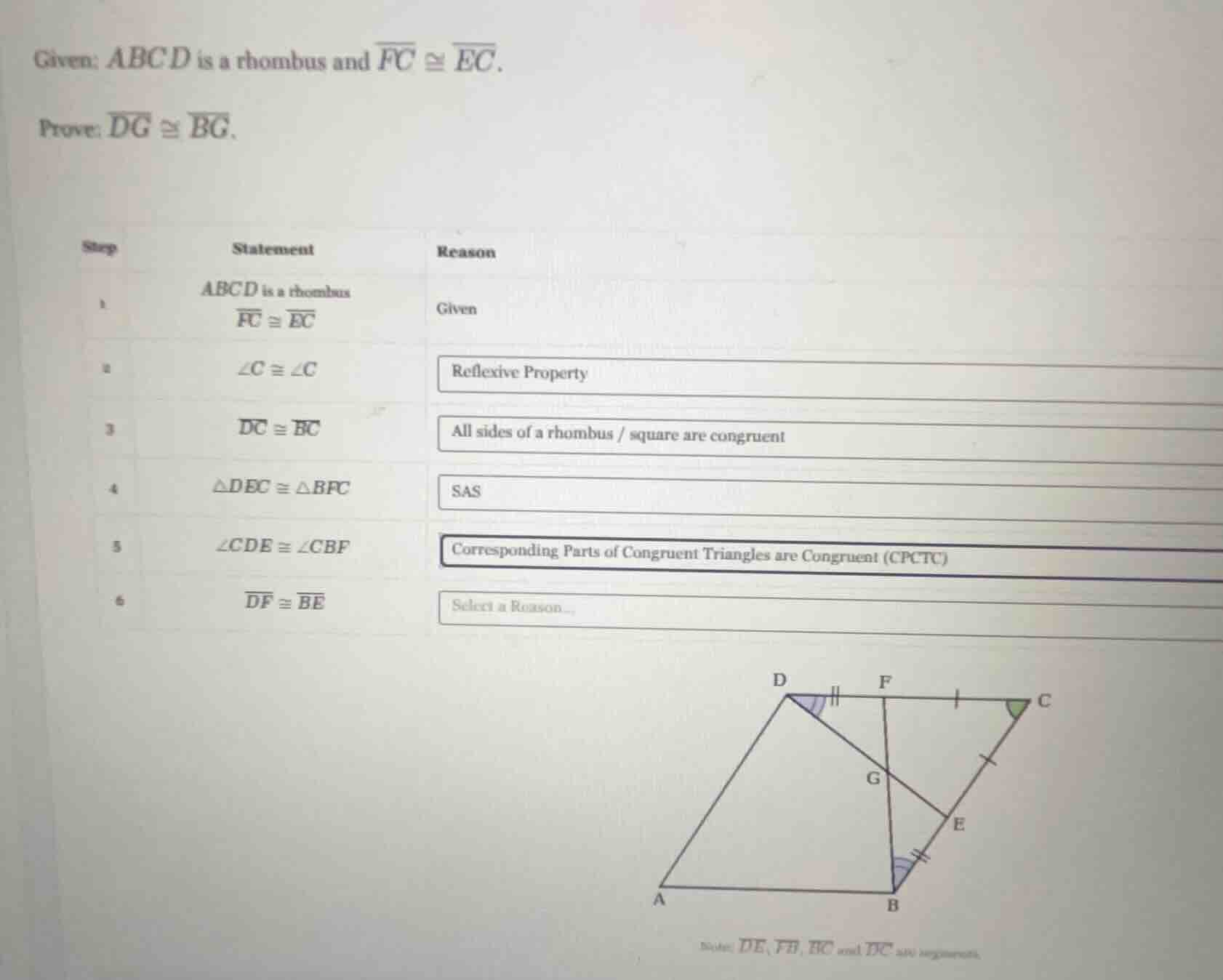
Question
given: abcd is a rhombus and \\(\overline{fc} \cong \overline{ec}\\).
prove: \\(\overline{dg} \cong \overline{bg}\\).
| step | statement | reason |
|---|---|---|
| 2 | \\(\angle c \cong \angle c\\) | reflexive property |
| 3 | \\(\overline{dc} \cong \overline{bc}\\) | all sides of a rhombus / square are congruent |
| 4 | \\(\triangle dec \cong \triangle bfc\\) | sas |
| 5 | \\(\angle cde \cong \angle cbf\\) | corresponding parts of congruent triangles are congruent (cpctc) |
| 6 | \\(\overline{df} \cong \overline{be}\\) | select a reason... |
(note: de, fb, ec and dc are segments. there is a diagram of rhombus abcd with points f, e, g as shown.)
Step1: Analyze known congruences
We know \(DC \cong BC\) (from rhombus properties) and \(FC \cong EC\) (given). Let's consider the segments \(DF\) and \(BE\). We can express \(DF\) as \(DC - FC\) and \(BE\) as \(BC - EC\).
Step2: Substitute congruent segments
Since \(DC \cong BC\) (so \(DC = BC\)) and \(FC \cong EC\) (so \(FC = EC\)), then \(DC - FC = BC - EC\). By the definition of congruent segments (if two segments have equal lengths, they are congruent), we have \(DF \cong BE\). The reason is "Segment Subtraction Postulate" (or "If \(a = b\) and \(c = d\), then \(a - c = b - d\) for segment lengths") and "Definition of Congruent Segments". But more precisely, since \(DC \cong BC\) and \(FC \cong EC\), subtracting the congruent segments (using the property that if \( \overline{DC} \cong \overline{BC} \) and \( \overline{FC} \cong \overline{EC} \), then \( \overline{DC}-\overline{FC} \cong \overline{BC}-\overline{EC} \) which is \( \overline{DF} \cong \overline{BE} \)), the reason can be "Subtraction of Congruent Segments" (or using the fact that \(DC = BC\) and \(FC = EC\), so \(DC - FC = BC - EC\), hence \(DF = BE\), so \( \overline{DF} \cong \overline{BE} \) by definition of congruent segments). Another way: From \(DC \cong BC\) (length \(DC = BC\)) and \(FC \cong EC\) (length \(FC = EC\)), then \(DC - FC = BC - EC\) (by subtraction property of equality for lengths), so \(DF = BE\), so \( \overline{DF} \cong \overline{BE} \) (if two segments have equal length, they are congruent). So the reason is "If two congruent segments are subtracted from two other congruent segments, the results are congruent (Segment Subtraction and Definition of Congruent Segments)".

Snap & solve any problem in the app
Get step-by-step solutions on Sovi AI
Photo-based solutions with guided steps
Explore more problems and detailed explanations
The reason for \( \overline{DF} \cong \overline{BE} \) is "If \( \overline{DC} \cong \overline{BC} \) and \( \overline{FC} \cong \overline{EC} \), then \( \overline{DC}-\overline{FC} \cong \overline{BC}-\overline{EC} \) (Segment Subtraction and Definition of Congruent Segments)" (or more succinctly, "Subtraction of Congruent Segments" or "Since \(DC = BC\) and \(FC = EC\), then \(DC - FC = BC - EC\), so \(DF = BE\), hence \( \overline{DF} \cong \overline{BE} \) by Definition of Congruent Segments").