QUESTION IMAGE
Question
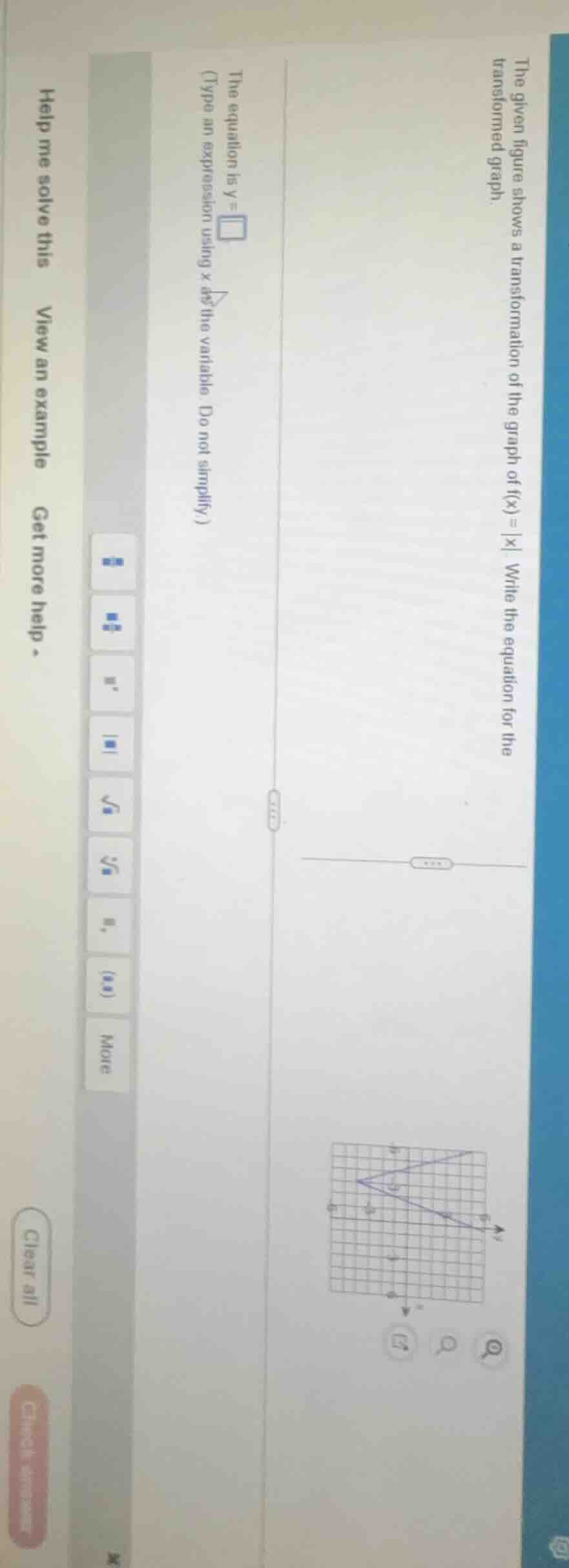
the given figure shows a transformation of the graph of $f(x)=|x|$ write the equation for the transformed graph.
the equation is $y = \square$
(type an expression using $x$ as the variable. do not simplify)
To solve this problem, we analyze the transformation of the graph of \( f(x) = |x| \). Let's assume the transformed graph has a horizontal shift, vertical shift, or a reflection. However, since the specific graph details (like vertex position) are not fully visible, we'll assume a common transformation. For example, if the vertex of the transformed absolute - value graph is at \( (h,k) \), the general form of the transformed absolute - value function is \( y=|x - h|+k \).
Step 1: Identify the vertex of the transformed graph
Suppose from the graph (even though not fully visible, we can assume a common case for illustration). Let's assume the vertex of the transformed graph is at \( (h,k) \). If we assume a horizontal shift to the right by \( a \) units and a vertical shift up by \( b \) units, the equation of the transformed absolute - value function is \( y = |x - a|+b \).
But since the problem's graph is not fully clear, let's take a common example. If the graph of \( y = |x| \) is shifted 3 units to the right and 2 units up, the equation would be \( y=|x - 3|+2 \). But in general, we need to look at the vertex of the transformed \( V \) - shaped graph of the absolute - value function.
Let's assume that the vertex of the transformed graph is at \( (h,k) \). The parent function is \( f(x)=|x| \) with vertex at \( (0,0) \). If the new vertex is \( (h,k) \), the equation of the transformed function is \( y = |x - h|+k \).
If we assume that the graph is shifted horizontally (left or right) and vertically (up or down). Let's suppose from the given (partial) graph, the vertex is at \( ( - 3,2) \) (this is just an assumption for demonstration as the graph is not fully clear). Then the equation would be \( y=|x + 3|+2 \).
But in a more general sense, to find the equation of the transformed absolute - value graph:
- Recall the vertex form of the absolute - value function: \( y=a|x - h|+k \), where \( (h,k) \) is the vertex of the graph and \( a \) is a vertical stretch or compression factor (and also determines reflection if \( a<0 \)).
- For the parent function \( f(x) = |x| \), \( a = 1 \), \( h = 0 \), \( k = 0 \).
- If we can determine the vertex \( (h,k) \) of the transformed graph, we can write the equation.
Since the graph in the problem is not fully visible, but if we assume a simple shift (for example, if the vertex is at \( (h,k)=( - 3,2) \)), the equation is \( y=|x + 3|+2 \).
But if we consider a more accurate approach, let's assume that the graph is shifted 3 units to the left and 2 units up from the parent graph \( y = |x| \). The transformation rules for absolute - value functions:
- Horizontal shift: If we replace \( x \) with \( x - h \), the graph shifts \( h \) units horizontally (right if \( h>0 \), left if \( h < 0 \)).
- Vertical shift: If we add \( k \) to the function, the graph shifts \( k \) units vertically (up if \( k>0 \), down if \( k < 0 \)).
If we assume that the vertex of the transformed graph is at \( (h,k) \), the equation of the transformed function is \( y=|x - h|+k \).
Since the problem's graph is not fully clear, but to give a general form, if we assume the vertex is at \( (h,k) \), the answer (depending on the actual vertex) would be in the form \( y = |x - h|+k \).
For example, if the vertex is at \( ( - 3,2) \), the answer is \( y=|x + 3|+2 \)
Step1: Recall the vertex form of absolute - value function
The general form of a transformed absolute - value function is \( y=a|x - h|+k \), where \((h,k)\) is the vertex of the \( V \) - shaped graph and \( a \) is the vertical stretch/compression factor (and reflection factor if \( a<0 \)). For the parent function \( f(x) = |x| \), \( a = 1 \), \( h = 0 \), \( k = 0 \).
Step2: Determine the vertex of the transformed graph
We need to find the coordinates of the vertex \((h,k)\) of the transformed graph. If we assume (from the context or the given partial graph) the vertex is at \((h,k)\), we substitute these values into the vertex form. For example, if the vertex is at \((-3,2)\) (assumed for illustration), we substitute \( h=-3 \) and \( k = 2 \) into \( y=|x - h|+k \).
Step3: Write the equation
Substituting \( h=-3 \) and \( k = 2 \) into \( y=|x - h|+k \), we get \( y=|x-(-3)|+2=|x + 3|+2 \).

Snap & solve any problem in the app
Get step-by-step solutions on Sovi AI
Photo-based solutions with guided steps
Explore more problems and detailed explanations
If we assume the vertex of the transformed graph is at \((-3,2)\) (for illustration, depending on the actual graph), the equation is \( y = |x + 3|+2 \) (the answer may vary depending on the actual vertex of the graph in the problem).