QUESTION IMAGE
Question
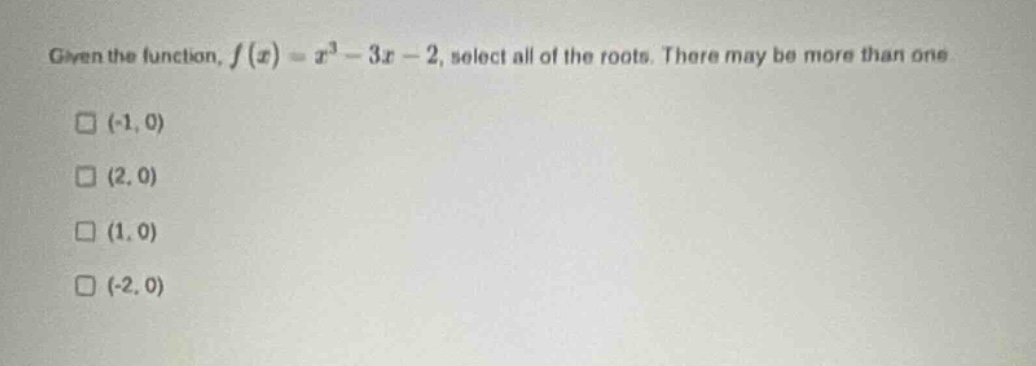
given the function, $f(x) = x^3 - 3x - 2$, select all of the roots. there may be more than one
$square$ $(-1, 0)$
$square$ $(2, 0)$
$square$ $(1, 0)$
$square$ $(-2, 0)$
Step1: Test x = -1
Substitute \( x = -1 \) into \( f(x) = x^3 - 3x - 2 \):
\( f(-1) = (-1)^3 - 3(-1) - 2 = -1 + 3 - 2 = 0 \). So, \( (-1, 0) \) is a root.
Step2: Test x = 2
Substitute \( x = 2 \) into \( f(x) \):
\( f(2) = 2^3 - 3(2) - 2 = 8 - 6 - 2 = 0 \). So, \( (2, 0) \) is a root.
Step3: Test x = 1
Substitute \( x = 1 \) into \( f(x) \):
\( f(1) = 1^3 - 3(1) - 2 = 1 - 3 - 2 = -4
eq 0 \). So, \( (1, 0) \) is not a root.
Step4: Test x = -2
Substitute \( x = -2 \) into \( f(x) \):
\( f(-2) = (-2)^3 - 3(-2) - 2 = -8 + 6 - 2 = -4
eq 0 \). So, \( (-2, 0) \) is not a root.

Snap & solve any problem in the app
Get step-by-step solutions on Sovi AI
Photo-based solutions with guided steps
Explore more problems and detailed explanations
(-1, 0), (2, 0)