QUESTION IMAGE
Question
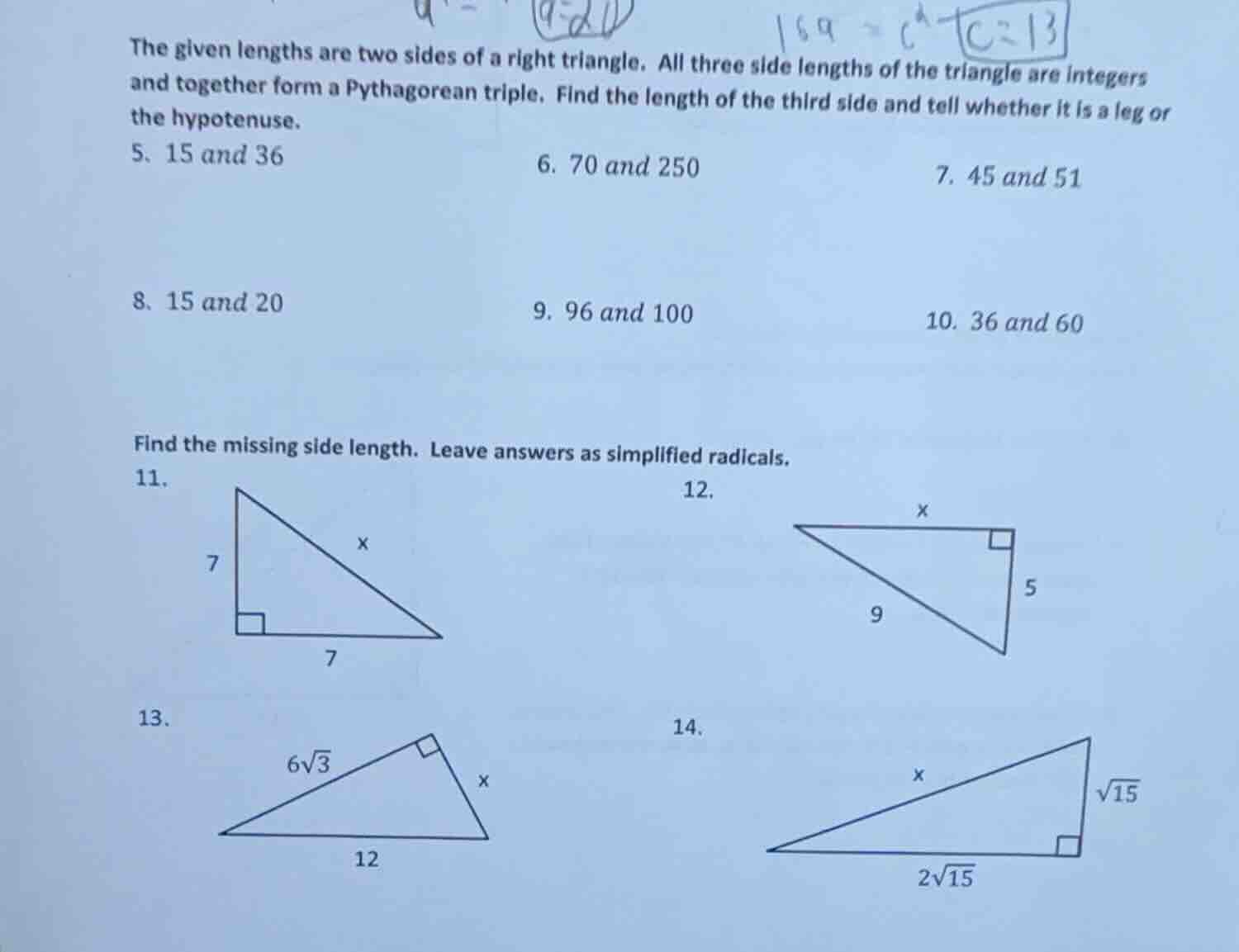
the given lengths are two sides of a right triangle. all three side lengths of the triangle are integers and together form a pythagorean triple. find the length of the third side and tell whether it is a leg or the hypotenuse.
- 15 and 36 \t\t\t\t 6. 70 and 250 \t\t\t\t 7. 45 and 51
- 15 and 20 \t\t\t\t 9. 96 and 100 \t\t\t\t 10. 36 and 60
find the missing side length. leave answers as simplified radicals.
- \t\t\t\t\t\t 12.
- \t\t\t\t\t\t 14.
Problem 5: 15 and 36
Step1: Check if hypotenuse is given
We use Pythagorean theorem $a^2 + b^2 = c^2$, where $c$ is hypotenuse. First test if 36 is hypotenuse: $15^2 + b^2 = 36^2$ → $b^2=1296-225=1071$, not a perfect square. So both are legs.
Step2: Calculate hypotenuse
$c=\sqrt{15^2 + 36^2}=\sqrt{225+1296}=\sqrt{1521}=39$
#
Problem 6: 70 and 250
Step1: Check if 250 is hypotenuse
$70^2 + b^2=250^2$ → $b^2=62500-4900=57600$
Step2: Calculate missing leg
$b=\sqrt{57600}=240$, this is a leg.
#
Problem 7: 45 and 51
Step1: Check if 51 is hypotenuse
$45^2 + b^2=51^2$ → $b^2=2601-2025=576$
Step2: Calculate missing leg
$b=\sqrt{576}=24$, this is a leg.
#
Problem 8: 15 and 20
Step1: Check if 20 is hypotenuse
$15^2 + b^2=20^2$ → $b^2=400-225=175$, not perfect square. So both are legs.
Step2: Calculate hypotenuse
$c=\sqrt{15^2+20^2}=\sqrt{225+400}=\sqrt{625}=25$
#
Problem 9: 96 and 100
Step1: Check if 100 is hypotenuse
$96^2 + b^2=100^2$ → $b^2=10000-9216=784$
Step2: Calculate missing leg
$b=\sqrt{784}=28$, this is a leg.
#
Problem 10: 36 and 60
Step1: Check if 60 is hypotenuse
$36^2 + b^2=60^2$ → $b^2=3600-1296=2304$
Step2: Calculate missing leg
$b=\sqrt{2304}=48$, this is a leg.
#
Problem 11
Step1: Use Pythagorean theorem (legs=7)
$x=\sqrt{7^2 + 7^2}$
Step2: Simplify the radical
$x=\sqrt{49+49}=\sqrt{98}=7\sqrt{2}$
#
Problem 12
Step1: Use Pythagorean theorem (hypotenuse=9, leg=5)
$x=\sqrt{9^2 - 5^2}$
Step2: Simplify the radical
$x=\sqrt{81-25}=\sqrt{56}=2\sqrt{14}$
#
Problem 13
Step1: Use Pythagorean theorem (hypotenuse=12, leg=$6\sqrt{3}$)
$x=\sqrt{12^2 - (6\sqrt{3})^2}$
Step2: Simplify the radical
$x=\sqrt{144-108}=\sqrt{36}=6$
#
Problem 14
Step1: Use Pythagorean theorem (legs=$2\sqrt{15}$ and $\sqrt{15}$)
$x=\sqrt{(2\sqrt{15})^2 + (\sqrt{15})^2}$
Step2: Simplify the radical
$x=\sqrt{60+15}=\sqrt{75}=5\sqrt{3}$

Snap & solve any problem in the app
Get step-by-step solutions on Sovi AI
Photo-based solutions with guided steps
Explore more problems and detailed explanations
- Third side: 39, it is the hypotenuse
- Third side: 240, it is a leg
- Third side: 24, it is a leg
- Third side: 25, it is the hypotenuse
- Third side: 28, it is a leg
- Third side: 48, it is a leg
- $7\sqrt{2}$
- $2\sqrt{14}$
- $6$
- $5\sqrt{3}$