QUESTION IMAGE
Question
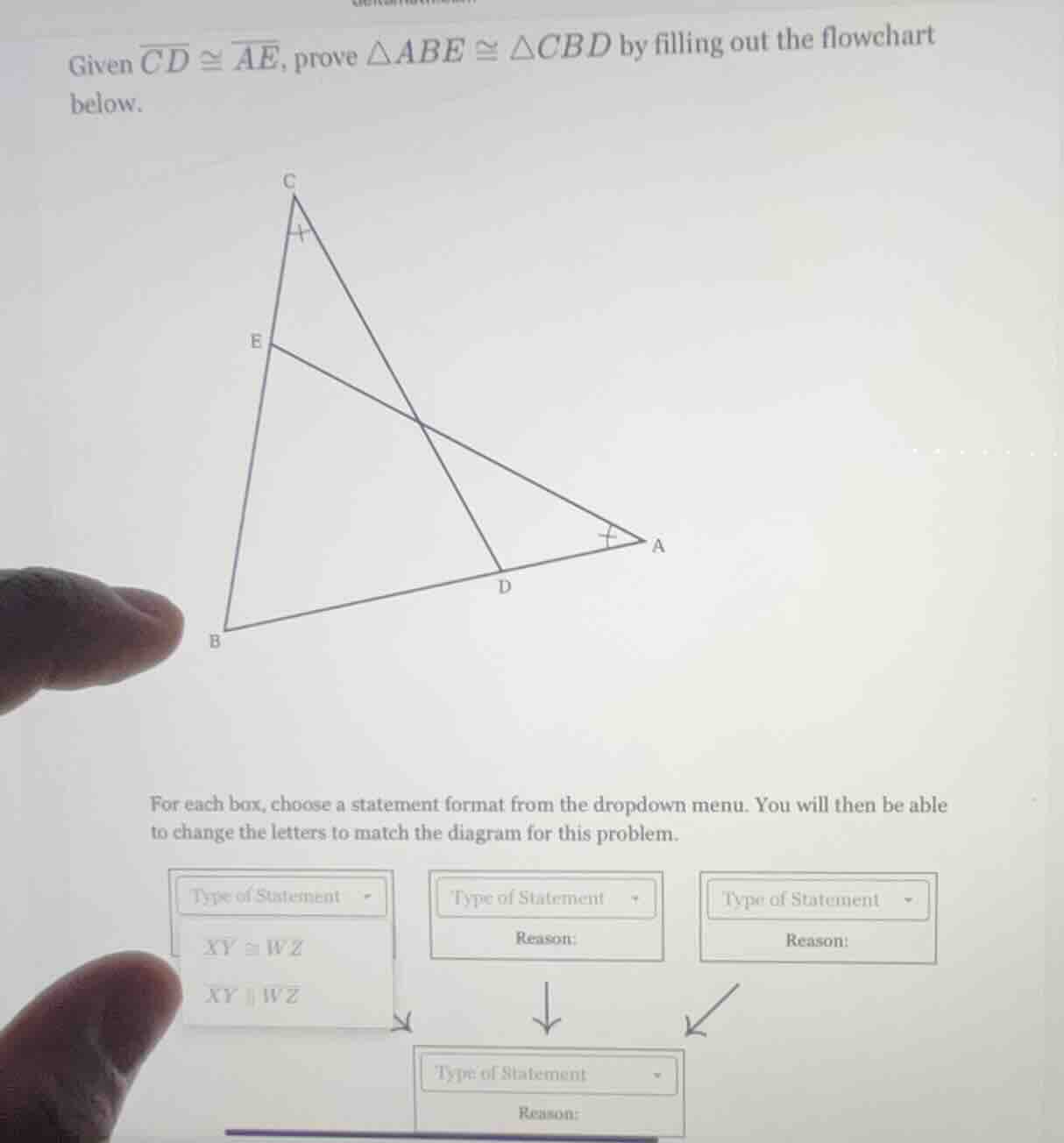
given \\(\overline{cd} \cong \overline{ae}\\), prove \\(\triangle abe \cong \triangle cbd\\) by filling out the flowchart below.
for each box, choose a statement format from the dropdown menu. you will then be able to change the letters to match the diagram for this problem.
Step1: Identify Given Information
We know $\overline{CD} \cong \overline{AE}$ (given). Also, from the diagram, $\angle A \cong \angle C$ (marked with congruency symbols). And $\overline{AB} \cong \overline{CB}$? Wait, no, let's check the triangles. Wait, $\triangle ABE$ and $\triangle CBD$: let's list the parts.
Wait, first, let's see the angles. $\angle A$ and $\angle C$ are congruent (given by the marks). Then, $\overline{AE} \cong \overline{CD}$ (given). Now, what about the included side or another angle? Wait, maybe $\angle B$ is common? Wait, $\angle B$ is the same for both $\triangle ABE$ and $\triangle CBD$ (common angle). So, let's structure the flowchart:
- First statement: $\angle A \cong \angle C$ (reason: given, as marked in the diagram).
- Second statement: $\overline{AE} \cong \overline{CD}$ (reason: given).
- Third statement: $\angle B \cong \angle B$ (reason: reflexive property of congruence).
Then, by ASA (Angle - Side - Angle) or AAS (Angle - Angle - Side), we can prove $\triangle ABE \cong \triangle CBD$. Wait, let's correct:
Wait, the given is $\overline{CD} \cong \overline{AE}$. Let's list the corresponding parts:
- $\angle A \cong \angle C$ (marked)
- $\overline{AE} \cong \overline{CD}$ (given)
- $\angle B$ is common to both $\triangle ABE$ and $\triangle CBD$, so $\angle B \cong \angle B$ (reflexive)
So, in the flowchart:
First box (statement): $\angle A \cong \angle C$ (type: angle congruence, but the dropdown has $XY \cong WZ$ or $XY \parallel WZ$. Wait, maybe the diagram has $\overline{AB} \cong \overline{CB}$? Wait, no, maybe I misread. Wait, the problem is to prove $\triangle ABE \cong \triangle CBD$. Let's use the given $\overline{CD} \cong \overline{AE}$, $\angle A \cong \angle C$, and $\angle B$ is common.
So, step 1: $\angle A \cong \angle C$ (reason: given, as marked). Step 2: $\overline{AE} \cong \overline{CD}$ (reason: given). Step 3: $\angle B \cong \angle B$ (reason: reflexive property). Then, by ASA (since $\angle A$, $\overline{AE}$, $\angle B$ in $\triangle ABE$ and $\angle C$, $\overline{CD}$, $\angle B$ in $\triangle CBD$? Wait, no, ASA is angle - side - angle, where the side is included. Wait, maybe AAS: two angles and a non - included side.
Wait, let's re - evaluate. Let's list the triangles:
$\triangle ABE$: angles $\angle A$, $\angle B$, $\angle AEB$; sides $\overline{AE}$, $\overline{AB}$, $\overline{BE}$
$\triangle CBD$: angles $\angle C$, $\angle B$, $\angle CDB$; sides $\overline{CD}$, $\overline{CB}$, $\overline{BD}$
Given $\overline{AE} \cong \overline{CD}$, $\angle A \cong \angle C$, and $\angle B \cong \angle B$ (common angle). So, by AAS (Angle - Angle - Side: $\angle A \cong \angle C$, $\angle B \cong \angle B$, $\overline{AE} \cong \overline{CD}$), we can prove the triangles congruent.
So, in the flowchart:
First statement: $\angle A \cong \angle C$ (type: if the dropdown allows angle congruence, but the given dropdown has $XY \cong WZ$ (segment congruence) or $XY \parallel WZ$ (parallel lines). Wait, maybe the diagram has $\overline{AB} \cong \overline{CB}$? Wait, the problem says "fill out the flowchart" with the dropdown options $XY \cong WZ$ or $XY \parallel WZ$. So, maybe the first statement is $\overline{AE} \cong \overline{CD}$ (type: $XY \cong WZ$, with $XY = AE$, $WZ = CD$), reason: given.
Second statement: $\angle A \cong \angle C$ (but the dropdown is for segments or parallel lines. Wait, maybe I made a mistake. Wait, the dropdown has $XY \cong WZ$ (segment congruence) or $XY \parallel WZ$ (parallel lines). So, maybe the triangles have $\overline{…

Snap & solve any problem in the app
Get step-by-step solutions on Sovi AI
Photo-based solutions with guided steps
Explore more problems and detailed explanations
To fill the flowchart:
- First Statement Box: $\boldsymbol{\overline{AE} \cong \overline{CD}}$ (Type: $XY \cong WZ$, where $XY = AE$, $WZ = CD$), Reason: Given.
- Second Statement Box: $\boldsymbol{\angle A \cong \angle C}$ (Reason: Given (marked in the diagram)).
- Third Statement Box: $\boldsymbol{\angle B \cong \angle B}$ (Reason: Reflexive Property of Congruence).
- Conclusion Box: $\boldsymbol{\triangle ABE \cong \triangle CBD}$ (Reason: AAS (Angle - Angle - Side) Congruence Criterion, since $\angle A \cong \angle C$, $\angle B \cong \angle B$, and $\overline{AE} \cong \overline{CD}$).
(Note: Adjust the statement types in the dropdown to match the congruence/angle statements as per the diagram's labeling.)