QUESTION IMAGE
Question
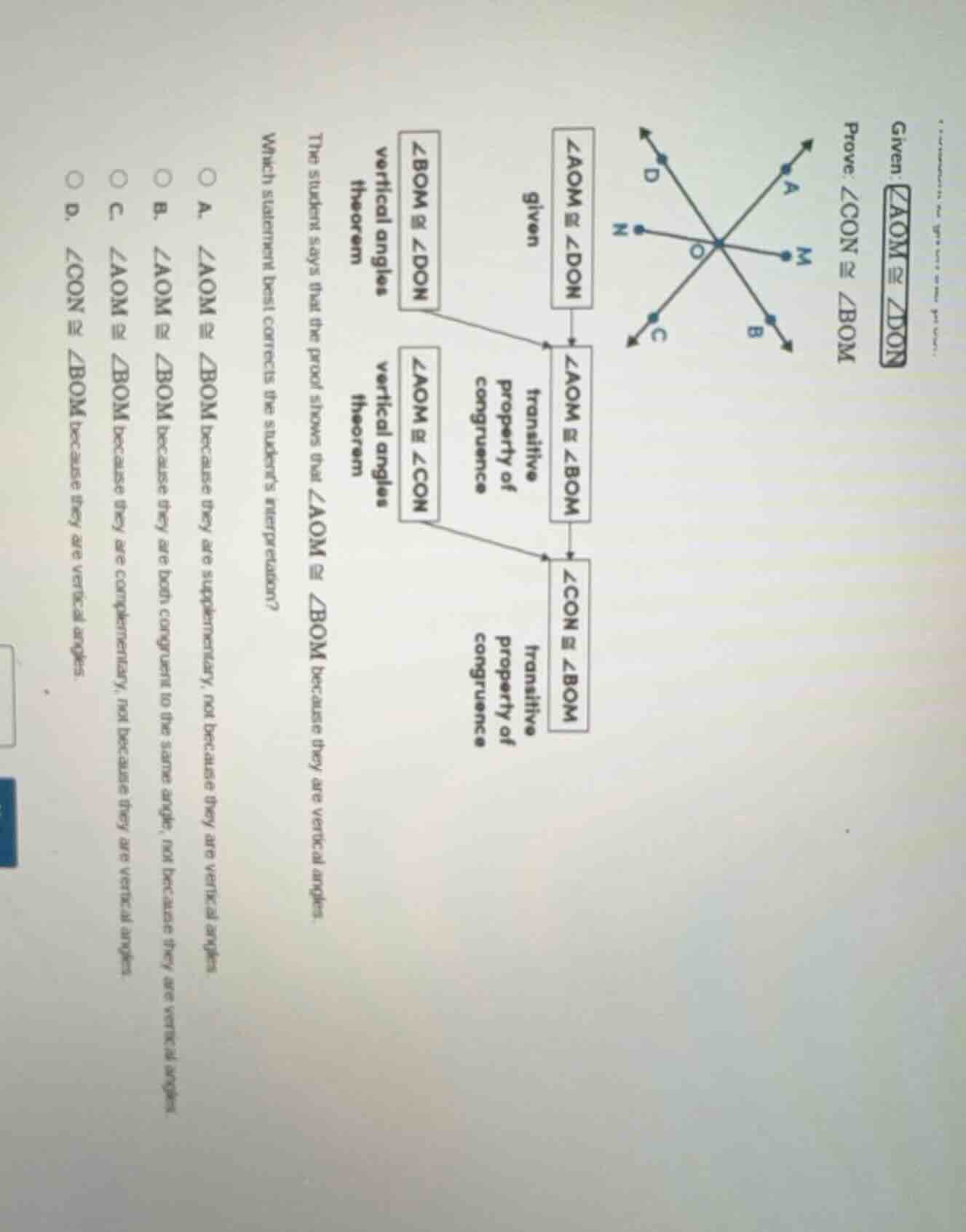
given: \\(\angle aom \cong \angle don\\) prove: \\(\angle con \cong \angle bom\\) the student says that the proof shows that \\(\angle aom \cong \angle bom\\) because they are vertical angles. which statement best corrects the student’s interpretation? a. \\(\angle aom \cong \angle bom\\) because they are supplementary, not because they are vertical angles. b. \\(\angle aom \cong \angle bom\\) because they are both congruent to the same angle, not because they are vertical angles. c. \\(\angle aom \cong \angle bom\\) because they are complementary, not because they are vertical angles. d. \\(\angle con \cong \angle bom\\) because they are vertical angles.
- Analyze the given proof structure: We know \( \angle AOM \cong \angle DON \) (given), \( \angle BOM \cong \angle DON \) (vertical angles theorem), and \( \angle CON \cong \angle BOM \) (vertical angles theorem). Then, by the transitive property of congruence, \( \angle AOM \cong \angle BOM \) because both \( \angle AOM \) and \( \angle BOM \) are congruent to \( \angle DON \), not because they are vertical angles (vertical angles would be pairs like \( \angle AOM \) and another angle, not \( \angle AOM \) and \( \angle BOM \) directly as vertical angles).
- Evaluate the options:
- Option A: Mentions supplementary angles, which is not relevant here.
- Option B: States \( \angle AOM \cong \angle BOM \) because they are both congruent to \( \angle DON \) (by transitive property) and not because they are vertical angles. This matches our analysis.
- Option C: Mentions complementary angles, which is incorrect.
- Option D: Incorrectly claims \( \angle CON \cong \angle BOM \) as the reason, but the proof is about \( \angle AOM \cong \angle BOM \).

Snap & solve any problem in the app
Get step-by-step solutions on Sovi AI
Photo-based solutions with guided steps
Explore more problems and detailed explanations
B. \( \angle AOM \cong \angle BOM \) because they are both congruent to the same angle, not because they are vertical angles.